What you'll learn
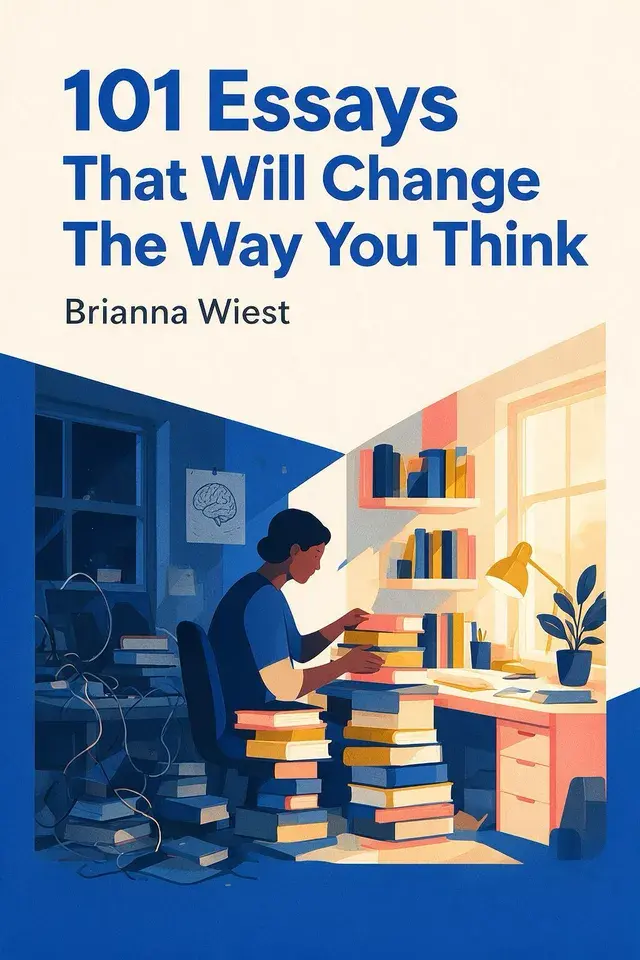
Key ideas from 101 Essays That Will Change The Way You Think
These ideas compress the book's argument without treating the author's view as settled fact. Use them as an orientation before reading the full work or listening in Wiseley.
Change begins when thoughts, identities, and interpretations are recognized as constructions rather than permanent destiny.
Emotional intelligence separates feeling from fact, permits temporary distress, and leaves room for a deliberate response.
Routines are presented as structures that turn chosen priorities into steady behavior, reducing the pull of impulse, comfort, and uncertainty.
Chasing constant happiness fails because adaptation restores familiar baselines; fulfillment is better understood as a byproduct of meaningful living.
Acceptance and non-resistance are presented as releasing the fight with reality while preserving discernment, effort, and purposeful action.
Independent thought tests inherited opinions by tracing their sources, checking evidence, considering beneficiaries, and understanding why opposing views might be valid.
Love is a reciprocal experience, not a possession, reward, or way for another person to repair identity.
How 101 Essays That Will Change The Way You Think builds its case
Follow how the book develops its argument. Each note is a brief orientation, not a replacement for the chapter.
The Scripts Behind Experience
One of the book’s foundational ideas is that experience does not arrive in the mind as a neutral record. The mind selects, interprets, organizes, and gives meaning.
Feelings Are Information, Not Facts
Feelings can be urgent without being authoritative. In Wiest’s framework, an emotion is a response, not a measurement of reality or a prediction of what happens next.
From Insight to Daily Practice
Awareness begins change, but it is not yet agency. The book’s practical turn is to place insight inside repeatable behavior.
What Makes a Life Good
A good life is easy to confuse with a polished life. A title, income, relationship, possession, or future milestone can look like proof that fulfillment has arrived.
Presence, Stillness, and Acceptance
Presence begins with a correction to the way life is imagined. The present is not a waiting room for a better version of life.
Worth Beyond the Body
Self-worth becomes unstable when it is assigned to the most visible parts of life. Body image is shaped partly through relationships and culture: parents’ comments, friends’ attitudes, retouched media, early intimate experiences, food traditions, and public objectification can all enter the inner voice.
Think Clearly, Live Honestly
Independent judgment begins where automatic agreement ends. Brianna Wiest argues that a durable life requires examining the ideas behind our choices, then communicating those choices honestly.
Love, Attachment, and Reciprocity
Love, in these essays, is not a prize another person owns or owes. It is a shared experience that requires honest, willing contribution from both people.
Growth Through Loss and Change
Growth does not arrive as a neat reward for mastering life. In this final movement, Brianna Wiest treats loss, heartbreak, suffering, and uncertainty as forces that can expose inherited stories and open a different future.