What you'll learn
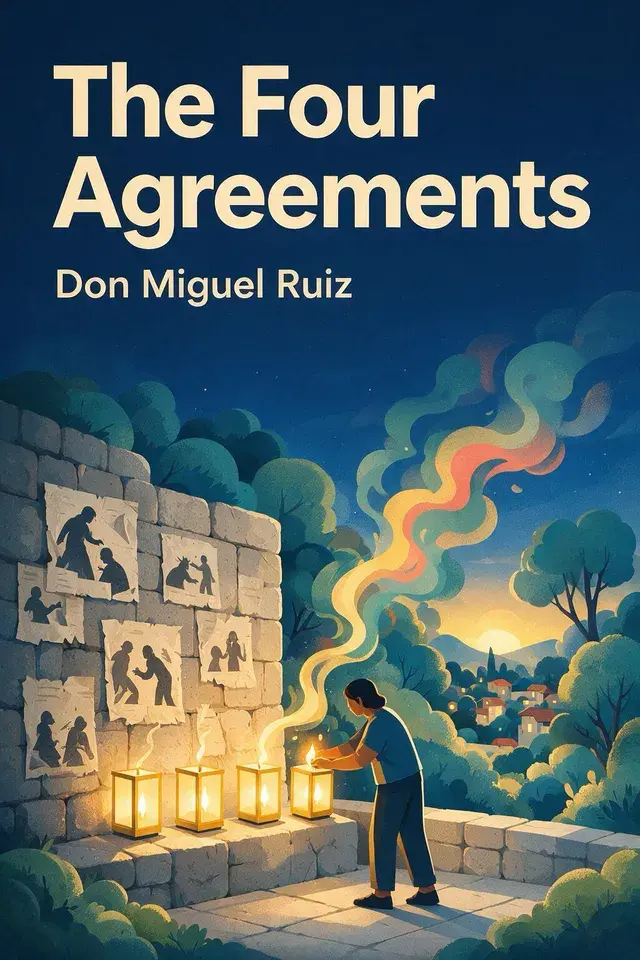
Key ideas from The Four Agreements
These ideas compress the book's argument without treating the author's view as settled fact. Use them as an orientation before reading the full work or listening in Wiseley.
Domestication turns repeated teaching, approval, punishment, and comparison into agreements that people eventually enforce on themselves.
Impeccability joins responsibility with refusing self-judgment, self-blame, and speech that turns against oneself.
Emotional poison becomes new suffering when it is accepted personally; non-reactivity is presented as a form of immunity.
Questions, explicit requests, and acceptance of yes or no replace invented certainty with clearer communication.
The fourth agreement turns the other three into habits through repeated action rather than understanding alone.
Healing combines truth, forgiveness without excusing harm, self-acceptance, and patient repetition that replaces long-repeated agreements.
Heaven on earth is presented as a present state of love, freedom, self-acceptance, and release from judgment.
How The Four Agreements builds its case
Follow how the book develops its argument. Each note is a brief orientation, not a replacement for the chapter.
The Inherited Dream
The book begins inside a Toltec spiritual frame. The author presents the Toltec not simply as a nation or race, but as scientists, artists, and spiritual practitioners who preserved ancient knowledge through lineages.
Words That Make Agreements
Ruiz calls the first agreement, being impeccable with the word, the most important and most difficult. His reason is that language is not merely descriptive.
Stop Carrying Others' Dreams
The second agreement, in Ruiz’s account, is a boundary around identity: do not take anything personally. It asks you to stop treating praise, blame, insults, or other people’s reactions as objective reports about who you are.
Questions Against Imagined Certainty
The third agreement addresses a subtle way the mind manufactures suffering: it treats a guess as knowledge. A missing fact feels uncomfortable, so the mind supplies a motive, intention, or explanation.
Practice Without Punishment
The fourth agreement answers a practical question: what turns the other three from ideas into a way of living? Ruiz’s answer is to always do your best.
Awareness Breaks Old Agreements
Once the four agreements are understood, Ruiz turns from description to transformation. He says freedom begins with awareness: noticing that one is not simply living by personal choice, but inside a learned dream of rules, fear, and judgment.
Heaven as a Chosen Perception
Once the old dream no longer dictates every response, the book’s final destination is not simply freedom from rules. It is a way of inhabiting ordinary life.