Choose by lens
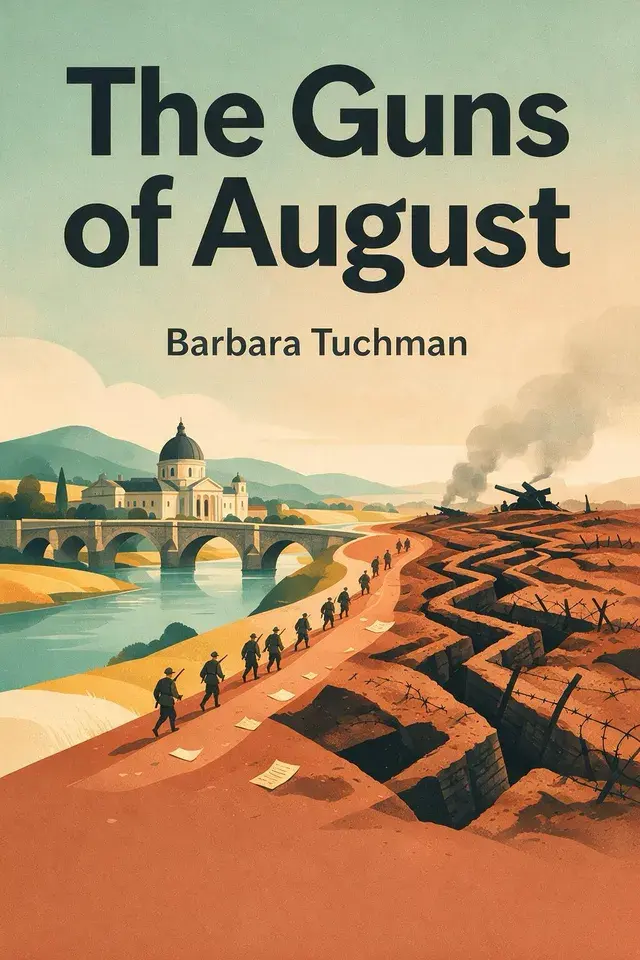
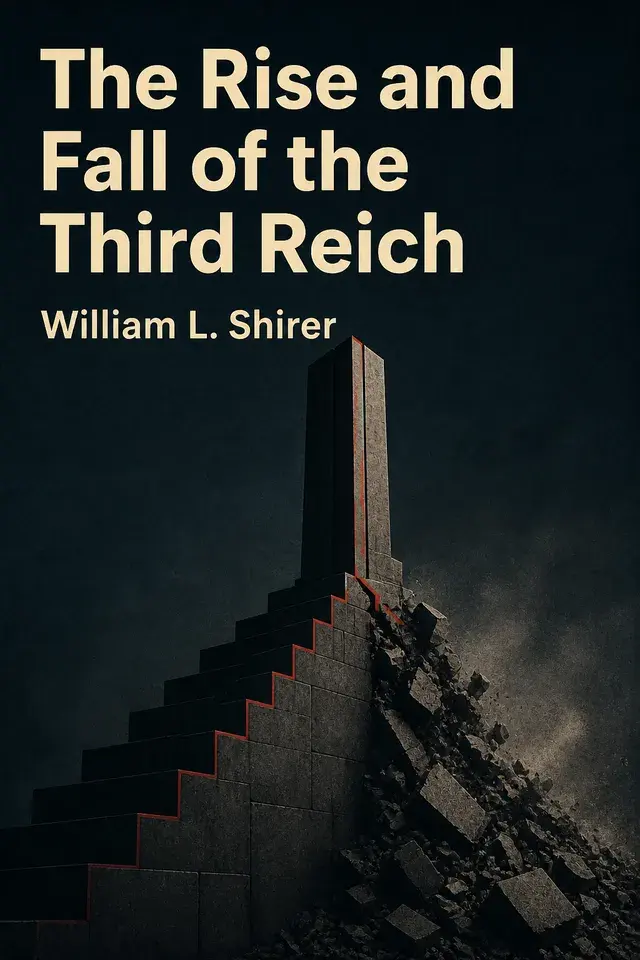
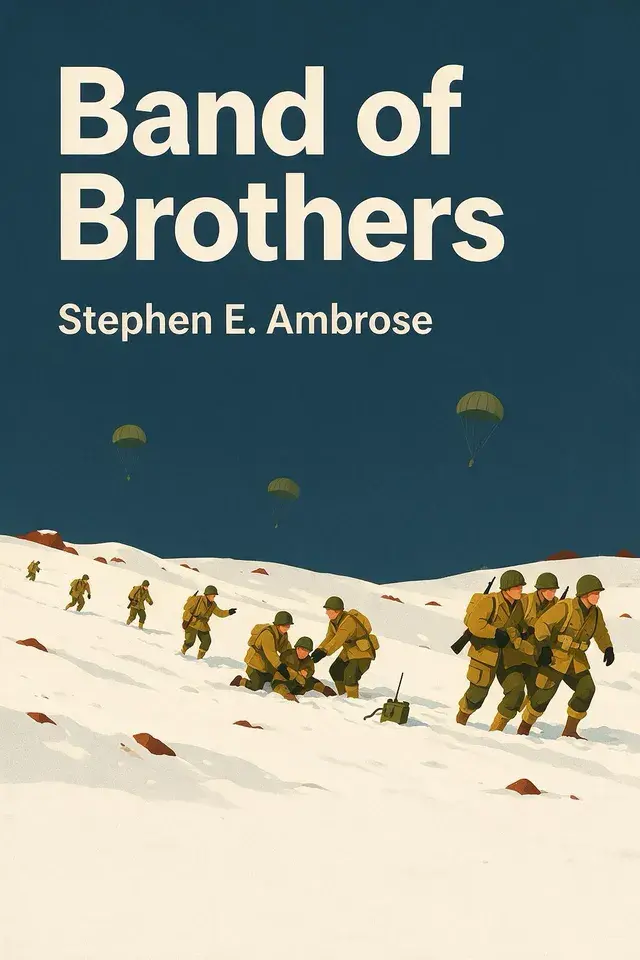
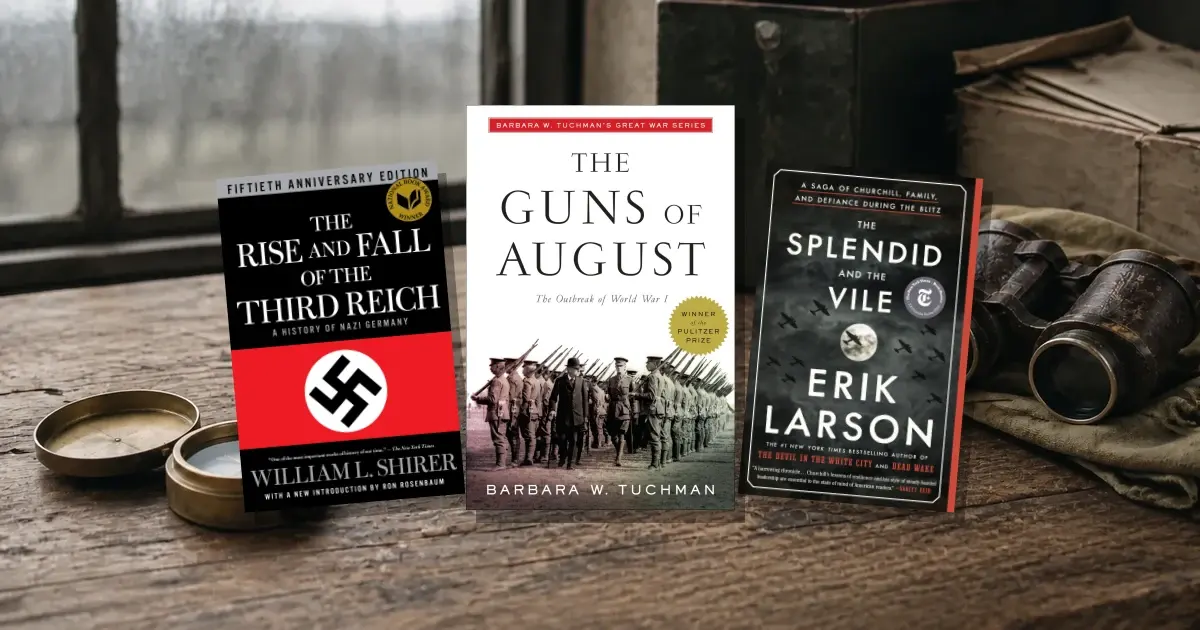
Five books, and one of them is not about the Second World War. Four are: the rise and fall of the Third Reich, Churchill's first year under the Blitz, one American parachute company from training to Bastogne, and the making of the atomic bomb. The fifth, The Guns of August, is Barbara Tuchman's account of August 1914, kept here because the collapse it describes set the terms for everything that followed. Wars are too large to hold in one book, so each classic narrows deliberately. Tuchman compresses to a single month to explain how peace fails. Shirer spends decades inside one dictatorship. Larson follows one man through one year of bombing. Ambrose follows roughly one company through the whole European war. Rhodes traces one chain of physics to one political choice. Pick the question first.
- How does a continent stumble into catastrophe: The Guns of August.
- How does a modern state turn totalitarian: The Rise and Fall of the Third Reich.
- What does leadership look like while the bombs actually fall: The Splendid and the Vile.
- What does the war cost at platoon level: Band of Brothers.
- How did science become the bomb — and who chose to use it: The Making of the Atomic Bomb.
What each book adds
Tuchman shows rigidity as the engine of disaster: war plans that could not bend, alliance deadlines outrunning diplomacy, and a Marne that produced deadlock instead of decision. Shirer, who watched much of it from Berlin, connects Hitler's minority movement, elite miscalculation, manufactured emergencies, and the New Order's planned ruin into one arc ending in rubble. Larson's close-up on Churchill's first year mixes radar sleuthing, rooftop visits during raids, family strain, and the slow assembly of American support. Ambrose tests a system rather than a myth: Currahee training, scattered D-Day drops turned into distributed combat power, attrition at Carentan, and Bastogne's siege. Rhodes gives the fullest account of the bomb's making — refugee physicists, the Manhattan system, Trinity, Hiroshima — and refuses to let scientific possibility excuse political choice.
- Most readable single starting point: The Guns of August for its novelistic month of collapse.
- Most demanding and most comprehensive: The Rise and Fall of the Third Reich.
- Most human-scale view of combat: Band of Brothers, best paired with a strategic overview.
A reading order across both wars
Chronology helps here. Begin with Tuchman to understand how the First World War began and why its settlement failed to hold. Read Shirer next for the long rise of the regime that started the second. Then narrow: Larson for the home-front year, Ambrose for the soldiers' view, and Rhodes for the weapon and the decision that closed the war in the Pacific.
- Note how each author uses sources — memoirs, documents, interviews — before trusting a scene.
- Keep a running list of decisions where one person's judgment changed outcomes.
- Finish with Rhodes asking what accountability looks like after such power exists.
Sources and scope
Book ideas are attributed to their authors. External evidence is linked directly when a claim needs more than the source book.
- The Guns of August: Source for prewar planning rigidity, alliance deadlines, Belgian resistance, Tannenberg, retreat, and Marne deadlock.
- The Rise and Fall of the Third Reich: Source for the Nazi seizure of power, coerced consent, the New Order, Barbarossa, and the mechanics of collapse.
- The Splendid and the Vile: Source for Churchill's first year, radar countermeasures, Blitz social life, Mers el-Kébir, and Lend-Lease politics.
- Band of Brothers: Source for airborne training, scattered drops, Carentan attrition, Market-Garden overreach, and Bastogne endurance.
- The Making of the Atomic Bomb: Source for fission science, exile physics, the Manhattan system, Trinity, Hiroshima, and postwar control questions.
To report a factual, attribution, rights, or accessibility concern, email hello@wiseley.app.
Questions readers ask
Is The Guns of August about World War I or World War II?
World War I — specifically its opening month of 1914, from the July crisis through the Marne. It matters to WWII readers because its account of rigid plans, alliance mechanics, and failed deterrence became required reading for leaders thinking about how wars start, including during the Cuban Missile Crisis era.
Do I need to read Shirer's whole Third Reich book?
It rewards full reading but is structured enough to follow by phase: the republic's failure, consolidation of dictatorship, the road to war, conquest and the New Order, then reversal and collapse. Its wartime-journalist vantage and document base make it the standard single-volume account of how the regime rose and fell.
How do The Splendid and the Vile and Band of Brothers differ?
They cover overlapping years from opposite ends. Larson stays with leadership, intelligence, morale, and politics during the Blitz; Ambrose descends with a parachute company through Normandy, Holland, and Bastogne. Together they show that 'the war' meant different things to a prime minister and to a sergeant.