What you'll learn
Key ideas from The Double Helix
These ideas compress the book's argument without treating the author's view as settled fact. Use them as an orientation before reading the full work or listening in Wiseley.
Avery’s transformation results made DNA a plausible hereditary material, while protein remained a serious competing explanation.
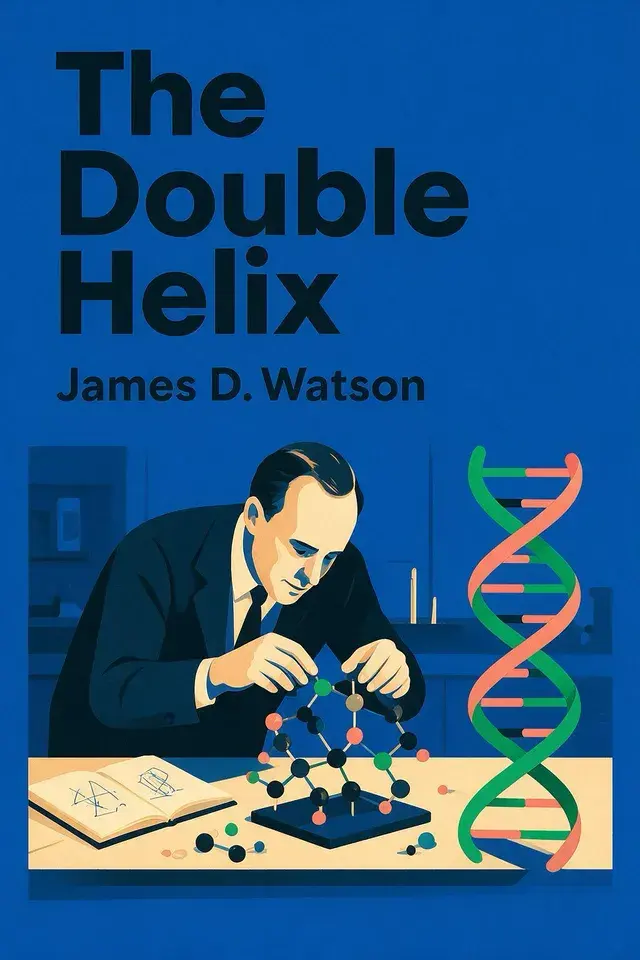
Watson and Crick turn incomplete diffraction and chemical clues into physical DNA models that can be tested.
Franklin’s hydrated B-form pattern constrained DNA as a helix with a thirty-four-angstrom repeat and an approximately twenty-angstrom diameter.
A–T and G–C pairs provide regular purine–pyrimidine packing and explain Chargaff’s base ratios.
Complementary strands make each sequence a template for building its partner, suggesting a mechanism for hereditary copying.
Photograph 51 and the MRC report carried structural information through disputed channels of transfer, permission, and confidentiality.
The memoir’s human-centered perspective makes difficult science accessible while also exposing the distortions of a young participant’s viewpoint.
How The Double Helix builds its case
Follow how the book develops its argument. Each note is a brief orientation, not a replacement for the chapter.
Why DNA Became the Problem
The Double Helix is a partial memoir before it is a settled history. Watson reconstructs the search as it appeared to him between 1951 and 1953, preserving youthful impressions instead of replacing them with later certainty.
Models Before Certainty
Once Watson was in Cambridge, DNA became a problem of construction. He and Francis Crick had fragments of diffraction and incomplete chemical knowledge, not a finished explanation.
Detours That Restore Direction
With direct DNA modeling paused, Watson changed the route rather than abandoning the problem. He needed a related project that could be pursued openly and might return useful structural evidence.
Constraints Reopen the Race
Watson’s working picture was an information flow: stable DNA would serve as a template for RNA, and RNA would likely serve as a template for protein. The arrows represented information transfer from nucleotide sequences to amino-acid sequences, not chemical conversion.
Complementarity Explains Copying
Watson’s first DNA model collapsed after a chemical correction. He had copied guanine and thymine in enol forms commonly shown in textbooks.
Credit, Access, and Correction
Once the double helix is remembered as a clean victory, a harder question follows: who supplied the knowledge, who controlled access, and who received recognition? The archival record complicates Watson’s first-person account without erasing Watson and Crick’s achievement.
A Memoir Becomes History
The Double Helix closes with a problem larger than the scientific discovery itself: what happens when a contested episode becomes a personal story? The book is not a definitive history of DNA.