What you'll learn
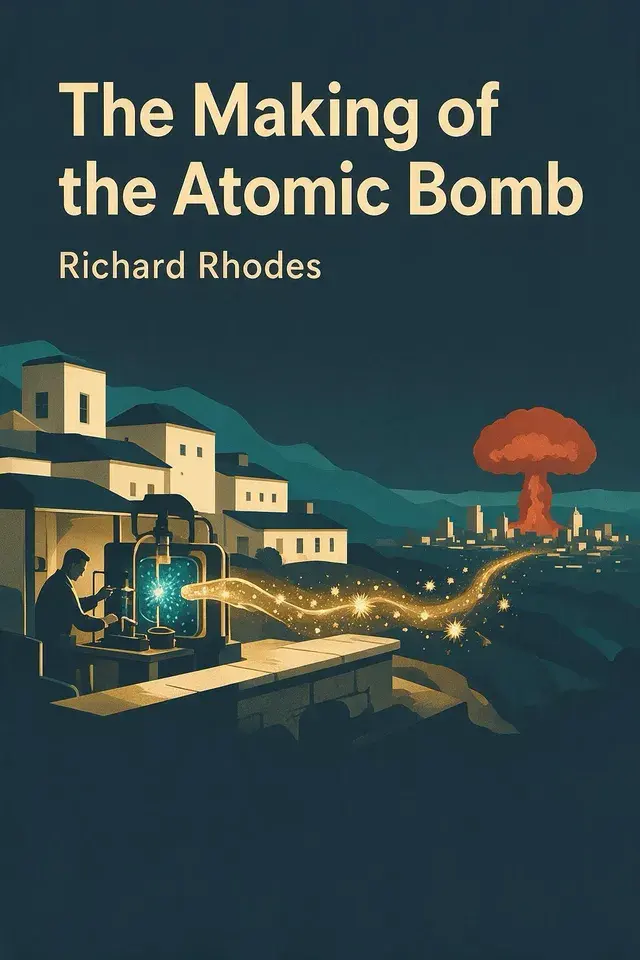
Key ideas from The Making of the Atomic Bomb
These ideas compress the book's argument without treating the author's view as settled fact. Use them as an orientation before reading the full work or listening in Wiseley.
Szilard’s chain-reaction idea made immense energy conditional on neutron multiplication, not an inevitable consequence of atomic science.
Noddack proposed fragmentation early, and later chemical and physical evidence established that uranium nuclei could split.
MAUD and later reviews converted a conditional possibility into parallel routes, secrecy, and national priority.
Groves unified dispersed research, contractors, land, materials, and priorities through centralized authority that accelerated decisions while provoking resistance.
The test confirmed destructive power but did not prove that an unannounced city attack was necessary or morally settled.
Hiroshima’s flash, blast, fire, and radiation transformed a militarized city into a civilian catastrophe and destroyed the systems needed for rescue.
Japan’s surrender emerged from atomic attacks, Soviet entry, internal conflict, and Hirohito’s decision rather than one uncontested cause.
Fission was difficult to prevent once the science converged, but secrecy, monopoly, arms racing, and international control remained political choices.
How The Making of the Atomic Bomb builds its case
Follow how the book develops its argument. Each note is a brief orientation, not a replacement for the chapter.
The Atom Becomes Possible
Atomic energy became thinkable only when the atom ceased to be a philosophical possibility and became an object that experiments could interrogate. Ancient atomism imagined invisible particles and void.
Science Enters Total War
World War I did more than add new weapons to old warfare. It reorganized knowledge, industry, and human beings into a system capable of producing death on an unprecedented scale.
Exile Builds a New Physics
The bomb’s future workforce did not emerge from a single laboratory. It was assembled by a social world: schools that rewarded discovery, cities that concentrated talent, and institutions that allowed talented people to move.
Neutrons, Machines, and Fission
The path to fission began with better ways to make and measure nuclear events. Rutherford’s rare nitrogen transmutation had shown that nuclei could be probed directly, but natural alpha particles could not overcome the electrical barrier of heavier elements.
From Fission to a Bomb Program
Fission did not become a bomb simply because uranium nuclei could split. The bridge was a chain of judgments: could the reaction multiply fast enough, in little enough material, to make a weapon?
Building the Manhattan System
The Manhattan District was unlike an ordinary research program. It was a secret state within the state, detached from the country’s normal industrial and social life, yet equipped with its own factories, airplanes, workers, and secrets.
Engineering the Nuclear Weapon
Once the project had material in hand, it faced a different problem: turning fissile substance into a device that could assemble quickly, survive transport, and work predictably. The answer was a chain of forced choices, measurements, production fixes, and rehearsals.
Trinity and the Decision to Use
Trinity began as a technical test, but its meaning was political from the start. After Roosevelt’s death, Truman learned that the unexplained project he had seen in Senate oversight was an extraordinarily destructive weapon.
Hiroshima, Nagasaki, and Surrender
After the previous chapter’s decision to use the bomb, the story moves from what the weapon could do to what it did to human beings. The moral question is concrete: people had placed life and death in their own hands, and Hiroshima made that power visible in bodies, streets, and a broken common world.
A Weapon Without a Political Solution
Once the bomb had been made and used, the central question was no longer whether nuclear energy could be released. It was what kind of political order could live with a weapon whose effects crossed borders.