What you'll learn
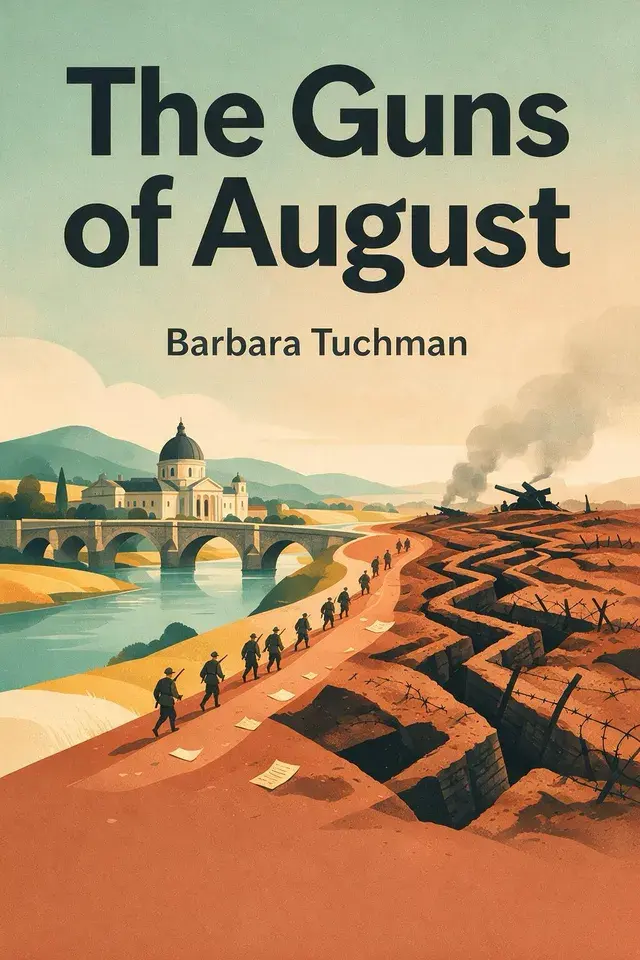
Key ideas from The Guns of August
These ideas compress the book's argument without treating the author's view as settled fact. Use them as an orientation before reading the full work or listening in Wiseley.
The Great Illusion and Germany and the Next War embody rival beliefs that interdependence restrains war or offensive conquest makes it necessary.
Germany’s plan depended on Belgian compliance, uninterrupted transport, and a decisive western victory before Russia or Britain could shape the war.
Austria’s ultimatum, German backing, and Russian mobilization turned a Serbian punishment into a crisis governed by alliance pressure and military deadlines.
Lorraine and the Ardennes exposed how artillery, entrenchments, terrain, and filtered intelligence defeated French offensive assumptions.
Tannenberg destroyed Samsonov’s army, exposed Russian institutional failure, and diverted German formations from the West in time to affect the Marne.
Von Kluck’s inward wheel shortened the German advance but exposed its flank after exhaustion, supply failure, and command disagreement.
Its incomplete victory hardened into trench deadlock, vast losses, disillusion, and consequences extending beyond the First World War.
How The Guns of August builds its case
Follow how the book develops its argument. Each note is a brief orientation, not a replacement for the chapter.
The Old Order Before the Guns
The Guns of August begins before the guns themselves. Its opening image is Edward VII’s funeral in May 1910, when nine kings rode through London and representatives of seventy nations gathered around the British crown.
Plans That Could Not Bend
Once the prewar order is in view, the next question is how governments thought a general war would work. Before anyone fired a shot, the European powers had already begun fighting on paper.
The Crisis Becomes War
The crisis became war through a sequence in which each government’s attempt to protect its position made compromise harder. Austria-Hungary issued an ultimatum to Serbia on July 23, rejected Serbia’s reply on July 26, declared war on July 28, and bombarded Belgrade on July 29.
The First Shocks: Goeben, Liège, and Alsace
The opening days of August did not reveal national plans unfolding cleanly. Germany and France began largely independent offensives: Germany moved toward Liège, while France entered Upper Alsace.
The Frontiers Collide
Before Mons became a legend, it was the endpoint of a decision made under pressure. Britain entered with a small Regular Army sustained by volunteers, not a mass army for a long war.
Russia Pays in the East
Russia entered East Prussia under an alliance obligation that had become a political test. France doubted Russian promises and pressed for an offensive before Germany could overwhelm France.
A War That Hardens: Terror, Sea, and Retreat
The opening campaign had been designed around speed. Once the battles on the Frontiers and at Mons failed to produce a decision, the war began to harden through several connected pressures.
Paris Finds a Counterstroke
By the end of August 1914, the retreat had become a contest over time. German armies still advanced, but each day consumed cohesion, supplies, and confidence.
The Marne and Its Afterlife
The Marne ended Germany’s attempt to win the war on its six-week schedule, but it was not the decisive Allied victory later legend implied. The German armies retreated, yet their line was not pierced, and the Allies did not turn the opening into a war-ending breakthrough.