Choose by the question you are living with
Relationship books sit on the same shelf, but they answer different questions. One asks what keeps a long partnership steady through disagreements that never fully go away. Another explains why one partner pursues while the other withdraws. Another asks why desire can fade precisely when a relationship feels safe. Name your question in one sentence before choosing, because each of these five books assumes a different problem. This list stays with romantic relationships: communication at work and with family has its own list, which keeps those needs separate.
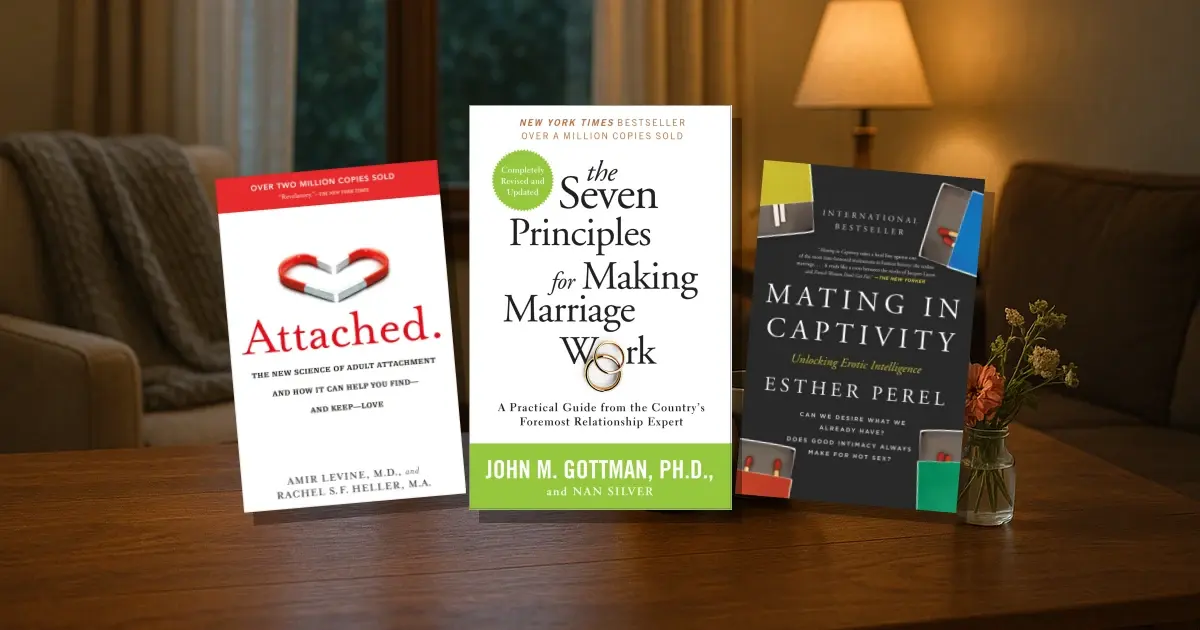
- A long partnership feels more like logistics than friendship: The Seven Principles for Making Marriage Work.
- One of you seeks reassurance while the other pulls away: Attached.
- The relationship feels safe, and desire has gone quiet: Mating in Captivity.
- You both try hard, and neither of you feels loved: The Five Love Languages.
- Expectations about money, chores, family, or commitment were never said aloud: Set Boundaries, Find Peace.
What each book adds
Gottman builds his framework from observing couples rather than from a theory of how spouses ought to behave. He describes a stable marriage as friendship, respect, and repair rather than an absence of conflict, separates solvable problems from perpetual ones that need acceptance and ongoing management, and warns that criticism, contempt, defensiveness, and stonewalling become dangerous when they turn habitual and overwhelm repair. Levine and Heller use adult attachment to explain pursuit and withdrawal. They present anxious, avoidant, and secure styles as broad patterns that can change, not fixed labels, and argue that a calm, specific request tells you more about a partner than weeks of guessing.
Perel starts from a tension: the security and closeness a committed relationship offers can coexist with, and sometimes dampen, erotic desire. She treats fading desire as something to interpret rather than proof that love has ended. Chapman proposes five languages of love, words, time, gifts, service, and touch, and asks partners to express care in the form the other actually recognizes. He presents it as an experiment each couple tests in practice, illustrated with couples’ stories, and grounds his case for loving without reciprocity in his Christian faith, offered as testimony rather than neutral evidence. Tawwab’s book also covers family, friendship, work, and digital life; its value here is the chapter on romantic relationships, which turns assumed rules about fidelity, money, household work, and children into explicit agreements.
- Best diagnosis of a long partnership: which conflicts can be solved and which have to be managed.
- Best vocabulary for chasing and retreating: anxious, avoidant, and secure patterns as tendencies, not verdicts.
- Best reframe for fading desire: room for autonomy, play, and anticipation inside commitment.
- Best small shared practice: finding out which form of love actually reaches your partner.
A reading path for one or two readers
If you are reading as a couple, start with the book that matches a question you both recognize, not the one that proves your side of an argument. Gottman is a sound first read for most long relationships because he covers everyday goodwill, conflict, and shared meaning together. Add Attached when the same chase-and-retreat cycle keeps returning, and Mating in Captivity when the friendship is strong but desire is not. Use The Five Love Languages or Tawwab’s agreements chapter as a small shared experiment rather than a diagnosis of your partner. If you are dating, Attached and Tawwab are the most useful pair: one treats inconsistency as information worth noticing early, the other suggests raising commitment, marriage, and children before assumptions turn into resentment. None of these books replaces professional support where safety, abuse, or serious distress is involved.
- Name the question together before either of you picks a book.
- Try one practice at a time, such as a gentler start to a complaint or a direct request, before adding another.
- Use each book’s vocabulary to describe patterns, not to label your partner.
Sources and scope
Book ideas are attributed to their authors. External evidence is linked directly when a claim needs more than the source book.
- The Seven Principles for Making Marriage Work: Source for the observation-based framework of friendship, respect, and repair, solvable versus perpetual problems, and the Four Horsemen.
- Attached: Source for anxious, avoidant, and secure attachment patterns, direct requests as information, and early attention to inconsistency.
- Mating in Captivity: Source for the tension between security and erotic desire and for treating fading desire as something to interpret.
- The Five Love Languages: Source for the five languages, translation into a partner's primary language, the experimental framing, and its faith-based grounding.
- Set Boundaries, Find Peace: Source for explicit agreements in romantic relationships and early conversations about commitment, marriage, and children.
To report a factual, attribution, rights, or accessibility concern, email hello@wiseley.app.
Questions readers ask
What is the best relationship book for couples?
For most long-term couples, The Seven Principles for Making Marriage Work is a sound first choice because it covers friendship, conflict, and shared meaning together. If one recurring pattern dominates, such as chasing and withdrawing or fading desire, start with the book written for that pattern instead.
Which relationship book helps when you are dating?
Attached is the most direct: it treats responsiveness and consistency as evidence worth noticing early, before a pattern hardens. Set Boundaries, Find Peace adds a practical step for new relationships, which is talking about commitment, marriage, and children before assumptions turn into resentment.
How is this different from the communication books list?
The communication list is organized by the conversation you face, at work, with family, and with a partner. This list stays with romantic relationships and is organized by the question a couple is living with, so the two overlap only where a partner conversation is the problem.
Can these books replace couples therapy?
No. They offer frameworks and practices, not an assessment of your relationship. Where there is abuse, coercion, fear for your safety, or serious distress, professional and specialist support comes first.