What you'll learn
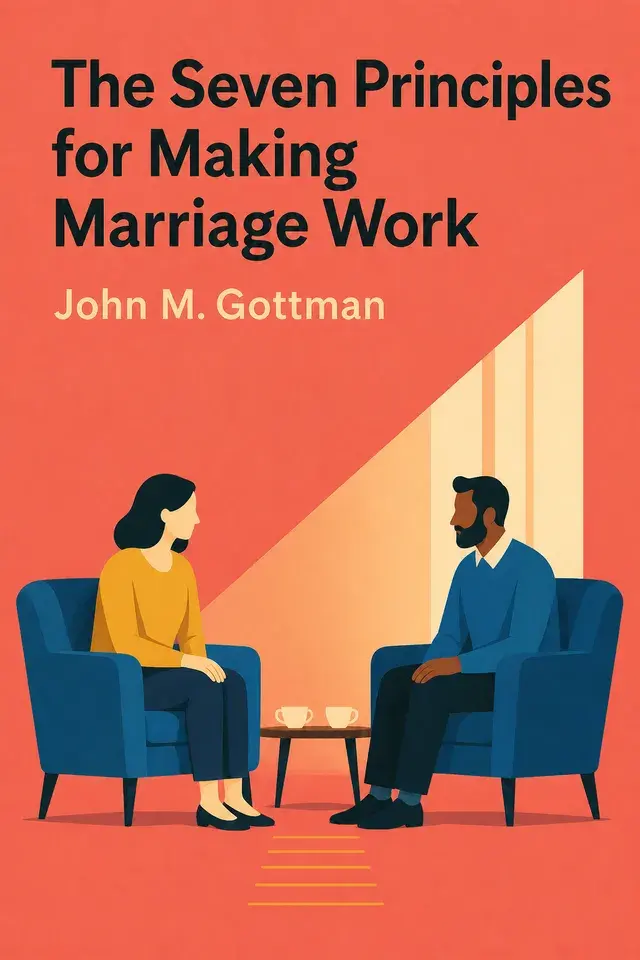
Key ideas from The Seven Principles for Making Marriage Work
These ideas compress the book's argument without treating the author's view as settled fact. Use them as an orientation before reading the full work or listening in Wiseley.
Marital stability is framed as a system of friendship, respect, positive sentiment, and repair rather than an absence of conflict.
Love maps keep partners emotionally visible by preserving current knowledge of each other’s daily life, history, stresses, hopes, and inner world.
An emotional bank account grows through repeated goodwill and shapes how spouses interpret later lapses, stress, and positive behavior.
Shared power means allowing a spouse’s reasonable needs and perspective to affect decisions without surrendering identity or every preference.
Marital conflict falls into solvable problems suited to situational problem-solving and perpetual problems requiring acceptance and ongoing management.
Solvable conflict begins with a soft startup focused on a specific problem, feeling, and request rather than an attack on character.
Honoring a dream may mean understanding, support, or participation, without requiring agreement that it is practical or should be realized.
Shared meaning turns marriage from a set of tasks into a lived culture of rituals, roles, goals, symbols, and stories.
How The Seven Principles for Making Marriage Work builds its case
Follow how the book develops its argument. Each note is a brief orientation, not a replacement for the chapter.
Marriage Is a Living System
Gottman begins with a question: what distinguishes marriages that remain satisfying from those that slowly lose their way? His answer comes from observation, not a theory of how spouses ought to behave.
Know the Person Beside You
A marriage can lose connection through inattention before it reaches a dramatic argument. The book’s first concrete mechanism is the love map: the mental space where each spouse stores current knowledge of the other.
Invest in Everyday Goodwill
Friendship in marriage is sustained less by occasional romance than by what partners do with the small moments of ordinary life. Gottman calls these moments bids: comments, questions, jokes, or requests for attention, affection, humor, or support.
Share Power, Not Control
The fourth principle is that marriage works best when both partners can influence one another. Influence means taking a spouse’s opinions, feelings, and needs seriously enough to let them affect decisions.
Read Conflict Before Solving It
Before deciding how to handle a marital disagreement, first decide what kind of disagreement it is. Gottman places virtually all marital conflicts in one of two categories: solvable problems and perpetual problems.
Repair, Soothe, and Compromise
Once a couple knows a disagreement is ordinary and solvable, the practical question is how to keep it from becoming a contest over character. Gottman argues that conflict cannot be managed well unless each partner accepts the other’s subjective reality.
Make Marriage a Team
Marriage is tested less by one dramatic crisis than by recurring pressures that make spouses compete for loyalty, money, time, sex, or authority. Gottman treats these disputes as emotional tasks in disguise.
Honor Dreams Within Gridlock
Some recurring marital disagreements do not yield to better arguments. They return because each partner is defending more than a preference.
Build a Shared Marital Culture
The book’s seventh principle shifts the question from how couples survive difficulty to what their marriage is for. A couple may handle disagreements reasonably well and still feel like efficient roommates.