What you'll learn
Key ideas from Men Are from Mars, Women Are from Venus
These ideas compress the book's argument without treating the author's view as settled fact. Use them as an orientation before reading the full work or listening in Wiseley.
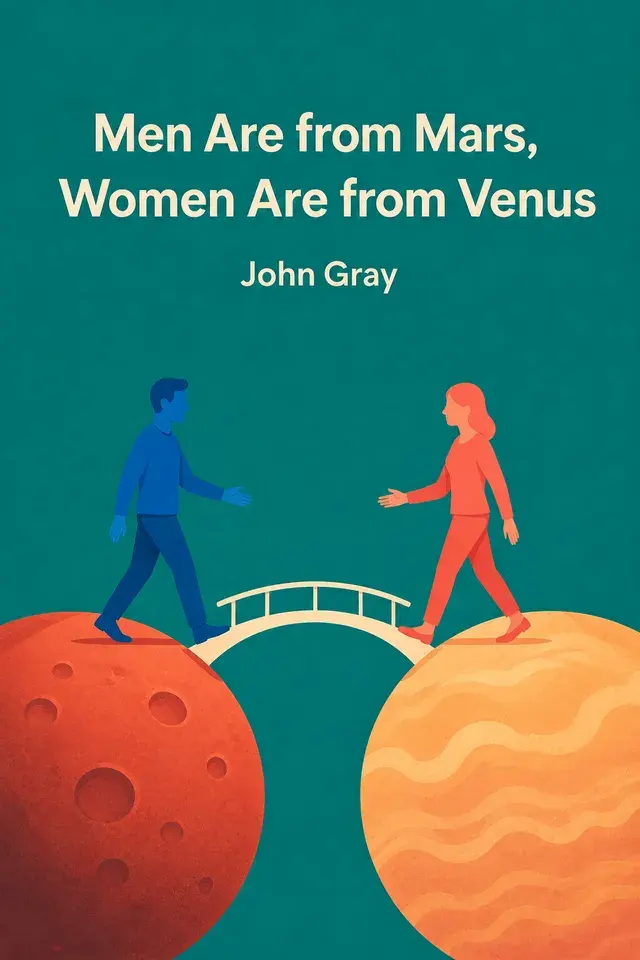
The book’s central lens is that love does not make partners react identically, so difference can be mistaken for rejection.
Mr. Fix-It describes solutions offered when a partner is seeking empathy and emotional relief.
The book treats dramatic relationship phrases as shorthand for present feelings and requests, so literal corrections can miss the message and intensify conflict.
Arguments escalate when hurt is heard as disapproval and defense as invalidation; direct feeling statements, listening, and respectful pauses are presented as interruptions.
The love-tank metaphor makes care measurable through repeated attention, affection, practical help, shared time, and appreciation.
The asking sequence replaces silent expectation with direct requests, genuine choice, acceptance of refusal, and patient persistence.
How Men Are from Mars, Women Are from Venus builds its case
Follow how the book develops its argument. Each note is a brief orientation, not a replacement for the chapter.
The Mars–Venus Lens
The book opens with a painful lesson the author says he learned at home. When his daughter Lauren was born, he and Bonnie were exhausted; Bonnie was injured, taking painkillers, and repeatedly awakened by the baby.
Fixing, Listening, and Stress
One of the book’s first practical claims is that arguments often begin with care aimed at the wrong need. Gray describes broad gendered tendencies toward different relief.
Needed, Cherished, and Reciprocal
Once the book’s earlier stress patterns are in view, Gray asks a deeper question: what makes a partner want to give, and what makes support difficult to receive? His answer is motivational.
Translation and the Rubber Band
Many relationship conflicts, the book argues, begin as translation problems rather than proof that love has disappeared. In Gray’s Mars–Venus framework, the same words can carry different emotional meanings.
Waves, Wells, and Safety
Alongside a man’s legitimate need for temporary space, Gray describes many women’s emotional experience as a wave. Within the book’s Mars–Venus framework, feeling loved can lift a woman’s self-esteem and give her abundant love to offer.
Love Needs and Conflict Repair
Love can be present in a relationship and still fail to reach the person who needs it. Gray says partners often offer the form of love they would want themselves, then read the mismatch as selfishness or indifference.
Scorekeeping into Small Acts
Gray turns his Mars–Venus model into a daily accounting system. His central point is that two partners can both give love and still feel neglected because they count differently.
Writing the Way Back
Gray begins with a useful distinction: difficulty communicating lovingly does not necessarily mean that partners lack love. In his account, communication is a learned emotional skill.
Asking, Seasons, and Renewal
The closing method begins with a simple but uncomfortable problem: someone can need support, never ask for it, and then experience its absence as proof that love is missing. Gray attributes this pattern to different expectations.