What you'll learn
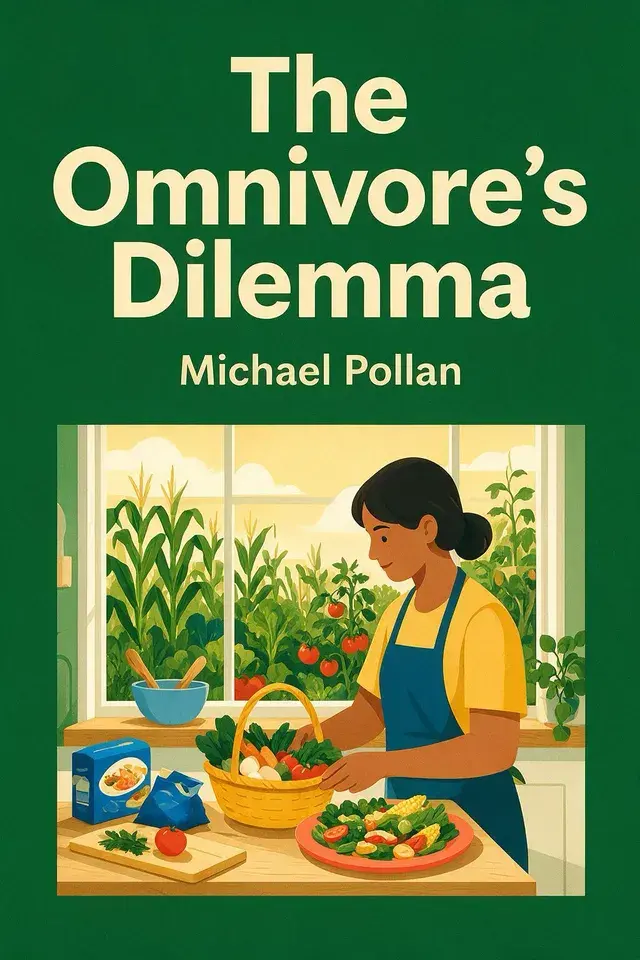
Key ideas from The Omnivore's Dilemma
These ideas compress the book's argument without treating the author's view as settled fact. Use them as an orientation before reading the full work or listening in Wiseley.
Pollan follows meals backward through industrial, organic, and hunter-gatherer chains to reconnect food with soil, energy, and consequence.
Synthetic nitrogen and fossil energy made dense corn production possible while disrupting water, atmospheric, and ecological nutrient cycles.
Fast food and supersizing turn cheap engineered calories into a consumer environment that encourages overconsumption and hides the meal’s origins.
Supermarket scale can preserve monoculture, machinery, confinement, processing, and long-distance logistics beneath an organic label.
Stacking lets cattle, chickens, turkeys, pigs, compost, and woodland perform linked services, so efficiency includes avoided inputs as well as products.
A plural food economy can combine local, organic, slow, and other chains, with diversity supporting resilience without requiring total self-sufficiency.
American dietary instability grows when commercial advice and marketing displace stable culinary traditions, shared meals, and trusted sensory judgment.
Animal ethics must include predation, crop deaths, species, habitats, and nutrient cycles; ecological trade-offs complicate absolute rules about meat.
How The Omnivore's Dilemma builds its case
Follow how the book develops its argument. Each note is a brief orientation, not a replacement for the chapter.
The Question Behind Every Meal
The omnivore’s dilemma begins with a basic problem: humans can eat a wide range of foods, but no instinctive menu tells us which choices are safe or nutritious. Pollan contrasts omnivores with specialized eaters, such as koalas, whose narrow diets reduce this uncertainty.
Corn and the Industrial Bargain
Following the book’s food chain backward, supermarket variety narrows to Zea mays, the botanical name for corn. The book treats this as a clue: abundance rests on a narrow biological base.
Cheap Meat, Engineered Appetite
Once industrial corn exists in abundance, the system must find places to put it. At the grain elevator, Number 2 field corn is not a distinctive food.
Organic at Industrial Scale
Organic enters Pollan’s investigation as more than a ban on chemicals. In the industrial food economy, price is almost the only message traveling from consumer to producer.
Grass as a Living System
Polyface begins by changing what a farm is understood to be. Joel Salatin calls himself a grass farmer because grasses remain when animals come and go.
Eating as Civic Practice
After following Polyface’s farm system, the focus turns to getting alternative food to eaters. Joel Salatin says sustainability includes distribution and marketing.
Learning to Be an Omnivore
After following several food chains, Pollan asks how a creature that can eat almost anything knows what to eat. Human omnivory is a biological advantage, but it brings no built-in menu.
Animals, Killing, and Moral Visibility
The moral problem of meat becomes unavoidable when the animal disappears from the product. Pollan describes reading Peter Singer’s Animal Liberation in a steakhouse while eating the animal whose moral status he was trying to defend.
The Perfect Meal’s Lesson
The investigation reaches its answer when Pollan tries to make one meal almost entirely himself. Foraging makes food’s uncertainty physical: he must find an organism, identify it correctly, and accept that effort may produce nothing.