What you'll learn
Key ideas from The Untethered Soul
These ideas compress the book's argument without treating the author's view as settled fact. Use them as an orientation before reading the full work or listening in Wiseley.
The inner voice is a changing object of awareness, not the witness who hears it.
A Samskara is an unfinished energy pattern formed when disturbance is resisted or pleasure is clung to instead of passing through.
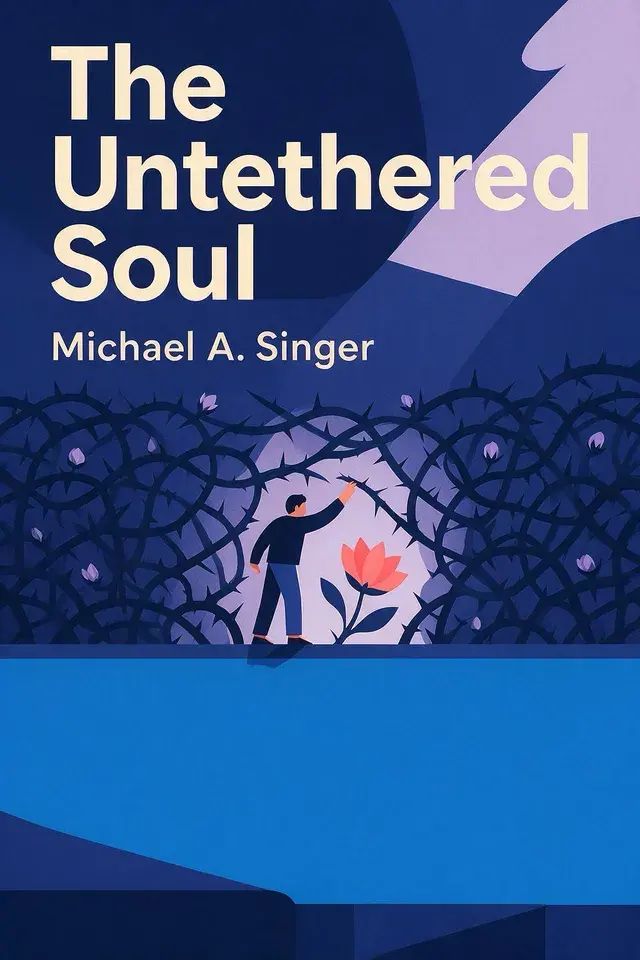
Protecting an inner thorn can organize relationships, routines, and choices around avoiding pain while leaving the wound intact.
Comfort zones function as invisible cages whose edges reveal where fear still limits consciousness.
Unconditional happiness is presented as a chosen commitment, not a reward dependent on favorable circumstances.
Divine love is unconditional and nonjudgmental, replacing guilt and shame with compassion and appreciation for creation.
How The Untethered Soul builds its case
Follow how the book develops its argument. Each note is a brief orientation, not a replacement for the chapter.
The Witness Behind the Voice
The book opens with a question that sounds simple: Who am I? The answer is not any one changing mood, role, relationship, body, or biography.
Opening the Spiritual Heart
Once awareness has been recognized as the witness, the book asks how that awareness becomes a practice. Michael A.
Freedom from Inner Thorns
Freedom, in Singer’s account, begins when a painful inner disturbance stops dictating the shape of life. The question is not whether safer circumstances can be built, but whether the wound itself will be met.
Beyond the Walls of Self
The earlier practice of relaxing around a disturbance has a larger implication. The disturbance may belong not only to a particular wound, but to the structure we call the self.
Happiness Without Conditions
The book now turns its account of inner resistance into a direct stance toward life. Singer reduces many apparent choices to one basic question: will you be happy, regardless of what happens?
Death, Balance, and Divine Love
At the end of The Untethered Soul, freedom is tested against the fact that life ends. Singer presents death as the clearest spiritual teacher because it exposes what cannot be held.