What you'll learn
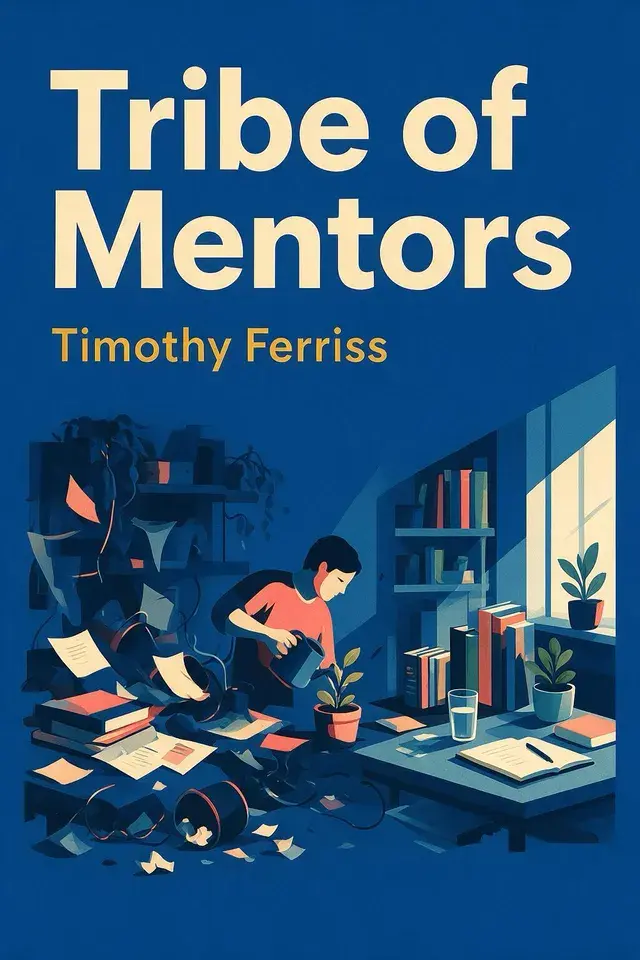
Key ideas from Tribe of Mentors
These ideas compress the book's argument without treating the author's view as settled fact. Use them as an orientation before reading the full work or listening in Wiseley.
Values-based priorities filter commitments through purpose rather than fear of missing out, status, guilt, or applause.
Failure becomes useful through causal examination and changed behavior, not through the event alone.
Attention is working capacity, so calendars, boundaries, and external systems protect the conditions for sustained work.
Feedback becomes capability when observation, communication, and collaboration turn advice into specific correction.
Useful information is information that could change the choice; extra data can raise confidence without improving accuracy.
Bootstrapping, low fixed costs, savings, and disciplined reinvestment convert current income into future creative and financial choice.
A good life is measured by ordinary days, where present happiness, health, and close relationships make life feel whole.
How Tribe of Mentors builds its case
Follow how the book develops its argument. Each note is a brief orientation, not a replacement for the chapter.
A Question-Driven Mentor Library
Tribe of Mentors begins with Ferriss turning forty without a clear post-forty direction. Against deaths among friends and public discussion of his college survival, the transition raised questions about whether his goals were truly his, whether planning had helped or harmed him, how to be kinder to himself, and how to reject noise.
Choosing What Matters
Across the mentors, self-direction begins by questioning inherited rules. Expectations and social approval can make a path feel inevitable before anyone asks whether it fits.
Failure as Usable Information
Failure does not come with a built-in meaning. Across the anthology, a setback is neither automatically a lesson nor a final verdict.
Protecting Attention and Capacity
One of the book’s clearest practical ideas is that attention is working capacity. Several mentors describe it as scarcer than time and as the medium through which work happens.
Learning with Teachers and Practice
Capability in this book is not treated as a hidden trait waiting to be discovered. It compounds when someone takes on a worthwhile problem, finds a teacher or model, practices fundamentals, and lets experience refine judgment.
Deciding Under Uncertainty
Decisions are hardest when the evidence is incomplete, the future is opaque, and every option supports a convincing story. The mentors in Tribe of Mentors do not promise a method for eliminating uncertainty.
Work, Ownership, and Freedom
Work creates autonomy only when its economics support it. Across the mentor answers, freedom is not escape from every boss or obligation.
The Good Life in Ordinary Days
The final test of a good life is not how impressive it looks from a distance. It is whether an ordinary day feels whole: whether health is valued as part of the good itself, close relationships are alive, and the present feels worth inhabiting.