What you'll learn
Key ideas from The Last Lecture
These ideas compress the book's argument without treating the author's view as settled fact. Use them as an orientation before reading the full work or listening in Wiseley.
Preparation and delivery make the cancer visible while showing that his response, not the diagnosis, remains his choice.
Specific dreams became workable when Pausch defined the desired experience and shaped proposals that others could support.
Disney’s rejection is answered by low-cost virtual-reality innovation, persistent contact, and extensive preparation.
Honest correction becomes constructive when care and credibility make difficult feedback hearable.
Pausch treats time as irreplaceable capital, so planning and protecting it matter more than recovering small amounts of money.
Pausch’s legacy scales through teams, institutions, and tools that help many people pursue ambitions beyond one-to-one mentorship.
Gratitude becomes durable when expressed concretely and paid forward, creating reciprocal loyalty across mentorship and institutions.
Pausch builds a specific, child-by-child legacy through experiences, records, and memories while leaving each child’s future open.
How The Last Lecture builds its case
Follow how the book develops its argument. Each note is a brief orientation, not a replacement for the chapter.
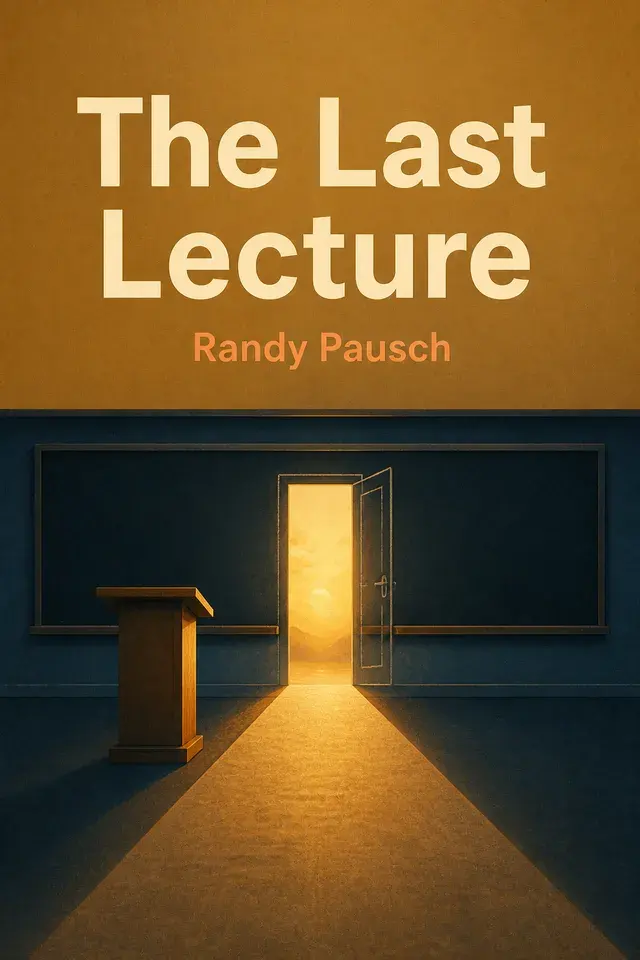
A Lecture for the Future
Randy Pausch’s last lecture begins with a fact that makes ordinary planning urgent: he has ten liver tumors and only a few months to live. He rejects self-pity as useless to himself and his family.
Dreams, Discipline, and Permission
Pausch attributes much of his ability to pursue difficult dreams to what he calls winning the parent lottery. His mother demanded high standards, while his father modeled service, intellectual curiosity, and responsibility.
Brick Walls Invite Better Work
A brick wall, Pausch says, can reveal how seriously someone wants a goal. He introduces the idea through a childish ambition: being the coolest person at every carnival by owning the largest stuffed animal.
Living Fully Under Prognosis
Pausch’s encounter with cancer begins not with a philosophical lesson, but with symptoms that demand explanation. He develops unexplained upper-abdominal pain, then jaundice that doctors initially suspect might be hepatitis.
Love Makes Room for Imperfection
Before illness becomes the organizing condition of family life, Pausch shows love through smaller tests: correction, play, patience with another person’s choices, and calm when plans go wrong. The lesson is not that relationships are smooth; care gives imperfection a livable shape.
Marriage, Grief, and the Present
Terminal illness does not turn Pausch and Jai’s marriage into a solemn performance. It makes ordinary marriage more deliberate.
Time, Feedback, and Honest Growth
Time is the one resource Pausch cannot replace. His illness makes that idea unusually concrete, but he presents it as a general fact: money can sometimes be recovered; minutes cannot.
Building Paths for Other Dreamers
At this point, Pausch shifts the question from fulfilling his own dreams to enabling other people’s. A mentor can open one door, but a team, institution, or tool can keep opening doors for people the mentor will never meet.
Act, Collaborate, and Risk
One of the most practical lessons in The Last Lecture begins with a chair. Pausch and his mother argued repeatedly about him leaning back in a dining-room chair.
Gratitude, Truth, and Duty
Across Pausch’s practical advice, a social ethic comes into view. A durable life depends not only on reaching goals, but on how a person receives help, handles ordinary work, speaks after causing harm, enters an unfamiliar culture, and participates in a community.
Joy, Family, and Lasting Love
The closing movement begins with a small habit: ask directly. When Dylan wants to ride in the front of the Disney monorail, Pausch asks an attendant, who agrees.