What you'll learn
Key ideas from The Prophet
These ideas compress the book's argument without treating the author's view as settled fact. Use them as an orientation before reading the full work or listening in Wiseley.
The teachings arise as speech about what already moves within the listeners, not as doctrine imposed from outside.
Mature love gives itself without owning or being owned, allowing devotion to coexist with freedom.
Work participates in life when love enters its making; indifference passes harm into the things others receive.
Wholeness holds joy and sorrow, comfort and freedom, reason and passion in a living balance.
Self-knowledge unfolds from latent inner knowledge and cannot be completed, measured, or reduced to one truth or path.
Beauty and religion join inward ecstasy to daily life, bringing body, work, nature, wonder, and worship into one open spiritual practice.
Death is treated as continuous with life, like a river joining the sea, rather than as life’s simple extinction.
How The Prophet builds its case
Follow how the book develops its argument. Each note is a brief orientation, not a replacement for the chapter.
A Teacher at the Threshold
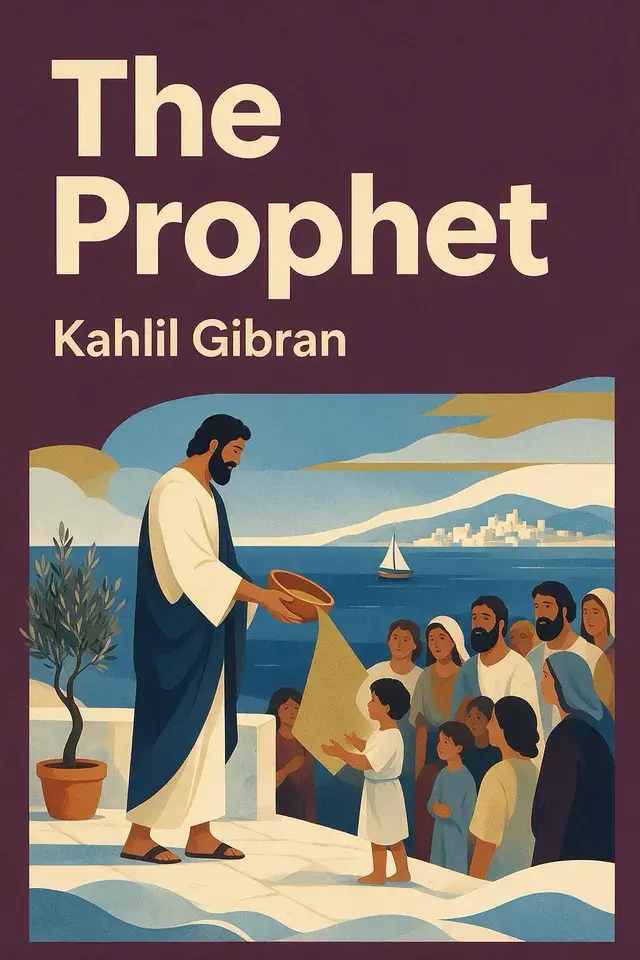
The Prophet opens at a threshold: not with a definition of wisdom, but with a man about to leave. Almustafa has waited twelve years in Orphalese for the ship that will return him to his birthplace.
Love Without Possession
Love, in The Prophet, is the first intimate test of spiritual freedom. It is not mainly a refuge from difficulty or a way to secure another person.
Shared Life Made Sacred
Once the book’s spiritual vision enters material life, sacredness appears in the ordinary movements by which people sustain one another: giving and receiving, eating and drinking, buying and selling, and working. The test is participation.
Freedom Through Inner Balance
Freedom, in Gibran’s vision, is not simply the removal of restraints. It is a form of inner balance: a person becomes whole by refusing to divide life into final opposites.
The Self Behind Words
Self-knowledge in The Prophet begins with recognition, not acquisition. People seek words for knowledge their hearts already carry in silence.
Wholeness in Goodness and Pleasure
The book’s positive vision begins by loosening the usual opposition between good and evil. Evil is not an independent power standing over against good; it is good distorted by frustrated hunger and thirst.
Death, Farewell, and Return
At the end of the Prophet’s teaching, death is not set against life as its opposite. Its secret is sought within life itself.