What you'll learn
Key ideas from How to Know a Person
These ideas compress the book's argument without treating the author's view as settled fact. Use them as an orientation before reading the full work or listening in Wiseley.
Illuminators help people feel larger and more alive, while Diminishers leave them reduced, unseen, or treated as categories.
Whole-person seeing holds change, contradiction, and dignity together instead of ending with a label.
Total attention, loud listening, pauses, and checked paraphrase make another person’s meaning more audible.
Understanding a person involves seeing individuality, group membership, and unequal social location together.
Empathy combines embodied mirroring, mentalizing another person’s situation, and caring in ways that meet that person’s actual needs.
Traits help predict behavior without defining moral character, and they remain observable, incomplete, and capable of change.
Personal stories give scattered events a changing structure through which identity, purpose, and future become intelligible.
How How to Know a Person builds its case
Follow how the book develops its argument. Each note is a brief orientation, not a replacement for the chapter.
The Moral Power of Being Seen
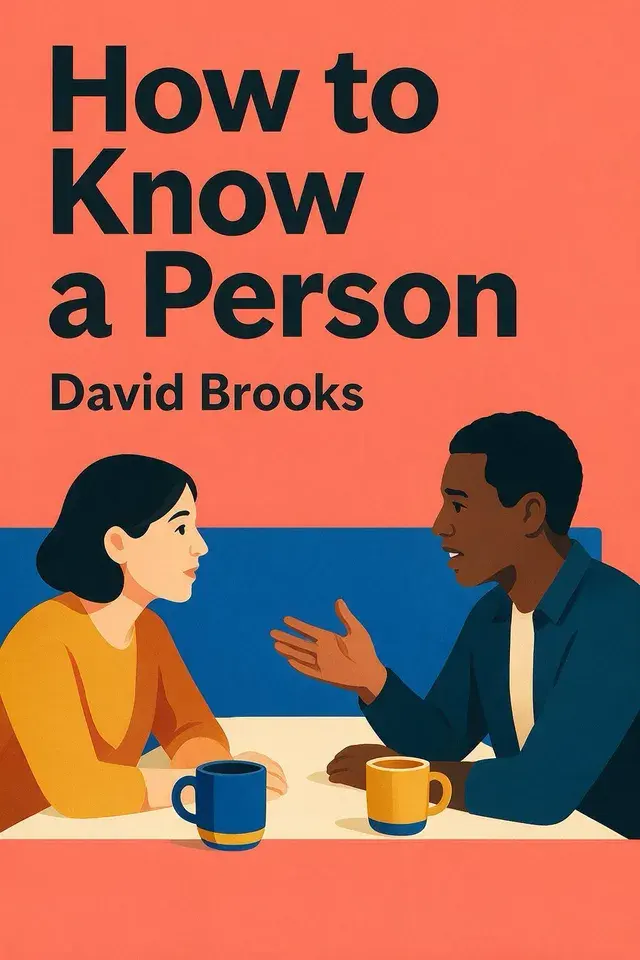
David Brooks opens by admitting he spent much of his life outside his own experience. He grew up where love existed but was rarely expressed, and became observant, reserved, and emotionally self-protective.
How We Missee Other People
People can look directly at one another and still fail to see. In a bar, Brooks notices a self-absorbed first date, couples absorbed in their phones, and conversations reduced to politics.
Accompaniment and the Constructed Person
Attentive seeing becomes a way of life when it changes how we move alongside people. Brooks calls this accompaniment: relaxed, sensitive, unhurried awareness that offers faithful help without directing another person’s journey.
Conversation as Shared Discovery
To know another person, you have to ask how the world looks from where they stand. Imagining what may be in someone’s mind is not enough.
The Social Cost of Blindness
Once failure to see another person becomes a social diagnosis rather than a private annoyance, Brooks calls it an epidemic of blindness. Contemporary society, he argues, is increasingly unable to recognize people as human beings.
Hard Conversations Across Difference
Hard conversations are rarely only about the stated issue. They include partisan family conflict, angry students challenging administrators, and populist resentment toward elites.
Depression, Wounds, and Defense
One of the hardest forms of conversation is trying to enter a reality another person can barely describe. Brooks explores this through Peter Marks, or Pete, a husband, father, physician, and eye surgeon whose playful, loving life concealed severe depression.
Empathy as Embodied Practice
Empathy, in the book’s account, is not a magical intuition or a single rush of fellow feeling. It is a trainable set of capacities, and those capacities can come apart.
Suffering, Grief, and Excavation
To understand a person after suffering, you have to know more than what happened. You have to know who they were before the loss, what assumptions it shattered, and how they rebuilt an outlook afterward.
Personality Beyond First Impressions
First impressions often tell us something real, but they become misleading when an impression hardens into a verdict. David Brooks offers personality traits as a more dimensional vocabulary: a way to notice the energy, sensitivities, and habits people bring to relationships.
Life Tasks and Changing Consciousness
The chapter’s central lens is developmental: a person is not finished, but continually reorganizes consciousness around the task they confront. The tasks named here move from bonding, to agency, to interpersonal identity, to career consolidation, to generativity, and finally to integrity.
Stories, Culture, and Identity
Earlier chapters show how conversation can make another person’s point of view audible. This chapter asks what becomes possible once a story begins.
Wisdom in Relationship
The book’s final movement asks what its practices add up to. It defines wisdom as knowledge of people: seeing deeply into someone’s character and situation, then helping them move through complexity.