What you'll learn
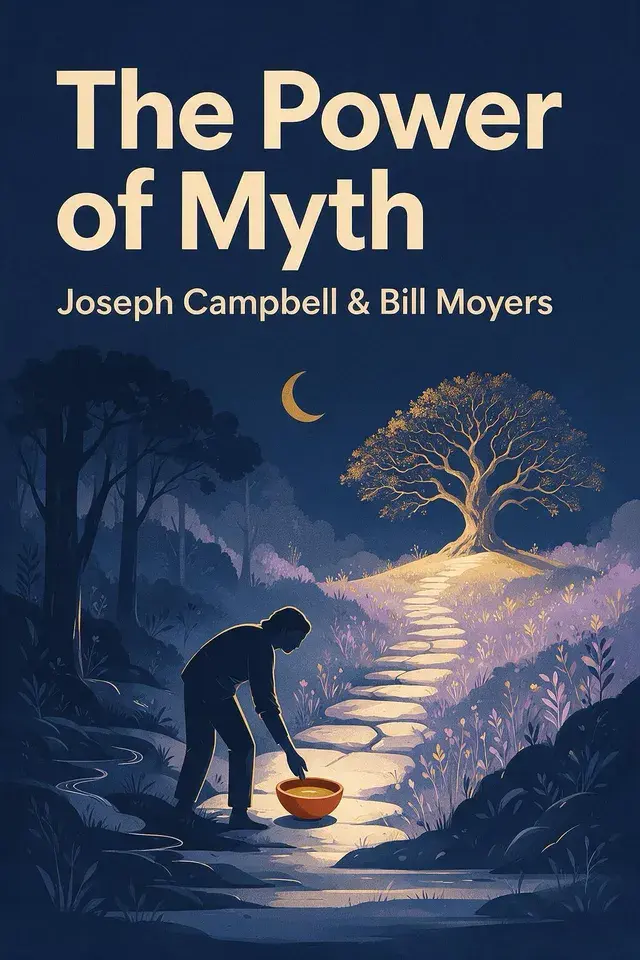
Key ideas from The Power of Myth
These ideas compress the book's argument without treating the author's view as settled fact. Use them as an orientation before reading the full work or listening in Wiseley.
Myth is a living symbolic orientation that connects personal experience with recurring human patterns.
Calling life a “thou” resists the objectifying “it” that enables extraction, war, and alienation in human relationships.
The hero leaves ordinary identity, faces ordeal or illumination, and returns with a boon whose value lies in service.
Vocation depends on inward discernment, teacherly clues, and personal responsibility rather than obedience to a fixed route.
The Grail joins nature and spirit through compassionate authenticity, asking individuals to repair society without surrendering conscience to its rules.
Ultimate mystery exceeds every image, so contemplation and nondual awareness loosen literal doctrine and egoic claims without replacing mystery with a new possession.
How The Power of Myth builds its case
Follow how the book develops its argument. Each note is a brief orientation, not a replacement for the chapter.
Myth in a Demythologized World
Campbell distinguishes between asking for the meaning of life and seeking an experience of being alive. Myth belongs to the second question.
Creation, Duality, and Mystery
Creation stories, in Campbell’s reading, are not chiefly attempts to answer who made the world, how it began, or why it exists. Their deeper purpose is recognition: the creator is not merely somewhere before creation but present throughout it.
Sacred Participation in Life
The most difficult fact about living, in Campbell’s account, is also ordinary: life feeds on life. The hunter survives by killing an animal, and the eater depends on a death.
Initiation, Sacred Centers, and Living Traditions
Myth becomes socially effective when it is enacted by bodies, anchored in places, and carried by people who can renew its symbols. Campbell treats ritual as myth enacted.
Sacrifice, Rebirth, and the Hero’s Gift
Planting myths begin with an unsettling fact: what feeds life often passes through burial, decay, or death. In the framework Campbell and Moyers discuss, hunting mythology turns outward toward animals, while planting mythology turns inward toward seed, earth, burial, sprouting, and connected growth.
The Inwardly Chosen Path
Myth becomes useful to modern individuality when treated as a way of reading experience, not as instructions to obey. Campbell and Moyers ask what happens when machines and institutions grow so powerful that people function like their parts.
Goddess, Father Quest, Love, and Grail
The chapter’s central movement is from origin to vocation, then from vocation to relationship. The Goddess names nature’s generative field; the father quest names the search for character and destiny.
Eternity in Symbolic Form
The closing movement widens the book’s earlier question of unity. Love and marriage can symbolize two aspects of a larger whole, but the final concern is broader: how can a symbol point toward mystery without claiming to possess it?