What you'll learn
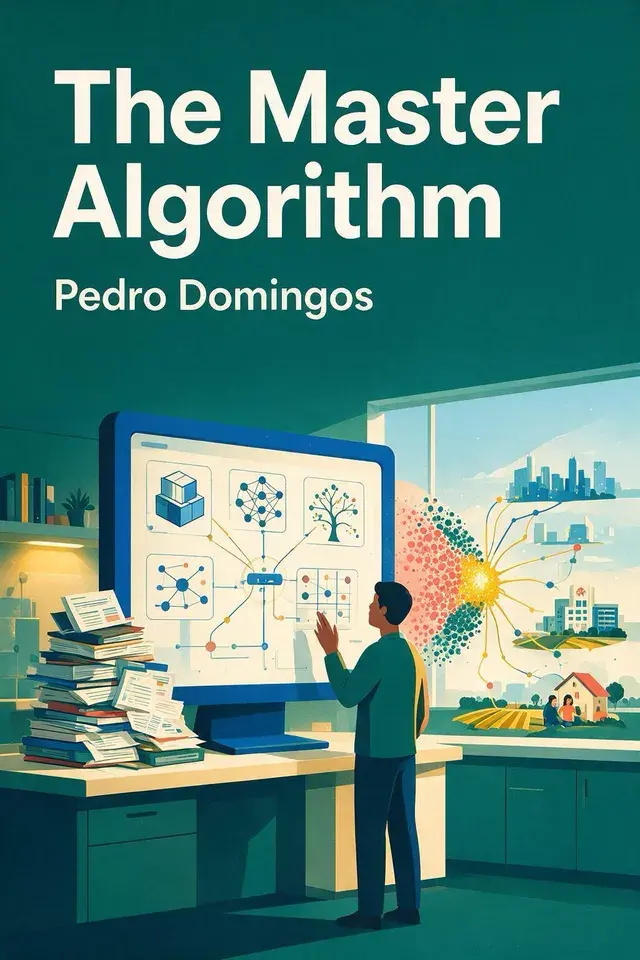
Key ideas from The Master Algorithm
These ideas compress the book's argument without treating the author's view as settled fact. Use them as an orientation before reading the full work or listening in Wiseley.
Reverse programming infers models or skills from data and desired outcomes instead of hand-writing every rule.
No free lunch says useful prediction depends on assumptions that favor the actual world, even though those assumptions remain fallible.
Symbolist learning recovers human-readable rules from examples, then evaluates whether those rules generalize beyond the data used to construct them.
Perceptrons learn linear boundaries; hidden layers and backpropagation extend neural learning to nonlinear patterns such as XOR.
Genetic programming searches program trees, enabling synthesis of formulas and behaviors rather than merely applying a fixed rule form.
Bayesian learning updates prior beliefs into posterior probabilities as evidence changes the relative support for competing hypotheses.
Support vector machines retain boundary-defining cases and maximize margins to limit overfitting while allowing some noise.
Alchemy maps symbolic, neural, evolutionary, Bayesian, and analogical methods into one programmable framework, but does not establish a universal learner.
How The Master Algorithm builds its case
Follow how the book develops its argument. Each note is a brief orientation, not a replacement for the chapter.
The Promise of a Learning Machine
Machine learning begins this book as a pervasive layer of modern life rather than a specialized research topic. It ranks searches, filters spam, recommends music and products, organizes information, and supports services in business, science, and daily routines.
Why Induction Needs Bias
Machine learning begins with a deceptively simple request: infer a rule from examples, then apply it to cases not yet seen. David Hume showed why that request cannot justify itself.
Rules Against the Noise
The previous chapter established why observations alone cannot select a general rule. The symbolist response is to make the missing structure explicit.
Networks Learn Through Weights
Where symbolic learning tries to recover explicit rules, connectionism stores knowledge in patterns of connections. Hebb’s principle says that neurons firing together strengthen their link.
Evolution Searches the Program Space
Neural learning adjusts numbers inside a chosen architecture. Evolutionary learning asks a different question: which architecture or program should exist at all?
Bayes Turns Evidence into Belief
Bayesian learning treats learning as evidence-weighted management of hypotheses. A learner begins with priors, degrees of belief in possible explanations before current data arrive.
Learning by Resembling Cases
When explicit theory is incomplete, a learner can generalize by asking which earlier cases resemble a new one. Instead of first building a general rule, the analogical approach transfers local structure from remembered examples.
Discovering Structure Without Labels
A labeled example tells a learner what answer to predict, but not what the world is made of. Domingos turns to learning without labeled answers.
Learning Through Action and Relations
Earlier traditions often treat learning as prediction from separate examples. This chapter asks what changes when a learner must act over time, retain practice, represent connections, or coordinate several learners.
Alchemy's Candidate Universal Learner
After surveying the five learning traditions, Domingos asks what a synthesis would look like in engineering terms. He separates learning into representation, evaluation, and optimization.
The Human Future of Learning
The search for a universal learner now becomes a question about human agency. What matters is less whether a future system resembles Alchemy than what it can do, who supplies its data, and who chooses its goals.