What you'll learn
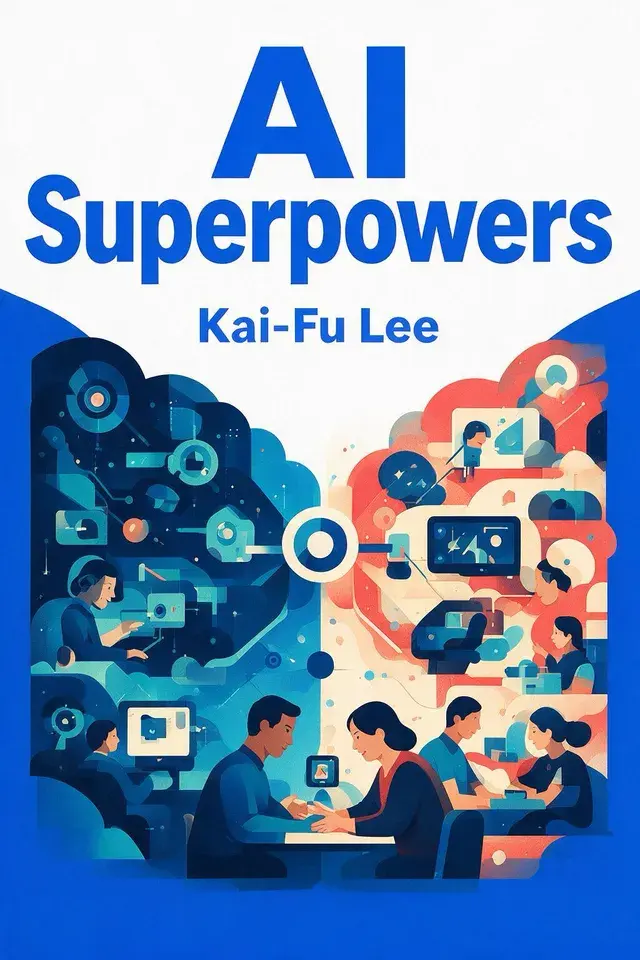
Key ideas from AI Superpowers
These ideas compress the book's argument without treating the author's view as settled fact. Use them as an orientation before reading the full work or listening in Wiseley.
Modern AI finds patterns and optimizes defined outcomes, so its power depends on relevant data, a clear goal, and a bounded domain.
Relentless competition rewarded rapid iteration, lean economics, persistence, and the ability to pivot when markets changed.
O2O and heavy platforms connected meals, rides, deliveries, vendors, and payments, producing detailed records of physical-world activity.
AI power depends on combining data, entrepreneurs, trained researchers and engineers, hardware, capital, and policy rather than maximizing one resource.
The four waves move from behavioral recommendations to structured prediction, sensory understanding, and autonomous physical action.
AI labor risk depends on task characteristics—data optimization, social interaction, dexterity, creativity, and structure—not a simple skill ranking.
Permanent exclusion from work threatens identity, purpose, and social cohesion, even if the most extreme job-loss forecasts fail.
Human agency remains decisive: AI can support flourishing only when societies value people beyond economic output and keep humans authors of the future.
How AI Superpowers builds its case
Follow how the book develops its argument. Each note is a brief orientation, not a replacement for the chapter.
From Discovery to Implementation
AI Superpowers opens with AI’s change in status. It has moved from academic laboratories and science fiction into products, business strategy, and government policy, making questions about safety, authority, work, and human purpose immediate.
Copycats Become Competitors
To understand how Chinese technology companies learned to execute, the author begins with a label that once sounded dismissive: copycat. His argument is not that copying was admirable or sufficient.
China’s Data Flywheel
China’s data advantage did not begin with a plan to collect data. It grew from a different route onto the internet.
The Implementation Power Balance
AI power, in Lee’s account, is not a contest over one algorithm. It is the ability to connect research, companies, data, engineers, hardware, capital, and government into systems that reach everyday use.
Four Waves of Deployment
Lee presents AI’s social impact as four cumulative waves. Internet AI learns from behavior online.
The Real AI Crisis
Once AI systems move from laboratories into products, the urgent question is not whether a machine will suddenly become omniscient. It is how quickly systems that already recognize patterns, predict outcomes, and optimize decisions will spread through work.
Inequality and Human Worth
AI’s economic danger, Lee argues, is not simply that machines may replace workers. It is that the benefits of intelligence could accumulate so unevenly that countries lose bargaining power, while people inside wealthy nations lose the work that tells them who they are.
A Human-Centered Social Contract
After diagnosing the disruption AI may bring to work and identity, Kai-Fu Lee turns to the response. He proposes a human-centered social contract, not a single technical fix.