What you'll learn
Key ideas from A Crack in Creation
These ideas compress the book's argument without treating the author's view as settled fact. Use them as an orientation before reading the full work or listening in Wiseley.
CRISPR shifts human influence on evolution from selecting random variation toward deliberate genetic editing.
Phage-matching spacers showed that bacteria can acquire and inherit sequence-specific antiviral memory.
Fusing CRISPR RNA with tracrRNA produced one guide RNA that made Cas9 programmable for researcher-chosen DNA targets.
CRISPR can target selected crop and livestock traits more directly than older breeding and mutagenesis, but precision does not remove uncertainty.
A gene drive biases inheritance so an engineered trait can spread through a population beyond the original release.
Containment, reversal ideas, field-release limits, and public deliberation are central because accidental or malicious spread may be difficult to undo.
Somatic editing offers the most immediate therapeutic path because it treats existing patients without passing changes to descendants.
Heritable embryo editing affects people who cannot consent and descendants, so clinical use demands conditions far beyond current proof of principle.
How A Crack in Creation builds its case
Follow how the book develops its argument. Each note is a brief orientation, not a replacement for the chapter.
The Power to Edit Life
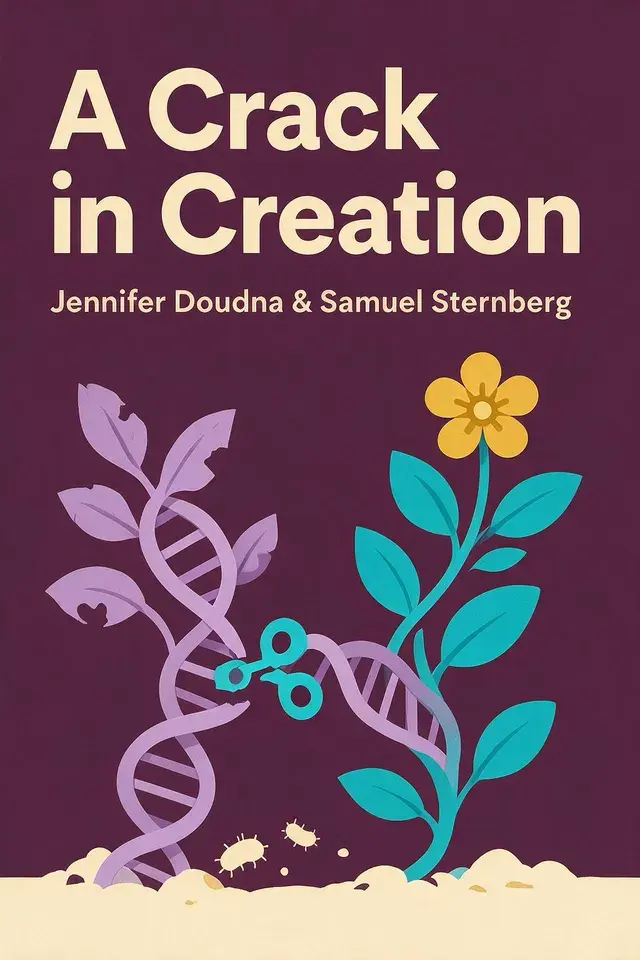
CRISPR enters this book as more than a laboratory method. Jennifer Doudna and Samuel Sternberg present it as a tool that could make an organism’s genome, its complete DNA, almost as editable as text.
The Long Road to Repair
Before scientists could edit a human genome deliberately, nature offered a strange demonstration of what repair might accomplish. In 2013, NIH researchers studying WHIM syndrome encountered Kim, whose disease seemed to have disappeared.
Bacteria Remember Viral Attacks
CRISPR began as a mystery in microbial DNA, not as a method for editing human genes. Its meaning emerged when researchers connected an unusual sequence pattern to the pressure exerted by bacteriophages, viruses that infect bacteria.
The Cas9 Editing Machine
CRISPR did not begin as one universal editing machine. It was a family of bacterial defense systems, each with its own machinery.
Editing Crops and Animals
CRISPR’s promise becomes concrete when the target is an individual plant or animal. Researchers can aim at a chosen gene and seek a trait such as disease resistance, altered growth, a research model suited to a disease, a useful medicine, or an organ for transplantation.
When Edits Spread
Most gene editing changes an individual organism. A gene drive changes inheritance rules for a population.
Healing Cells, Testing Limits
CRISPR enters medicine with a striking promise: instead of managing symptoms, it may address disease at its genetic source. Researchers have corrected single-letter mutations in living mice and repaired severe mutations in cultured human cells.
The Human Germline Reckoning
Human germline editing changes the question from what can be done for one patient to what one generation may choose for others. Editing an egg, sperm, or embryo could affect the resulting person and descendants.