What you'll learn
Key ideas from The Federalist Papers
These ideas compress the book's argument without treating the author's view as settled fact. Use them as an orientation before reading the full work or listening in Wiseley.
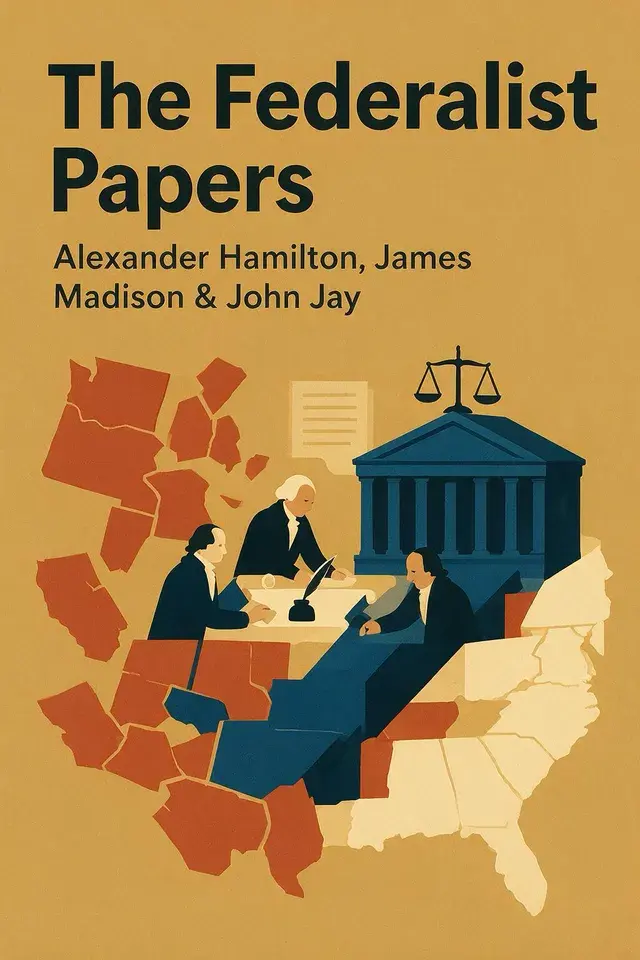
Ratification is framed as a choice between preserving one capable Union and risking dismemberment into rival confederacies.
Faction cannot be abolished without destroying liberty, but representation and a wider republic can make oppressive majorities harder to form and coordinate.
The Confederation legislates for sovereign states, so national resolutions depend on voluntary compliance rather than enforceable law.
The Constitution is federal in its state-based foundation, national in its direct operation, and mixed in the sources of its governing powers.
The compound republic creates double security by dividing power between national and state governments and within each.
A single elected President concentrates executive decision-making while keeping responsibility visible to the people.
Judicial review enforces the People’s higher constitutional authority over legislative acts rather than making courts a rival sovereign.
How The Federalist Papers builds its case
Follow how the book develops its argument. Each note is a brief orientation, not a replacement for the chapter.
The Choice of Union
The Federalist Papers begin by presenting ratification as a decision whose consequences reach beyond any single administration. The question is whether Americans will preserve the Union under a government capable of acting for the whole, or allow it to break into several confederacies.
Disunion's Domestic Logic
Once the essays turn from foreign danger to what the states might do to one another, the warning becomes domestic. If the Union broke into separate states or partial confederacies, ordinary differences would become recurring hostility.
Why the Confederation Fails
Earlier essays forecast what disunion might cause. In these essays, the Federalists ask a different question: why does the existing Confederation fail even when the states recognize common interests?
Power for Defense and Liberty
Building on the earlier case for an energetic Union, these essays ask what common defense requires. Their answer is that the Union must possess the means of defense: authority to raise armies, build and equip fleets, direct operations, protect strategic posts, and provide the resources those tasks require.
The Fiscal Constitution
These essays treat revenue as the practical test of constitutional government. The Union must fund military forces, fleets, civil administration, debts, and other legitimate needs.
The Constitution's Mixed Republic
In these papers, the Constitution is put to a comparative test. The plan need not be flawless; it must be a safer, more workable alternative to the Confederation.
What National Power Covers
Once the case for an effective Union is established, the question becomes jurisdiction: which tasks belong to the national government, and which remain with the States? The essays propose two tests.
Checks Against Concentrated Power
The argument now turns from what government may do to how its powers are arranged. The danger is not power itself, but its consolidation.
The People and Their House
The House is presented as the republic’s instrument for turning public judgment into national law. Its design joins two demands: representatives must handle difficult federal questions yet remain dependent on the people.
The Senate's Stabilizing Role
The Senate completes the Constitution’s bicameral design by giving the national legislature a second, differently constituted voice. A senator must be at least thirty and a citizen for nine years, compared with twenty-five and seven for a Representative.
An Accountable Executive
The Federalist’s defense of the executive begins with a practical question: how can a republic act decisively without creating a king? Its answer is concentrated authority joined to visible dependence.
Courts, Law, and Constitutional Limits
The institutional design is incomplete until a court can say what national law means in a concrete dispute. The proposed judiciary is meant to enforce constitutional limits without becoming a second legislature or a rival sovereign.
The Last Case for Adoption
At the end of the argument, the papers answer the objections that remain. Federalist Eighty-Four addresses the missing Bill of Rights, national distance, public debts, and expense.
Founding Texts and Constitutional Frame
These appended documents provide a different kind of ending. They are not another Federalist argument, but the founding texts whose principles and machinery the essays defend.