What you'll learn
Key ideas from The Black Swan
These ideas compress the book's argument without treating the author's view as settled fact. Use them as an orientation before reading the full work or listening in Wiseley.
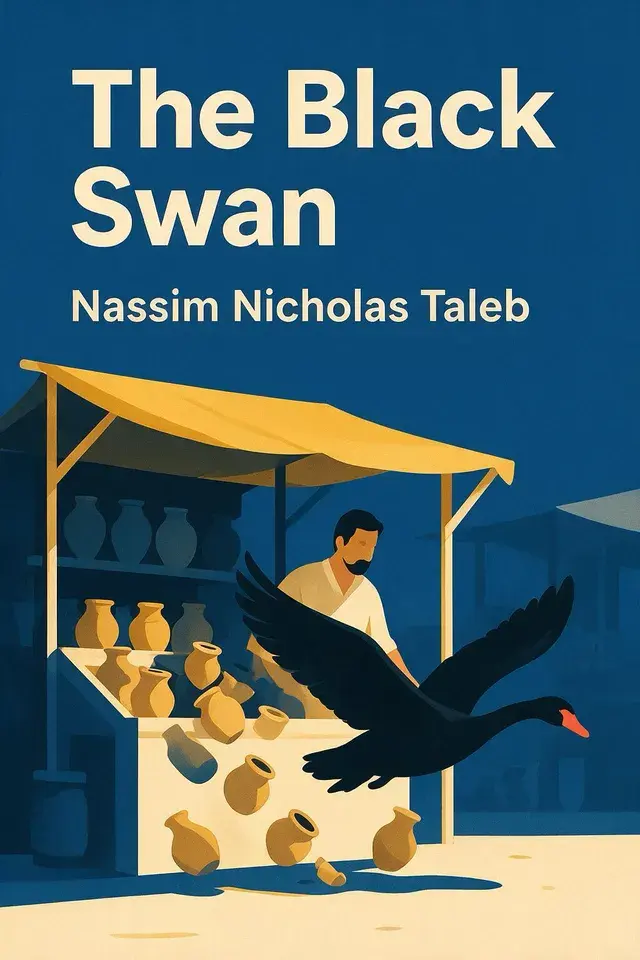
A Black Swan is an outlier with extreme impact that becomes explainable and seemingly predictable mainly in hindsight.
The turkey’s favorable history increases confidence without securing safety, so a long record can become negative evidence before a sudden reversal.
Stories compress information and soothe randomness, but they can hide consequential exceptions and distort probability.
Prediction fails structurally when complexity grows faster than models and rare events are excluded from business-as-usual forecasts.
Mediocristan makes averaging useful; Extremistan makes standard deviation and related measures fragile when rare events control outcomes.
Taleb’s risk posture combines protection from terminal negative surprises with limited exposure to potentially large positive ones.
How The Black Swan builds its case
Follow how the book develops its argument. Each note is a brief orientation, not a replacement for the chapter.
When the Unexpected Rules
Taleb opens with a deceptively simple problem: a long run of white swans cannot prove that every swan is white. Millions of confirming observations may support a universal rule, but one black swan can overturn it.
Why Hindsight Feels Inevitable
History often looks more orderly when viewed from the end. Taleb begins with a basic error: we assume that the world is more understandable, explainable, and predictable than it really is.
Scalable Success, Wild Inequality
Yevgenia Krasnova’s breakthrough begins with a manuscript that refuses the usual boundary between fiction and nonfiction. Publishers cannot classify it, identify a target audience, or place it in a precise bookstore genre.
The Turkey and Induction
Induction begins with a simple but unsettling question: how can a finite record of observations justify a general rule about what has not yet happened? We know only the past, yet we routinely treat repeated experience as a guide to the future.
Testing Beliefs Against Failure
One of the most important asymmetries in reasoning is that confirmation and disconfirmation do not carry equal weight. Seeing many white swans may fit the belief that all swans are white, but it cannot establish that universal claim.
How Stories Hijack Reality
Stories do not merely describe reality; they reorganize it. Taleb calls this the narrative fallacy: the inability to see a sequence of facts without adding causal links or direction.
Emotion Warps the Odds
The mind does not meet randomness as a neutral calculator. It notices what is vivid, emotional, and easy to picture, then lets that material stand in for the odds.
Waiting for the Big Break
Some kinds of work are paid by surprise rather than by steady accumulation. A scientist may spend a long time finding nothing, an artist may work without an audience, and an inventor may wait for one discovery that changes everything.
The Cemetery of Failure
To understand a success story, Taleb asks us to look for the people who can no longer tell theirs. The visible record is crowded with survivors, winners, published works, rescued victims, and cities that endured.
Survival Is Not a Cause
Survival is often mistaken for proof. When a person remains after a succession of dangers, continued existence can look like evidence of toughness, wisdom, or a special ability to recover.
Games Are Not Life
At the heart of this chapter is a disagreement between two ways of handling uncertainty. Fat Tony is sociable, streetwise, and comfortable with informal arrangements.
The Scandal of Prediction
The scandal of prediction is not merely that forecasts miss. It is that we continue to forecast with confidence after major misses, without asking why our confidence outruns our knowledge.
Forecasts, Plans, and Hidden Error
Forecasting begins with a simple accountability question: how often do forecasters check their predictions after the future arrives? Outlooks appear regularly, but the people who issue them rarely publish audits of their past performance.
Discovery Without a Schedule
We often tell an institution’s story as if it moved toward a destination chosen in advance. Taleb argues that the story is usually written backward.
Why the Future Cannot Be Known
The deepest obstacle to predicting the future is not simply a shortage of information. It is that the future may contain knowledge that does not yet exist.
Tacit Knowledge Against Platonism
Taleb's argument about uncertainty becomes an argument about knowledge itself. The problem is not only that forecasts fail.
Epistemocracy and Future Blindness
One of the book's important figures is not the expert who speaks with perfect certainty, but the epistemocrat. The term names a person who treats knowledge as fallible, recognizes the limits of personal understanding, and is cautious about claiming mastery.
History Cannot Be Reverse-Engineered
History can feel more intelligible than the future because its events have already occurred. Taleb argues that this impression is misleading.
Extremistan and Winner-Take-All
Extremistan describes a world in which outcomes are heavily concentrated: a small number of winners can account for a disproportionate share of rewards. Taleb presents it as increasingly random, unequal, and dominated by wild rather than mild variation.
Networks, Fragility, and Social Rank
Taleb applies his argument about Black Swans to social and economic systems, where success is often scalable: one product, institution, or person can capture a disproportionate share of attention and reward. His experience at Wharton convinced him that apparent achievement contains substantial luck, and that we usually notice our own luck while overlooking the luck of competitors.
The Bell Curve's Comforting Trap
The bell curve feels reassuring because it gives uncertainty a center. Most observations gather around an average, while increasingly large departures become rapidly less likely.
Gaussian Assumptions, Fractal Reality
To see why the bell curve feels so persuasive, Taleb begins with a quincunx, a board of staggered pins. At each pin, a ball can fall left or right, and each choice is independent of the previous one.
Power Laws and Tail Uncertainty
This part of The Black Swan turns from the bell curve to a different way of seeing unevenness. Taleb’s question is not whether randomness can be represented mathematically.
Gray Swans, Models, and Ruin
Some extreme events are neither ordinary statistical fluctuations nor wholly unknowable surprises. They are large, but their general shape can be imagined and modeled.
Living With Asymmetric Uncertainty
Living with uncertainty begins with a modest admission: our theories and data do not exhaust what the world can do. That does not make knowledge useless or every event equally mysterious.