What you'll learn
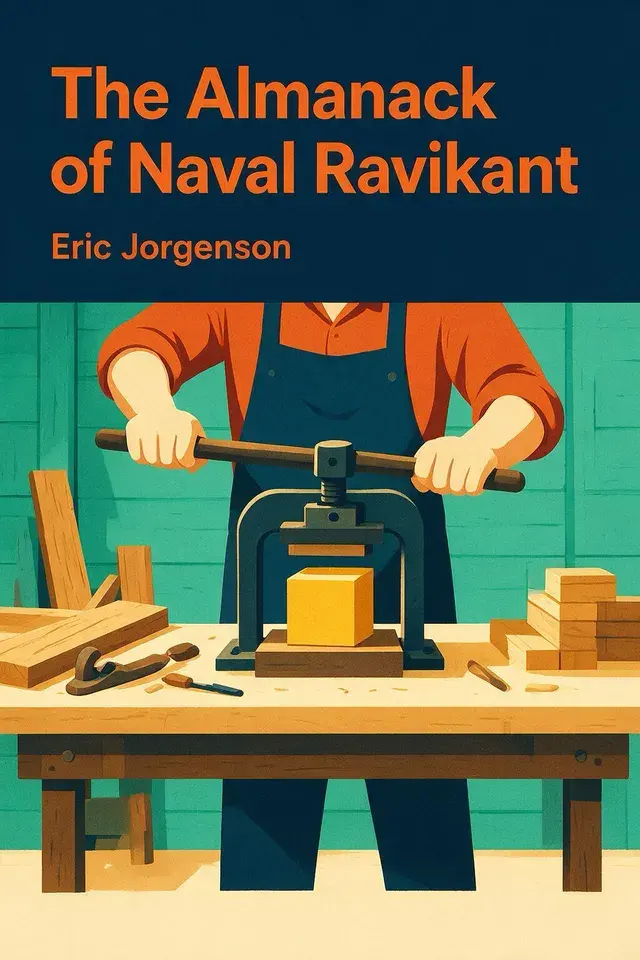
Key ideas from The Almanack of Naval Ravikant
These ideas compress the book's argument without treating the author's view as settled fact. Use them as an orientation before reading the full work or listening in Wiseley.
Specific knowledge emerges from unusual combinations of ability, curiosity, personality, upbringing, and experience.
Productization turns specific knowledge into a repeatable product or service that can reach people at scale.
Accountability ties outcomes to a person’s name, creating incentives and credibility while exposing them to failure, loss, and delayed reward.
Ownership lets people capture nonlinear upside from businesses, products, equity, and intellectual property rather than only selling hours.
Long-term relationships compound trust, reputation, and opportunity when repeated conduct makes cooperation easier and more valuable.
First-principles reasoning and reality testing expose how ego, desire, inherited identity, and incentives distort decisions.
Happiness is presented as a personal, trainable peace that emerges when desire and mental movement loosen their hold.
Freedom is presented as self-authored direction, because knowing what one wants is harder than carrying out a known desire.
How The Almanack of Naval Ravikant builds its case
Follow how the book develops its argument. Each note is a brief orientation, not a replacement for the chapter.
A Map for Wealth and Happiness
The Almanack of Naval Ravikant opens with a deceptively difficult question: can wealth and happiness be learned? The book does not answer by offering a continuous life story or a single theory.
Find and Productize Your Edge
How does a person turn an unusual way of seeing the world into useful work? The answer begins by moving away from the usual career script.
Turn Judgment into Leverage
Once valuable specific knowledge exists, the economic question is no longer how many hours can be sold. It is how accountability, ownership, judgment, and leverage turn it into results beyond direct effort.
Play Long Games, Buy Financial Freedom
Financial freedom is not simply the result of earning more. In Naval’s framework, it is the outcome of a long game: create something people value, keep a share of the result, build trust through repeated conduct, and prevent spending from rising every time income does.
Think Clearly, Read Deeply
Once leverage makes direction more important than effort, the question is how to choose well. The book defines wisdom as knowing long-term consequences, and judgment as applying that wisdom to external problems.
Make Peace the Default
The book opens its happiness discussion by reversing the familiar pursuit of three major goals: wealth, health, and happiness. People commonly chase them in that order, as if money comes first and happiness arrives later.
Train the Body, Mind, and Environment
The preceding chapter puts the inner life at the center. This chapter asks how that philosophy becomes behavior.
Claim Your Time and Attention
Freedom starts with a question harder than execution: what do you actually want? Naval argues that carrying out a known desire is easier than discovering one.
Create Meaning, Keep Your Values
After the book’s discussions of wealth, freedom, and peace, the final question is what any of them are for. Naval offers no single answer to the meaning of life.