What you'll learn
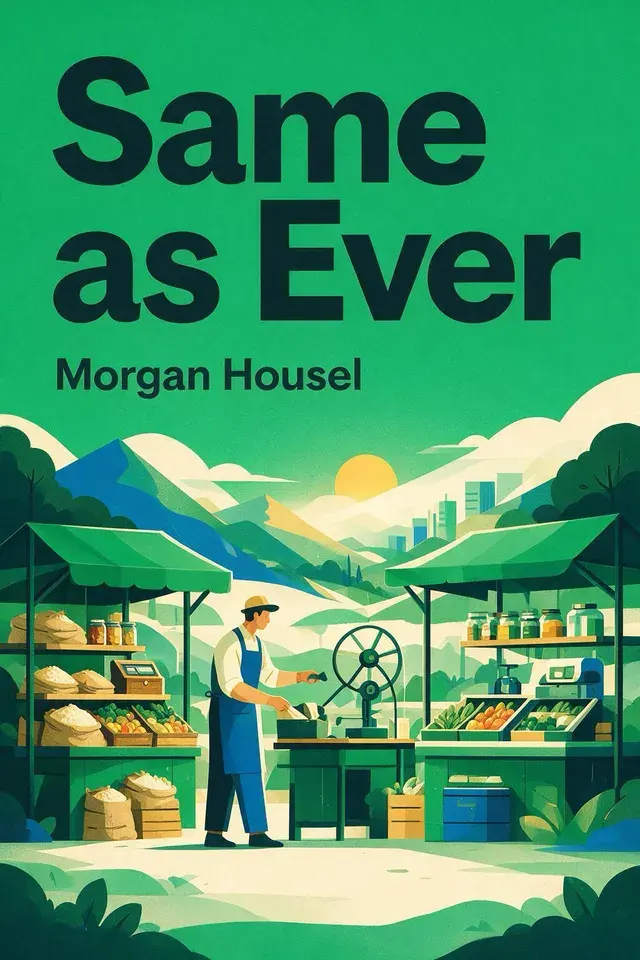
Key ideas from Same as Ever
These ideas compress the book's argument without treating the author's view as settled fact. Use them as an orientation before reading the full work or listening in Wiseley.
Changing conditions are less dependable guides to the future than recurring motives such as fear, greed, tribalism, and the search for certainty.
Happiness reflects the gap between circumstances and expectations, so material progress can leave satisfaction unchanged when expectations rise with it.
Probabilities describe uncertainty better than binary verdicts, and a successful outcome cannot prove that a decision was well judged.
Compelling presentation can spread old, incomplete, or wrong ideas, so influence and truth require separate evaluation.
Calm can increase optimism, borrowing, and complacency until stability itself makes a financial system fragile.
Slack, unstructured time, and good-enough precision protect systems and judgment from fragility.
The Red Queen dynamic makes adaptation necessary for survival, while long endurance never removes vulnerability to new threats.
Wealth, fame, and fear change the decision-maker, so people cannot reliably forecast which future selves or beliefs circumstances will produce.
How Same as Ever builds its case
Follow how the book develops its argument. Each note is a brief orientation, not a replacement for the chapter.
The Invariants Lens
Same as Ever begins with a question more useful than a forecast: what remains dependable when the future takes many forms? Housel opens with a small example.
Expectations Shape Experience
Why can someone have more and still feel no happier? Morgan Housel begins with a gap: happiness depends not only on circumstances, but on the difference between what people have and what they expect.
Whole People, Probabilistic Worlds
People want judgment to produce two clean things: a person who is easy to admire and an outcome that is easy to explain. Housel argues that both desires distort reality.
Stories Against the Spreadsheet
Facts can be correct and still lose the room. A spreadsheet can display a pattern, but it cannot make that pattern matter.
When Stability Creates Breakage
Stability is often mistaken for the end of risk. In Housel’s account, it can be the stage that changes risk into fragility.
Resilience Through Useful Imperfection
After the book’s account of fragility, crisis, and compounding, the practical question is not how to predict every shock. It is how to remain standing when the next one arrives.
Decay, Innovation, and Appearances
Competitive advantage is never a permanent possession. A company can become large, efficient, and seemingly unbeatable, yet the conditions that created its lead can change.
Incentives Change the Person
People like to think values govern behavior and incentives merely test them. Housel argues the order is often reversed.
Long Horizons Need Flexibility
Long-term thinking is often described as if it were a tunnel: endure the present, arrive at a better future, and leave short-term trouble behind. The author’s point is less comforting and more practical.
Scars and Self-Questions
One of the book’s closing distinctions is between rebuilding and recovering. A building, a market, a business, or an economy can return after a disaster.