What you'll learn
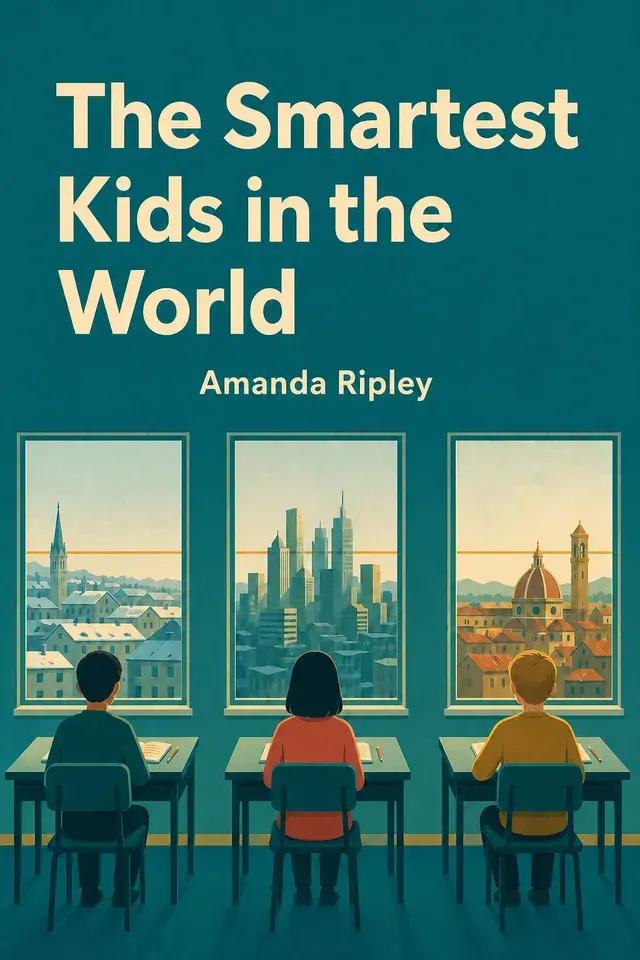
Key ideas from The Smartest Kids in the World
These ideas compress the book's argument without treating the author's view as settled fact. Use them as an orientation before reading the full work or listening in Wiseley.
PISA measures how students apply knowledge, interpret evidence, communicate reasoning, and solve practical problems rather than recall alone.
Long school days, family spending, and private tutoring helped produce strong results, but rankings also made exhaustion, inefficient effort, and inequality part of the design.
Mathematical ability is developable, and serious expectations can raise the ceiling for ordinary students.
Finland’s trust in teachers rests on selective recruitment and demanding preparation completed before schools receive broad autonomy.
Academic drive is socially shaped by family coaching, peer norms, and a shared public purpose for rigorous learning.
Gettysburg shows that removing a low track cannot substitute for common rigor, strong teaching, equitable resources, and ambitious school purpose.
Equity combines high expectations with early, need-based support rather than treating unequal preparation as a reason for softer standards.
Joyful rigor joins demanding, truthful learning with autonomy, meaningful work, capable teachers, and equitable access.
How The Smartest Kids in the World builds its case
Follow how the book develops its argument. Each note is a brief orientation, not a replacement for the chapter.
The Mystery of Unequal Learning
Why can children in similar-looking schools learn so much more—or so much less—than one another? And why can countries with similar resources produce sharply different results?
Measuring Learning Beyond Memorization
Before the book compares countries, it needs a way to compare learning. PISA is useful because it asks a harder question than whether students remember what school presented.
When Standards Lose Meaning
In Sallisaw, Oklahoma, the American education problem is easy to miss. The town has highway commerce but remains small, rural, and poor.
Korea's Productive Pressure
South Korea's high achievement did not come from an ancient national gift. Ripley describes a country that, in the nineteen-fifties, was largely illiterate, with weak scientific and mathematical infrastructure, very large classes, too few teachers, and limited access to middle school.
Math Reveals the Rigor Gap
Math is where an education system’s promise becomes visible. A student cannot reason with algebra, probability, or geometry if earlier pieces never became secure.
Finland's Trustworthy Teachers
Finland’s low-pressure schools can look like a paradox. Students have free time, teachers have broad discretion, and classrooms may lack the technology Americans associate with innovation.
The Social Engine of Drive
Formal rigor does not pull students forward by itself. A demanding curriculum or consequential exam can set a standard, but sustained effort also needs a social environment that makes the standard believable.
Poland's Experiment in Equal Challenge
Poland offers a useful change-over-time case. Its education system improved while the country was still carrying severe burdens.
Equity Without Lowering Expectations
The hardest test of Finland’s model is whether rigor can be shared across race, immigration, ability, poverty, and family background. That means separating equal expectations from equal treatment.
Markets, Credentials, and Consequences
School becomes most concrete when it meets the adult economy. South Korea’s hagwon industry shows how competition can reward responsive instruction, yet turn unequal access to tutoring into a race for scarce credentials.
What World-Class Schools Require
If the comparisons in this book lead anywhere, they lead to a practical question: what should a serious, fair, and enjoyable school look like? Ripley’s answer is joyful rigor.