What you'll learn
Key ideas from Silent Spring
These ideas compress the book's argument without treating the author's view as settled fact. Use them as an orientation before reading the full work or listening in Wiseley.
Carson's central framework is ecological interdependence: altering one part of the living world can endanger relationships beyond the intended target.
Persistence and slow excretion can turn small exposures into accumulating body burdens.
Groundwater links pesticide use across wells, springs, streams, and rivers, even when contamination remains invisible or its route is uncertain.
Weak evidence, limited consultation, and underfunded investigation made collateral deaths a failure of public authority.
Bird populations may decline through reproductive failure and secondary poisoning even when some adults survive exposure.
Labels and tolerances cannot guarantee safety when mixed exposures, missing tests, fragmented jurisdiction, and weak recourse remain.
Heritable resistance spreads across generations and turns repeated chemical use into a treadmill of replacement compounds.
The chapter defines pest control as ecological guidance that strengthens natural checks through precise, species-aware interventions.
How Silent Spring builds its case
Follow how the book develops its argument. Each note is a brief orientation, not a replacement for the chapter.
A Fable, Then a Thesis
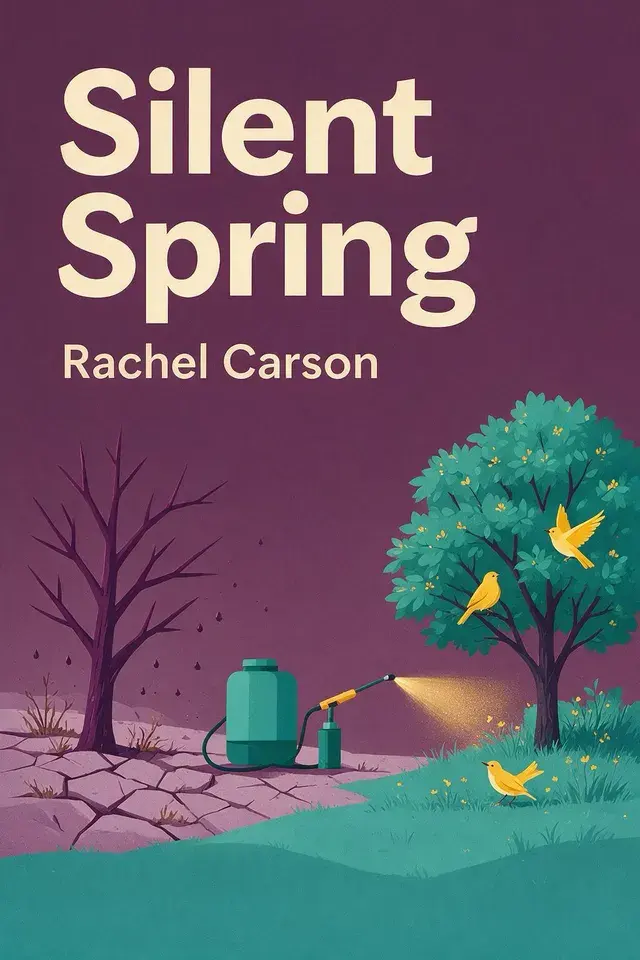
Imagine an American town where farms, forests, streams, domestic animals, wildlife, and seasonal beauty seem to belong to one healthy whole. Then a strange blight settles over it.
The Chemistry of Ubiquitous Risk
To understand why synthetic pesticides cannot be judged by a quick kill or an absence of immediate symptoms, Carson asks us to follow a chemical through time. The important questions are how long it remains, where it is stored, what it becomes, how it enters the body, and what happens when it meets other substances.
Water, Soil, and Living Systems
Water may seem abundant, but most of the planet’s water is saline and unusable for ordinary drinking, farming, or industry. That leaves usable supplies vulnerable to shortage and contamination.
Eradication Without Evidence
Before asking whether a pesticide kills the intended pest, Carson asks why the campaign was authorized. Large-area control treats a plant, an insect, or its surrounding community as an obstacle.
Wildlife Cascades and Dead Rivers
One of the clearest warnings in Silent Spring is that a pesticide need not kill only the organism it targets. In sprayed communities, spring could arrive without the usual birdsong.
Spraying Becomes Everyday Exposure
After mass campaigns revealed how spraying could damage landscapes and communities, Carson widens the question. Exposure is not confined to the exceptional day when aircraft pass overhead.
The Human Price of Persistence
The argument about persistence now turns inward. Carson’s human-health concern is not limited to dramatic poisonings of highly exposed workers.
Nature Fights the Chemical War
The danger of an insecticide is not limited to what it kills on the day of application. Carson argues that chemical control can weaken the living defenses that restrain pests, then create conditions in which the original problem returns in a stronger form.
The Other Road
After tracing how broad chemical campaigns can disrupt the relationships they claim to manage, Carson closes by asking whether pest control itself must be abandoned. Her answer is no.