What you'll learn
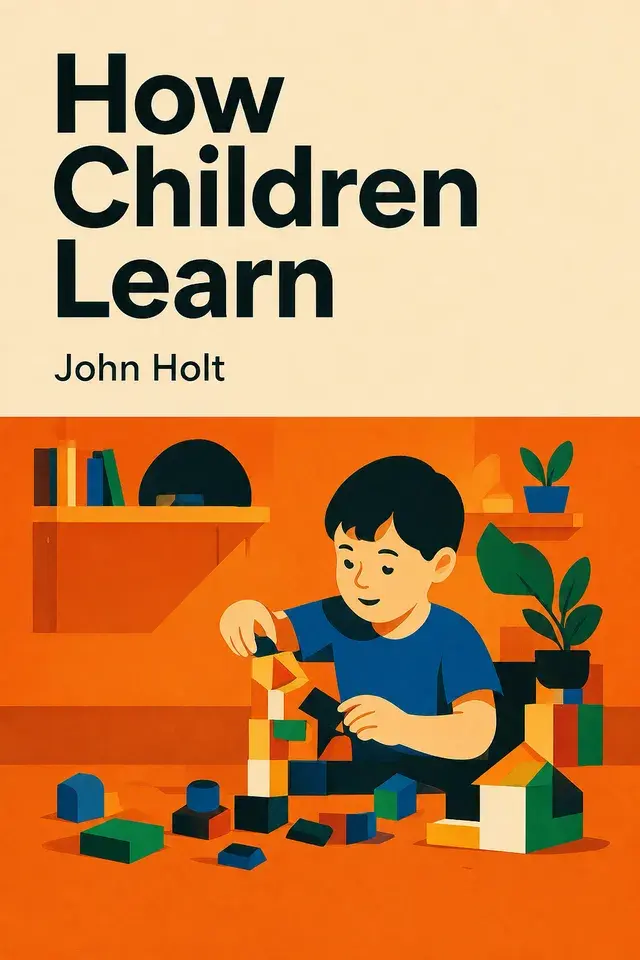
Key ideas from How Children Learn
These ideas compress the book's argument without treating the author's view as settled fact. Use them as an orientation before reading the full work or listening in Wiseley.
Children often learn boldly before school, while fear, compulsion, and fragmented tasks can train them to avoid learning.
Play gives children agency through imitation, role reversal, cause-and-effect games, and shared delight.
Real work and responsive apprenticeship give children visible purposes, while repetitive schooling and unsolicited teaching can interrupt ownership of inquiry.
Children develop language through vocal play, meaningful exchange, contextual hunches, and successive approximation rather than isolated subskills.
Meaningful print and real communication make reading and writing more intelligible than isolated skill drills.
Understanding develops from patient experience into a provisional mental model before deduction and explanation can reliably extend it.
Love and appreciative attention keep care relational, preserving children’s energy, imagination, and wonder as conditions of human learning.
How How Children Learn builds its case
Follow how the book develops its argument. Each note is a brief orientation, not a replacement for the chapter.
Trust Before Technique
John Holt opens with a simple question: what do children do before schooling, and what allows that learning to continue? He begins not with technique, but with observation.
Curiosity, Play, and Agency
To an adult, a child who touches, pulls apart, or repeats an action may seem distracted. Holt treats these acts as beginnings of knowledge.
Tools, Work, and Inquiry
Here Holt traces a path from operating a thing to understanding it. For young children, meaning often comes after action.
Language Needs a Listener
Language, in Holt’s account, does not begin as a lesson in sounds, labels, or rules. It begins in the body: a child discovers what breath, voice, lips, tongue, and rhythm can do, then repeats sounds because they are interesting to hear and feel.
Reading by Meaning
Once spoken language is understood as making meaning with other people, Holt turns to the printed page. Reading is not a staircase of isolated skills, he argues, but another form of communication: marks carry someone’s speech or thought, and the reader recovers their meaning.
Courage Learns in Cycles
Physical learning does not move smoothly. In Holt’s account, courage rises, falls, and returns.
Making Thought Visible
Children do not learn to draw simply by looking at a thing. Holt opens this discussion with two first-grade girls: one draws a large tree, while the other says she does not know how.
Fantasy Builds Reality
Holt’s central point is easy to miss: children use fantasy not to escape reality, but to enter it. Pretend play lets them borrow adult powers in manageable form.
Experience Before Explanation
Across this book, Holt’s theory of learning can be stated as an order of operations. Experience comes first: a learner sees, handles, listens, tries, notices consequences, and returns to the problem.
Love, Freedom, and Trust
At the end of How Children Learn, Holt turns from the processes of learning to the moral question beneath them: what kind of relationship should adults have with children? His conclusion rests on careful personal observation and reports from parents.