What you'll learn
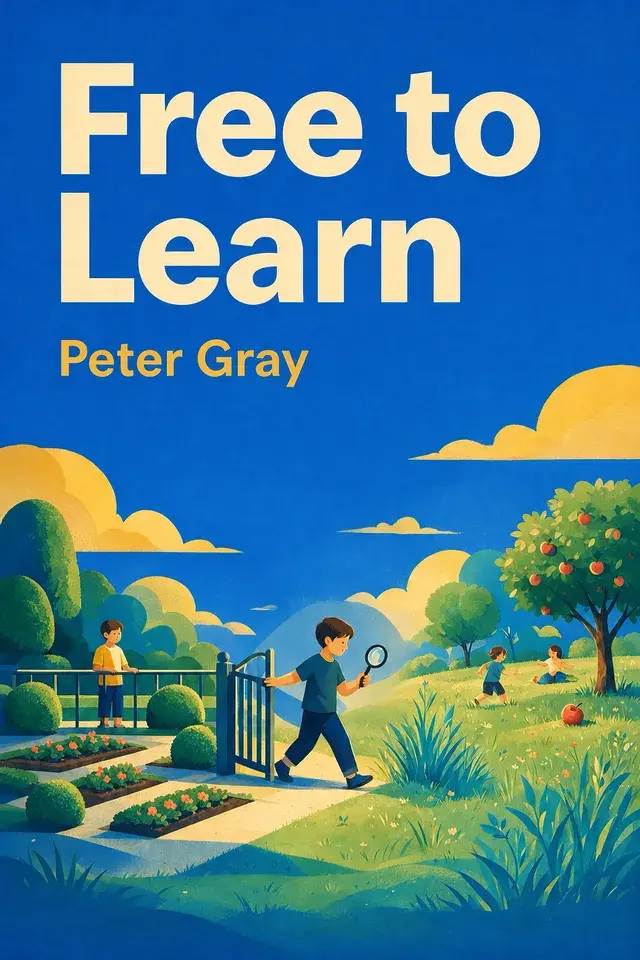
Key ideas from Free to Learn
These ideas compress the book's argument without treating the author's view as settled fact. Use them as an orientation before reading the full work or listening in Wiseley.
Free play is structured by children themselves, giving them room to choose activities, revise rules, solve problems, and experience personal control.
Modern schooling appears as a historical product of subsistence change, hierarchy, religion, industry, and state power.
Evaluation turns learning into anxious performance, making shame, cheating, and a students-versus-system mentality intelligible consequences.
Sudbury Valley gives students real authority over school rules, staffing, spending, activities, and due process.
Curiosity initiates exploration, playfulness turns discovery into practice and creation, and sociability carries knowledge through peer networks.
Informal peer play turns self-control, negotiation, and perspective-taking into lived practice governed by children’s continuing consent.
Trustful parenting treats children as competent agents and gives them love, resources, privacy, safety, and requested help without directing a parent-designed future.
How Free to Learn builds its case
Follow how the book develops its argument. Each note is a brief orientation, not a replacement for the chapter.
Childhood’s Lost Freedom
Gray begins with a family crisis that changed the direction of his work. His son Scott resisted compulsory schooling in deliberate ways.
How Obedience Became Education
Modern schooling can seem like a permanent feature of human life. Gray argues that it is neither timeless nor inevitable.
The Seven Costs of Coercion
Gray’s critique starts with a blunt question: what happens when education is compulsory? He argues that school is not merely an imperfect teaching method, but involuntary confinement.
A Democratic School That Works
To test whether his theory works in real life, Gray turns to Sudbury Valley School. Daniel Greenberg and other parents founded it in nineteen sixty-eight as a democratic institution consistent with American principles.
The Drives Behind Learning
How can a child learn enough to participate in a complex culture when nobody assigns a complete curriculum? Gray begins with a practical answer from Sugata Mitra’s computer experiments.
Play, Peers, and Development
Gray’s central social claim is that free play with other children functions as a small society. Children must make decisions, regulate emotion and impulse, take others’ perspectives, negotiate, make friends, and retain control of the activity.
Trustful Parenting in Practice
Once a parent accepts that children can direct much of their own development, the practical question changes. The task is not to design a child’s future, but to create conditions in which the child can take ownership of life.
A Voluntary Educational Future
Gray’s closing vision is a society where education once again belongs to the learner. He does not present this as a finished blueprint.