What you'll learn
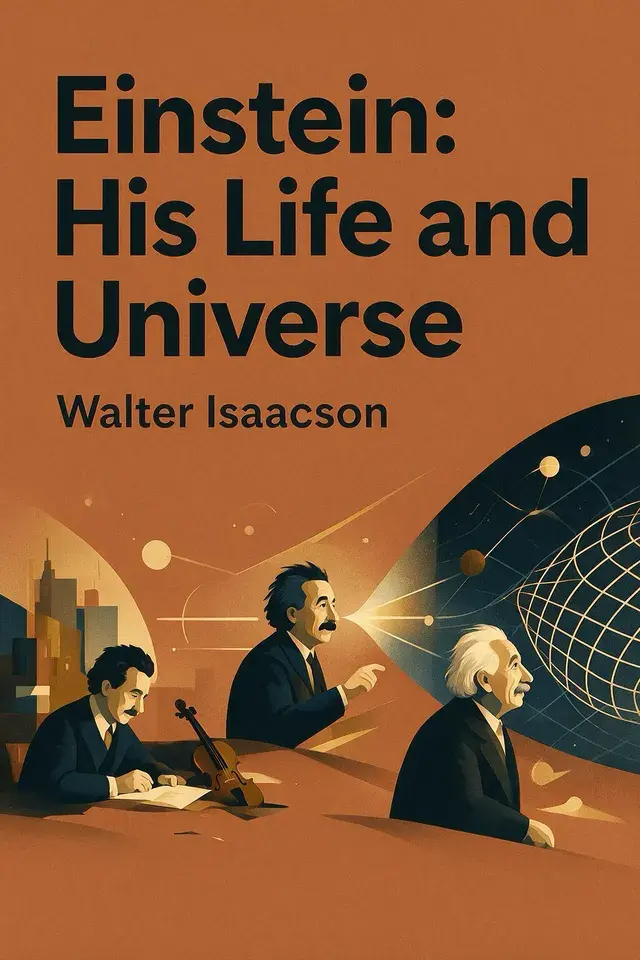
Key ideas from Einstein: His Life and Universe
These ideas compress the book's argument without treating the author's view as settled fact. Use them as an orientation before reading the full work or listening in Wiseley.
Einstein’s originality grew from childhood wonder, visual imagination, philosophical skepticism, and a search for hidden order.
Grossmann’s network and the Bern patent office supplied a salary, practical problems, and time for independent theory.
Einstein’s 1905 program replaced ether, absolute time, and continuous light with principles tied to observable consequences.
The equivalence principle turned gravity into a problem of curved spacetime, but Riemannian mathematics and collaboration were needed to express the insight.
Antisemitism pushed Einstein toward Jewish solidarity and Zionist work without erasing his internationalism or skepticism about nationalism.
The Copenhagen interpretation’s probability and measurement-centered realism conflicted with Einstein’s commitments to causality, separability, and an objective world.
Einstein’s pacifism shifted from absolute refusal to conditional defense while preserving peace and freedom as the ultimate aims.
Einstein’s signature helped turn Szilárd’s fission warning into government action, but his wartime role remained indirect and technically limited.
How Einstein: His Life and Universe builds its case
Follow how the book develops its argument. Each note is a brief orientation, not a replacement for the chapter.
The Mind That Questioned Authority
Einstein’s originality did not arrive as a miracle, and his childhood does not fit the later legend of a failed student. Isaacson presents a developmental explanation: a distinctive temperament met particular books, teachers, music, and schools, gradually becoming a method for questioning assumptions.
After Graduation: Partnership, Work, and the Patent Office
Graduation in 1900 did not deliver Einstein into academic physics. He had no teaching post, research record, or patron, and was the only graduate in his section without an assistantship.
The Miracle Year Rewrites Nature
By 1905, physics had a structural problem. Newtonian mechanics offered a causal picture of matter in motion, while Maxwell's equations described electricity and magnetism as fields that propagated as light.
From Academic Ascent to Curved Spacetime
After nineteen oh five, Einstein’s scientific reputation rose faster than his professional standing. Special relativity covered only uniform motion and left Newtonian gravity outside the theory.
Eclipse, Fame, and Jewish Belonging
General relativity became publicly credible before it became publicly intelligible. Einstein’s 1915 equations predicted that starlight passing close to the sun would be deflected by about one point seven arcseconds, roughly twice Newton’s value.
Quantum, Reality, and the 1920s Turn
After the Nobel and early-1920s public arc, Einstein’s central transition unfolded inside physics. His relation to quantum theory was not a clean rejection.
1930–33: Exile and the Revision of Pacifism
By the early 1930s, Einstein’s politics formed a qualified whole. He was a militant pacifist, internationalist, anti-racist, defender of individual freedom, and supporter of social justice.
Princeton: Refuge, Fame, and Responsibility
Once the American refuge became permanent, Princeton offered Einstein something rare: protection with room to be left alone. He had expected his 1933 stay to be temporary, but never returned to Europe.
The Completeness Problem
By the 1930s, Einstein’s quarrel with quantum mechanics was less about whether its calculations worked than about what they meant by reality. His thought experiments did not refute the theory.
The Atomic Age and Free Minds
Fission created a political problem before it created a weapon. When uranium experiments made a self-sustaining chain reaction plausible, Leo Szilárd and Eugene Wigner feared that Germany might gain access to uranium and turn the discovery into a bomb.
An Unfinished Theory and a Free Mind
Einstein’s final scientific years were marked by persistence without success. He kept walking to the Institute with scraps of equations, testing them against Bruria Kaufman’s objections.