What you'll learn
Key ideas from John Adams
These ideas compress the book's argument without treating the author's view as settled fact. Use them as an orientation before reading the full work or listening in Wiseley.
Education, law, and the diary turned repeated failure and self-criticism into habits of preparation, inquiry, and resistance to arbitrary power.
Abigail’s intelligence, candor, labor, and steadiness made marriage an equal partnership that enlarged Adams’s capacity for public duty.
Adams’s Boston Massacre defense made fair process a public test, even when defending unpopular soldiers damaged his reputation and practice.
Thoughts on Government translated revolutionary purpose into checks and balances, executive authority, an independent judiciary, and public education.
French aid helped defeat Britain, but its strategic purpose also encouraged American dependence, making diplomatic autonomy a practical necessity.
The Alien and Sedition Acts converted wartime fear into repression, with the Sedition Act targeting political speech.
Adams’s conditional peace mission ended the Quasi-War but fractured Federalist support and arrived too late to save his reelection.
Books and correspondence turned Adams’s retirement into an active intellectual vocation shaped by argument, friendship, and religious reflection.
How John Adams builds its case
Follow how the book develops its argument. Each note is a brief orientation, not a replacement for the chapter.
Virtue Before Revolution
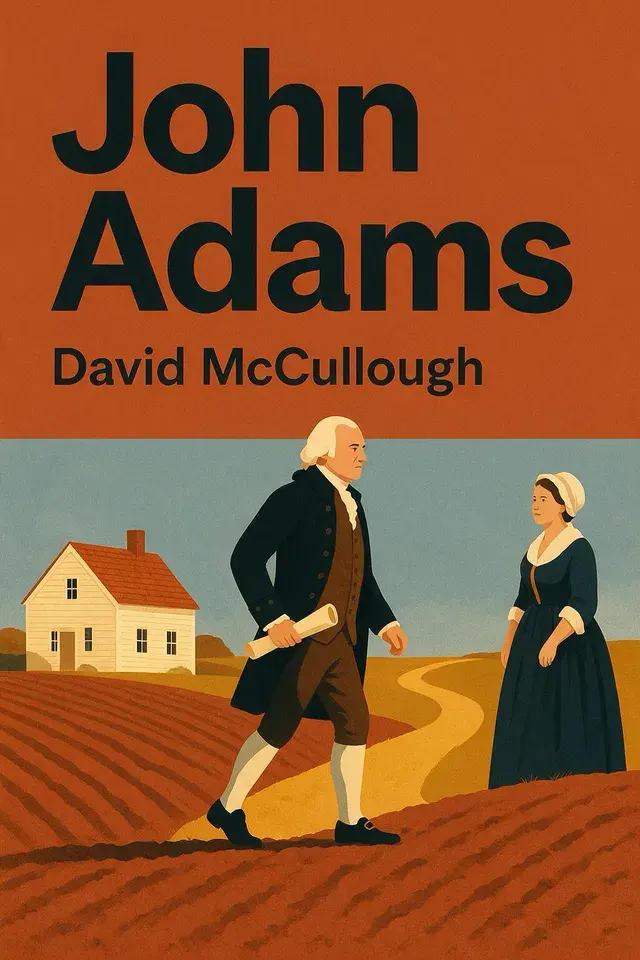
At the opening of David McCullough’s account, John Adams is a forty-year-old Braintree lawyer, farmer, Harvard graduate, husband, father, and revolutionary. The war has pulled him from a local life into national decisions, but he is not presented as a finished statesman.
Liberty Under Fire
John Adams’s transformation into a revolutionary leader began with a decision that many Bostonians saw as betrayal. Crowds gathered at Boston’s Custom House, pelted British soldiers, and met gunfire that killed five men.
Independence Made Governable
Independence emerged from argument under pressure, not a single flash of agreement. In 1776, Congress faced military reverses, disease, trade restrictions, and British and German forces.
Duty, France, and a Constitution
Adams’s first mission to France began with a sacrifice already paid at home. Wartime inflation, shortages, and scarce labor made household and farm management harder.
Dutch Credit, American Leverage
Adams’s second European mission exposed a contradiction. Congress sent him to France to negotiate peace and commerce, yet American independence depended on an ally pursuing its own interests.
Peace, Europe, and Constitutional Design
The peace settlement did more than end fighting; it tested whether the new country could act for itself. In Paris, Adams, Franklin, and Jay negotiated with Britain without waiting for French direction, despite congressional instructions and the French-American alliance.
Building the Federal Republic
Adams returned to the United States with a theory of constitutional compromise and a practical test ahead. The Constitution, he believed, need not satisfy every ideal if it protected order, liberty, and safety, while leaving room for amendment.
Neutrality Against the Factions
During Washington’s second term, Adams found the vice presidency a lonely vantage point on a government splitting into parties. Abigail stayed in Quincy because travel was difficult, her health needed care, and the household had to protect its independence.
Peace Against the War Party
John Adams entered the presidency in 1797 with a narrow electoral margin, an inherited cabinet, and a deteriorating relationship with France. The French Directory had refused to receive Charles Cotesworth Pinckney, while seizures of American ships created an undeclared maritime war.
Defeat, Retirement, and Family Continuity
Defeat did not end John Adams’s public meaning; it changed the setting in which that meaning had to survive. On inauguration day in 1801, he left Washington by stage at four in the morning, eight hours before Thomas Jefferson took the oath.
Faith, Memory, and Final Legacy
In old age, Adams found that public service could continue without office. It moved into books, letters, memory, and judging his own life.