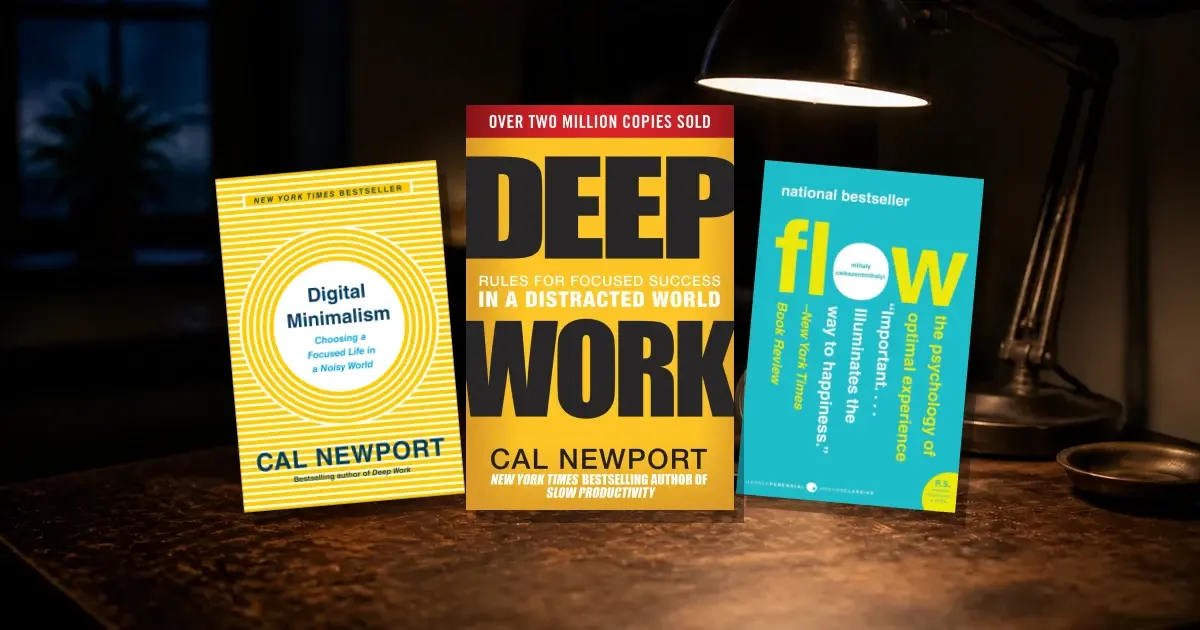
What Deep Work is about
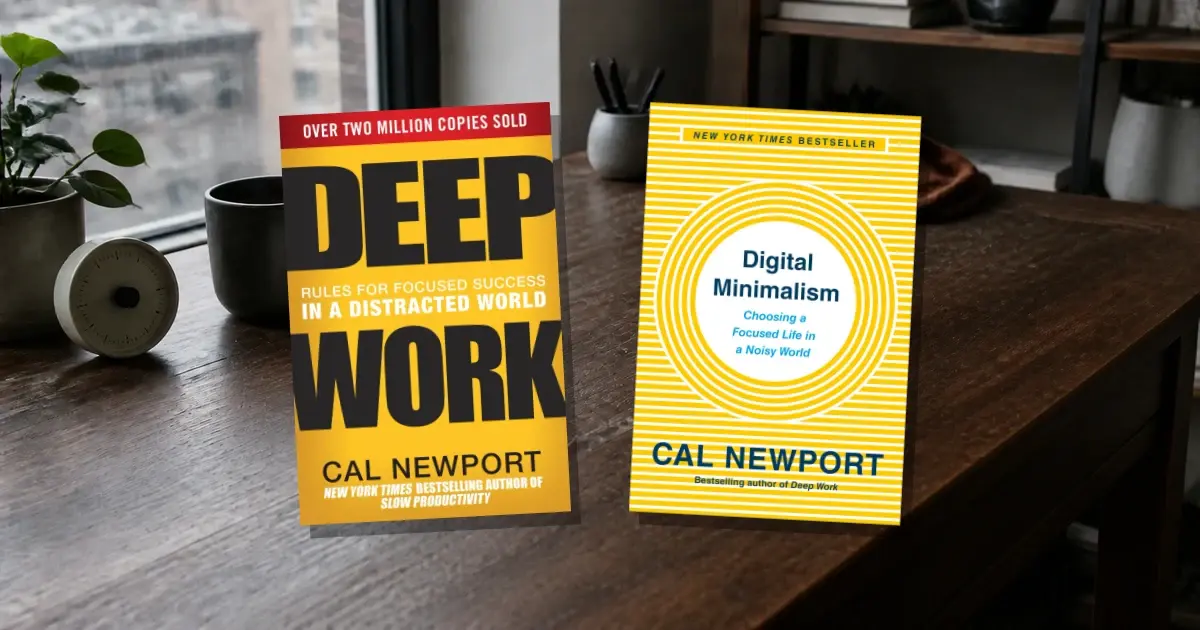
Deep Work is Cal Newport’s case that distraction-free concentration has become both rare and valuable, and that it can be trained rather than waited for. He separates deep work from shallow work, argues that switching leaves attention residue that degrades output, then sets out four rules for protecting depth. Wiseley’s summary follows that argument chapter by chapter.
Newport’s claim has two halves. The economic half is that an economy rewarding rapid learning and exceptional output favors people who can concentrate, while knowledge work’s weak measurement lets shallow activity survive as a proxy for productivity: inboxes answered, meetings attended, responsiveness visible. Because organizations neglect concentration, he argues, the ability to concentrate becomes a scarce individual advantage.
The second half is about meaning. Newport argues that sustained attention changes the quality of experience, joining difficult constraints, growing skill and craftsmanship into something worth choosing for its own sake. His four rules follow from both halves: work deeply through a ritual and a scheduling philosophy that fits your obligations, train concentration by tolerating boredom, judge each network tool against the few goals that matter most, and drain the shallows with scheduled time, a shallow-work budget and a fixed stopping hour.
What you'll learn
Key ideas from Deep Work
These ideas compress the book's argument without treating the author's view as settled fact. Use them as an orientation before reading the full work or listening in Wiseley.
Deep work is distraction-free effort at the edge of ability, while shallow work is logistical activity that usually creates less new value.
Deep work is becoming scarcer as digital activity expands while becoming more valuable to people who cultivate it.
Deep work makes meaning visible by joining difficult constraints, growing skill, and the satisfaction of craftsmanship.
A ritual specifies place, duration, rules, and physical supports that remove avoidable friction from each session.
Attention develops through repeated practice in resisting distraction, tolerating boredom, and returning to a chosen problem.
Network tools earn a place when their substantial benefits for a few central goals outweigh the time, attention, and opportunity costs they impose.
Deep work has a bounded daily capacity, so shallow obligations must be reduced rather than allowed to fill the schedule.
Fixed stopping times create scarcity that protects deep work by forcing deliberate commitments, aggressive culling of shallow obligations, and sharper organization.
A Wiseley example: one deep block in a calendar you do not control
Wiseley editors wrote this example to show one way to use Cal Newport’s argument. It is not taken from the book.
Take a week with meetings on four mornings. Instead of hunting for a clear day, name one output for the week: a draft, a model, a decision memo. Find the largest uninterrupted gap, often a ninety-minute stretch, and put that output in it on two days. Write the ritual down, so it needs no decisions: same room, phone in a drawer, one document open, a stated stopping time.
Then make your availability predictable rather than constant, with a stated window for replies and a short end-of-day note naming what is finished and what comes next. This is the scaled-down version, and deliberately so. Newport’s own point is that no scheduling philosophy is universal; this is the one that fits a meeting-heavy week.
How Deep Work builds its case
Follow how the book develops its argument. Each note is a brief orientation, not a replacement for the chapter.
The Case for Deep Work
Deep work is a modern name for an old way of working: giving one difficult thing your full attention long enough to change what you can do. Cal Newport opens with Carl Jung’s Bollingen Tower, established in nineteen twenty-two.
Why Depth Becomes Rare
Deep work has an awkward place in modern organizations. It can be valuable, yet workplaces often make it difficult to do.
Depth Makes Work Meaningful
Even if focused work improves learning and output, that economic argument does not explain why someone should choose a demanding life. Newport’s deeper claim is that depth changes the quality of experience.
Build a Deep-Work Ritual
Rule #1, Work Deeply, begins with a practical problem. Admiring concentration is not enough when work is surrounded by open offices, meetings, neglected inboxes, and pressure to respond quickly.
Make Deep Work Operational
Once a deep-work ritual has specified the setting and rules for a session, the remaining problem is execution. Real life brings interruptions, collaboration needs, deadlines, and tired minds.
Train the Mind to Concentrate
Rule #2 begins with a demanding premise: concentration is not a fixed personality trait. It is a skill that grows through repeated practice.
Choose Tools, Protect Leisure
Once attention is treated as something worth protecting, Rule #3 asks which network tools deserve a place in that protected space. The author avoids both permanent disconnection and automatic connectivity.
Drain the Shallows
After deciding which activities deserve attention, the next problem is managing the time left for them. Newport’s fourth rule, “Drain the Shallows,” starts from a practical asymmetry: deep work creates distinctive value, but its capacity is limited, while shallow obligations can spread until they fill the day.
Become Hard to Reach
Deep work ultimately needs a boundary around access to your time. Newport’s closing proposal is fixed-schedule productivity: choose a firm stopping time, then work backward to fit the job inside it.
Read it with these limits in mind
- Newport writes from and about knowledge work with some schedule control. The rules assume you can decline meetings, negotiate availability or set a stopping hour, which many jobs do not allow.
- The examples come largely from academics, executives, writers and programmers. The argument is not tested against shift work, care work, or roles whose value genuinely is responsiveness.
- Supporting mechanisms such as attention residue and myelination are the author’s reading of the research. Treat them as scaffolding for the argument rather than a settled account of how concentration works.
- Newport notes that an extreme period of deep work can carry a real cognitive cost, so the book is not an argument for maximizing focused hours without limit.
Who it helps, and when to read the whole book
Deep Work tends to be most useful to:
- Knowledge workers whose results depend on learning something hard or producing something original.
- Anyone who finishes a full day of activity and cannot name what they made.
- Managers deciding how much responsiveness a role actually requires.
Read the complete book when:
- You want the full case for each of the four rules, with the examples and research Newport cites.
- You are redesigning how a team communicates and need his chapters on shallow-work budgets and email protocols.
- You want the argument about craftsmanship and meaning, which a summary can only sketch.