What you'll learn
Key ideas from A Mind for Numbers
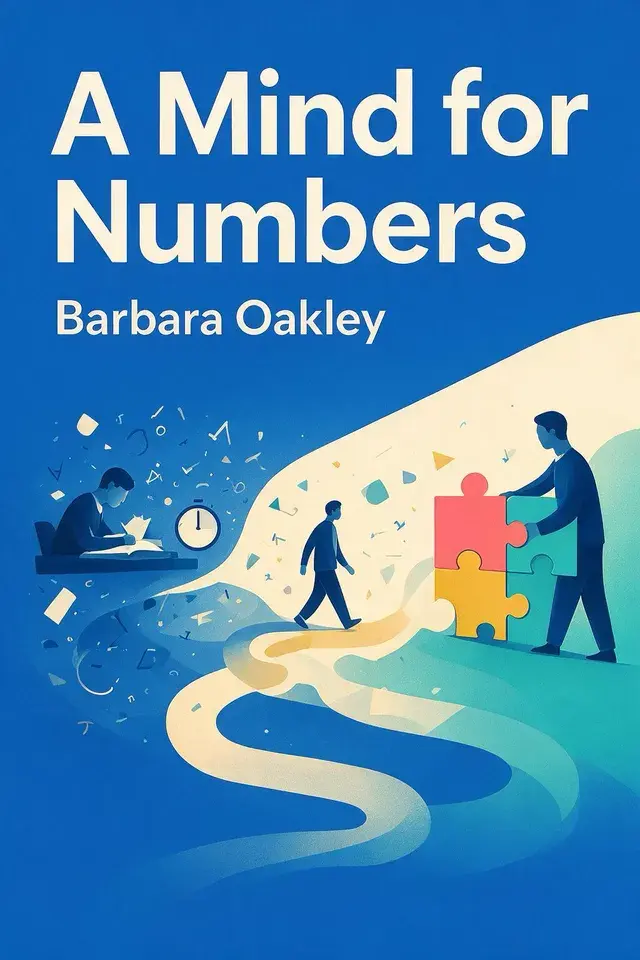
These ideas compress the book's argument without treating the author's view as settled fact. Use them as an orientation before reading the full work or listening in Wiseley.
Oakley’s movement from math avoidance to engineering expertise frames mathematical ability as developable rather than a fixed identity.
The focused and diffuse modes work as an exchange: preparation supplies material, and relaxed processing can reorganize it or reveal alternatives.
Understanding gives a chunk meaning; retrieval, varied context, and interleaving make it accessible beyond the example that introduced it.
Cue-controlled routines, device barriers, accountability, anticipated rewards, and process-focused Pomodoro intervals make starting finite and repeatable.
Vivid visual, spatial, sensory, verbal, and motor hooks make abstract facts and procedures more retrievable.
Abstract patterns transfer more readily across fields than isolated concrete examples, but transfer still requires adaptation and does not create automatic expertise.
Self-directed learning combines personal responsibility with formal and informal resources rather than rejecting either one.
Testing functions as both assessment and learning because retrieval reveals what preparation has made usable.
How A Mind for Numbers builds its case
Follow how the book develops its argument. Each note is a brief orientation, not a replacement for the chapter.
Ability Is Built, Not Bestowed
Mathematics and science can seem like territories that some people are born able to enter and others are not. A Mind for Numbers opens by challenging that division.
Focus, Diffuse Thought, and Insight
Why might a difficult problem become clearer when you stop looking at it? A Mind for Numbers answers with a model of attention.
How Understanding Becomes a Chunk
Learning becomes usable when a learner can hold a pattern without rebuilding it from scratch. Oakley explains the need through working memory, the small mental workspace for conscious processing.
Designing Work Against Procrastination
Oakley presents procrastination as a learned escape from discomfort. A task can feel unpleasant before it begins, especially mathematics.
Memory Systems That Make Knowledge Portable
Once a learner understands a difficult subject, another problem remains: important information must be available when the book is closed and the task changes. Oakley presents memory as something that can be designed.
Competence, Identity, and Transfer
Learning changes more than what a person can do. It can change what they believe they are, and where an idea can be used.
Self-Directed Learning, Mentors, and Reality Checks
Learning becomes more resilient when the learner is an active owner rather than a passive recipient. Oakley’s self-directed ideal does not mean learning alone or rejecting school.
Testing, Perspective, and Mastery
Learning is not complete when a page looks familiar or an answer looks recognizable. Performance asks whether knowledge can be retrieved and used when the book is closed, time is limited, and pressure is present.