What you'll learn
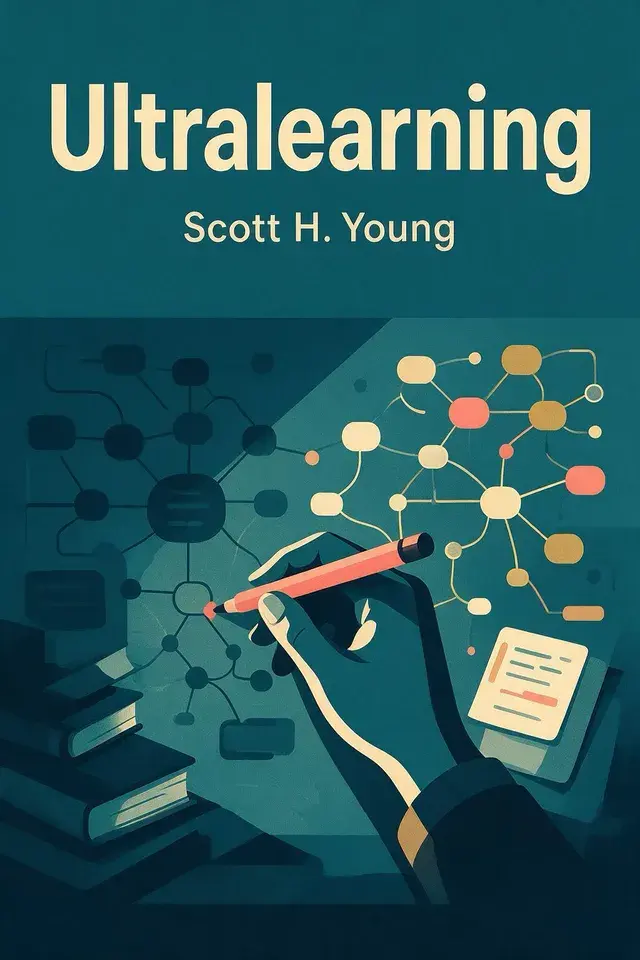
Key ideas from Ultralearning
These ideas compress the book's argument without treating the author's view as settled fact. Use them as an orientation before reading the full work or listening in Wiseley.
Why, What, and How connect motivation, required concepts, facts, procedures, and methods to the learner’s intended outcome.
Focus has separate starting, sustaining, and quality problems, so the remedy depends on diagnosing which obstacle is active.
Direct practice ties learning to the decisions and actions required in the target performance, reducing the distance that transfer must cross.
Overall progress is often governed by one rate-determining weakness, so the strongest drill target is the component with the greatest likely whole-skill gain.
Effortful retrieval generally strengthens learning more than passive review when recall remains difficult but recoverable.
Principles, pattern libraries, concrete models, struggle, and proof make knowledge more adaptable than memorized procedures.
Experimentation treats learning methods as hypotheses tested through deliberate variation, measurement, and retention of what works.
An ultralearning project links a narrow goal, deliberate preparation, scheduled work, adaptive execution, evidence-based review, and a deliberate next step.
How Ultralearning builds its case
Follow how the book develops its argument. Each note is a brief orientation, not a replacement for the chapter.
The Case for Deliberate Self-Education
Ultralearning is an intense, self-directed, action-oriented way to acquire knowledge and skill. The learner chooses a demanding goal, takes responsibility for the route, and treats knowledge as something to use.
Map the Learning Terrain
Tristan de Montebello’s public-speaking project shows how adaptable principles can guide a novel challenge. The next question is how to approach a project whose path is not clear.
Build Attention on Purpose
After a learner maps a project, the next requirement is making attention available for it. Young separates focus into starting, sustaining, and creating the quality the task needs.
Practice the Real Performance
Study can feel productive while leaving a learner unprepared for the moment that matters. Someone may read about communication without presenting, learn a language through an app without speaking, or collect programming lessons without building.
Attack the Bottleneck
Whole-skill practice exposes the real challenge, but it can leave the cause of failure blurry. Someone can understand mathematical concepts, remember procedures, and know when they apply, yet stall because arithmetic or algebra is too slow.
Make Learning Retrievable
Exposure is not the same as possession. A passage can feel familiar while its ideas disappear when no cues are available.
Keep What You Learn
Learning is not complete when you can produce an answer once. It becomes useful when an answer, procedure, or skill remains available after the immediate project and its cues have faded.
Understand, Don’t Just Recognize
Understanding begins before truth. Scott H. Young presents the eighth principle as a demand to ask what a statement means before deciding whether it is true. Recognition is weaker: a familiar formula, paragraph, or procedure can feel understood because it looks familiar. Deep understanding connects an idea to mechanisms, examples, and principles, so it can guide thought when the surface form changes. Richard Feynman provides the chapter’s central case. Mark Kac distinguished ordinary geniuses, whose achievements…
Experiment Toward Mastery
Mastery usually begins with imitation. A beginner needs examples, established methods, and a manageable route through a new field.
Run Projects, Then Expand
By the end of Ultralearning, the principles form an operating loop. A project begins with a concrete result and narrow scope, then moves through research, scheduled practice, adaptive execution, review, and a decision about what happens next.