What you'll learn
Key ideas from Dead Wake
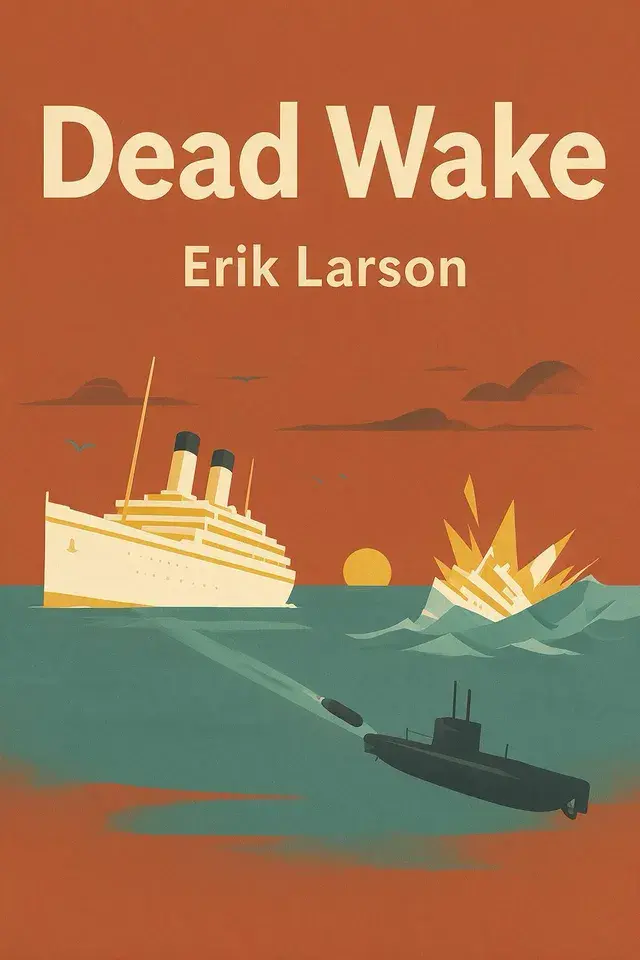
These ideas compress the book's argument without treating the author's view as settled fact. Use them as an orientation before reading the full work or listening in Wiseley.
The Lusitania represented commercial luxury, national pride, speed, and confidence in modern engineering.
Prize law treated maritime combat as a regulated sequence of stop, search, protect, and prize-court capture; submarines made those rules difficult to apply.
Room 40 could decode, track, and profile German operations, but secrecy made using its knowledge a structural dilemma.
Room 40 tracked U-20, but its intelligence did not become a clear warning, escort, diversion, or safer route for the Lusitania.
One strike became catastrophic through flooding, listing, lost propulsion, failed systems, and evacuation decisions made under severe time pressure.
The Admiralty’s effort to blame Turner obscured its own failures and the Room 40 intelligence it kept secret.
American war followed renewed sinkings, the Zimmermann telegram, and the wider 1917 crisis rather than the Lusitania alone.
How Dead Wake builds its case
Follow how the book develops its argument. Each note is a brief orientation, not a replacement for the chapter.
The Liner and Its Illusion
The Lusitania first appears in Dead Wake not as a doomed ship, but as a persuasive argument about modern life. Built for Cunard’s North Atlantic service, she carried nearly two thousand people, displaced more than forty-four thousand tons, and could exceed twenty-five knots.
A New Kind of War
To understand why a passenger voyage could become an international crisis, start with the old rules of war at sea. Nineteenth-century prize law assumed that a surface warship could stop and search a merchant vessel, protect its crew, and take the ship before a prize court.
Intelligence Without Action
By 1915, the submarine had become powerful enough to change naval warfare, but it was not a dependable machine. U-20 was a narrow steel cylinder packed with ballast tanks, engines, fuel, batteries, torpedoes, pipes, cables, gauges, and a crew with little room to move.
Routine Inside a Danger Zone
On May first, nineteen fifteen, the Lusitania left New York through a harbor where war and commerce coexisted. Interned German liners and crowded ferries made conflict visible, yet the departure looked like an ordinary public spectacle.
How Catastrophe Cascaded
The attack did not become inevitable simply because Lusitania entered a war zone. It required a narrow convergence of timing, navigation, visibility, and assumptions about speed.
The Sinking's Long Afterlife
The Lusitania’s story did not end when the hull disappeared. Survivors drifted in water of about fifty-five degrees for roughly three hours, while small torpedo boats, trawlers, and fishing vessels assembled the rescue.