The quick answer
Read Steve Jobs for a concentrated study of product integration: technology, design, storytelling, and a closed ecosystem shaped into one experience. Read Elon Musk for a wider study of mission-driven risk across software, cars, rockets, satellites, social media, and artificial intelligence. Isaacson finds a family resemblance in their urgency and appetite for impossible deadlines, but the books do not show that harshness caused every breakthrough—or that copying it would reproduce the results.
- Product taste and integrated experience: Steve Jobs.
- Scale, manufacturing, and repeated all-in bets: Elon Musk.
- A clean leadership recipe: neither biography provides one.
Their ambition works through different mechanisms
Jobs repeatedly narrows attention until hardware, software, typography, packaging, and launch theater express a coherent judgment. Musk repeatedly expands the boundary of the problem, questions cost assumptions, pushes work closer to the physical system, and accepts existential company risk. Both methods can mobilize exceptional effort. Both also create predictable failure modes: Jobs’s reality distortion field produces fear and unstable judgment, while Musk’s crisis cadence can make exhaustion and conflict part of ordinary operations.
- Jobs asks whether every element belongs to one experience.
- Musk asks which physical or organizational constraint can be removed.
- In both accounts, collaborators supply expertise that founder-centered stories can obscure.
Extract principles, not a personality
Compare one consequential decision from each book by separating mission, mechanism, evidence, and cost. A useful lesson might be hidden craftsmanship, rapid feedback from the factory floor, or willingness to simplify a product. “Be more extreme” is not a mechanism. Keep the biographies’ counterevidence in view: damaged trust, family harm, weak governance, expensive reversals, and teams that succeeded through skills no founder possessed alone.
- Name the specific practice before calling it visionary leadership.
- Record who absorbed the practice’s cost and who could challenge it.
- Test a bounded version with feedback instead of performing the founder’s temperament.
Sources and scope
Book ideas are attributed to their authors. External evidence is linked directly when a claim needs more than the source book.
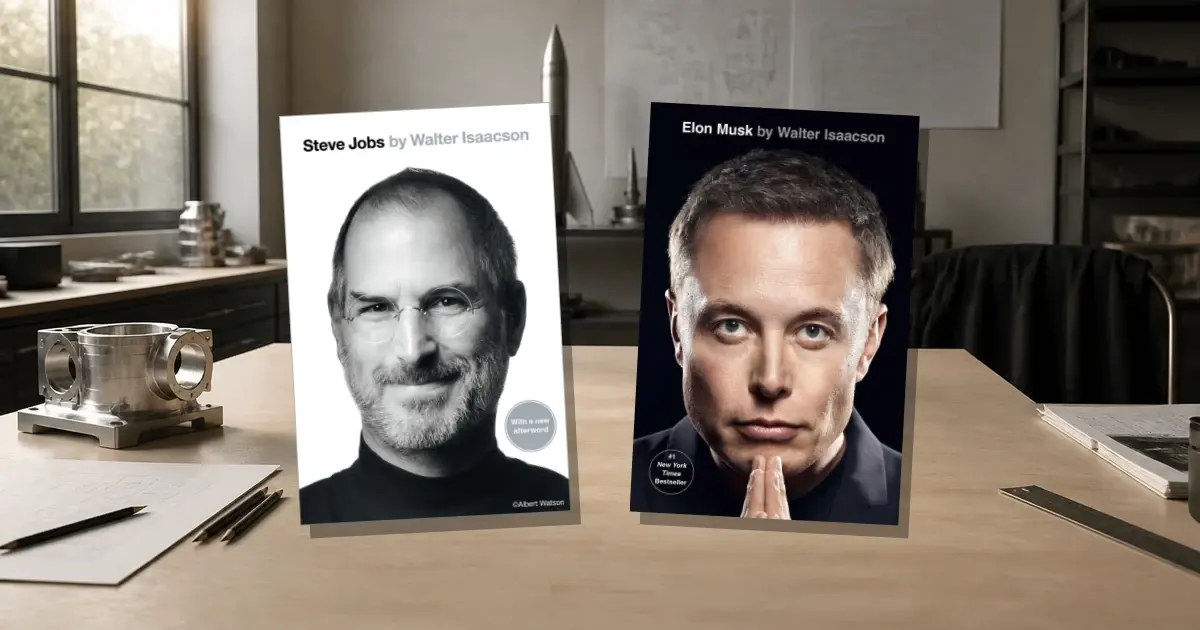
- Steve Jobs: Primary source for Jobs’s product integration, reality distortion field, partnerships, and personal costs.
- Elon Musk: Primary source for Musk’s mission-driven risk, manufacturing methods, crisis cadence, and public power.
To report a factual, attribution, rights, or accessibility concern, email hello@wiseley.app.
Questions readers ask
Which biography is better for product leaders?
Steve Jobs stays closer to product coherence and the tension between taste and collaboration. Elon Musk adds manufacturing, capital intensity, infrastructure, and public power. Choose the operating environment closest to your question.
Do the biographies argue that difficult behavior is necessary for innovation?
No. They document intensity alongside achievement, but also show partners, engineers, institutions, timing, and capital doing essential work. Association inside a life story does not prove that harm caused the outcome.