What you'll learn
Key ideas from Blue Ocean Strategy
These ideas compress the book's argument without treating the author's view as settled fact. Use them as an orientation before reading the full work or listening in Wiseley.
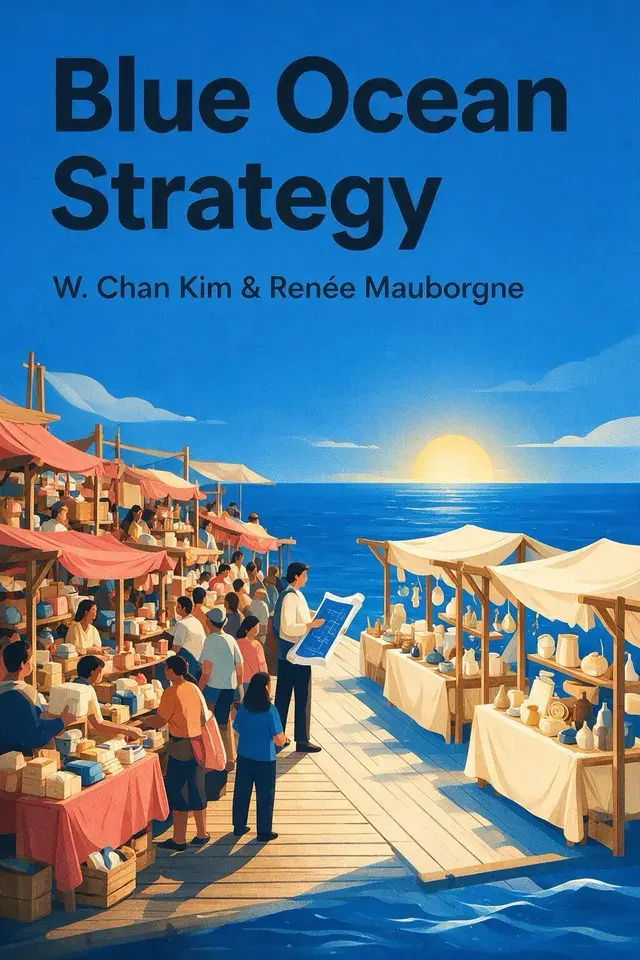
Red oceans divide existing demand within familiar industry boundaries, while blue oceans create new demand and market space.
Value innovation aligns utility, price, and cost to create a leap in buyer and company value while pursuing lower cost.
The Four Actions Framework asks which factors to eliminate, reduce, raise, and create when redesigning buyer value.
Blue-ocean growth begins by examining noncustomers and shared buyer needs before refining existing market segments.
The strategic sequence begins with exceptional buyer utility, then tests a mass-market price, target cost, and adoption.
Fair process combines engagement, explanation, and expectation clarity; none of the three establishes fairness alone.
Red and blue oceans coexist, requiring competition in current markets alongside systematic renewal through value innovation.
How Blue Ocean Strategy builds its case
Follow how the book develops its argument. Each note is a brief orientation, not a replacement for the chapter.
From Red Oceans to Blue
Business strategy is often framed as a contest. A firm enters an established market, accepts its boundaries, and tries to win customers from rivals.
The Value Innovation System
Value innovation is the operating logic at the heart of a blue ocean strategy. It means pursuing a leap in buyer value and company value at the same time.
See the Strategy Canvas
The strategy canvas is presented as a practical way to make an industry’s strategy visible. It maps the factors on which companies compete and invest, then shows the level of value buyers receive across those factors.
Design a Distinct Value Curve
To design a distinct value curve, the chapter starts with four questions. What should the industry eliminate because it has long competed on factors that may no longer create value?
Cross the Boundaries of Demand
Blue oceans often appear when a company stops treating industry boundaries as natural. Kim and Mauborgne describe six paths for reconstructing those boundaries.
Reframe the Total Solution
The six paths are completed by shifting attention from the product to the customer’s total problem. The fourth path examines complementary products and services: what shapes the experience before, during, and after use.
Make Strategy Visible
Blue-ocean strategy asks managers to see the whole strategic picture before they disappear into budgets, spreadsheets, and tactical plans. The authors call this the second principle: focus on the big picture, not the numbers.
Reach the Noncustomer Mass
Blue ocean strategy’s third principle is to reach beyond existing demand. The authors argue that companies often begin with current customers, then divide them into ever narrower segments.
Test Utility and Price
The authors place buyer utility at the beginning of a blue-ocean idea’s strategic sequence. The sequence then moves to strategic price, target cost, and adoption.
Build a Profitable Blue Ocean
An attractive value proposition does not automatically make a blue ocean profitable. The authors complete the strategic sequence with a business-model test.
Lead Through Tipping Points
Blue Ocean Strategy treats execution as a strategic problem, not an administrative afterthought. Its fifth principle is to overcome the key organizational hurdles that keep a new value proposition from becoming action.
Make Execution Fair
Blue ocean strategy is not complete when leaders design an offering. The sixth principle is to build execution into strategy from the beginning.
Renew Before Blue Turns Red
Blue oceans do not last forever. A successful value innovation can create a period with little credible challenge, but visible performance eventually attracts imitators.
History of Repeated Reinvention
The appendix offers a deliberately limited historical sketch of automobiles, computers, and movie theaters. Its purpose is not to provide a complete history.