What you'll learn
Key ideas from Build
These ideas compress the book's argument without treating the author's view as settled fact. Use them as an orientation before reading the full work or listening in Wiseley.
General Magic shows that extraordinary technology can fail when it outruns customer need, infrastructure, and timing.
Customer pain can redirect a product path, while technical quality still depends on sales, placement, incentives, and distribution.
The product is the complete customer journey, from discovery through post-purchase support and eventual exit, not only the device.
V2 uses customer evidence to improve execution and evolution while preserving the product’s defining identity.
A durable idea has a clear why, widespread pain, persistent pull, and researched risks that still merit judgment and commitment.
Practical balance accepts temporary intensity while protecting sleep, health, recovery, and nonwork attention.
Stewardship includes clear succession, clean transfer of authority, learning from failure, and measuring a life by products and people.
How Build builds its case
Follow how the book develops its argument. Each note is a brief orientation, not a replacement for the chapter.
Learn by Taking Risks
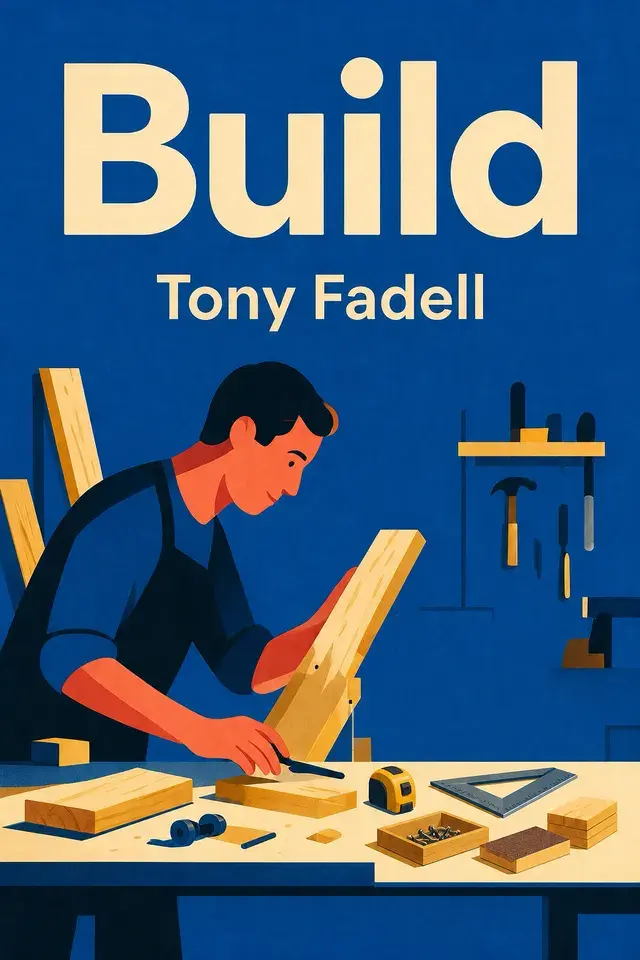
Build begins before there is a product, company, or title. In Tony Fadell's view, the first project is becoming capable enough to make something real.
See the Whole System
Build by Tony Fadell argues that a job becomes meaningful through its people, not compensation, perks, or titles. Career choice is partly a search for capable, curious, humble collaborators.
Judgment, Conflict, and Exit
Uncertain work creates two temptations: keep searching for proof, or move ahead on instinct and pretend it is certainty. The author proposes a middle path.
Design the Whole Experience
Fadell’s design lesson begins before sketches: start with the problem customers feel and the reason a solution should exist. Downloadable MP3 libraries let people store music digitally, but not conveniently play it through quality home equipment.
Disrupt, Then Execute
Tony Fadell frames product work as a balance among evolution, disruption, and execution. Evolution improves an existing thing; disruption changes the status quo; execution delivers the promise well.
From Fit to Profit
A product can be brilliant and still not be a business. Fadell’s rough rule is that apparent overnight successes usually take six to ten years.
Founders, Capital, and Focus
Before an idea becomes a company, the founder must make the surrounding conditions less fragile. Fadell says readiness cannot be proven in advance; it accumulates through exposure.
Carry Pressure Without Breaking
Fadell separates two ideas of work-life balance. The ideal is a near-mythical state in which work stays outside the rest of life.
Scale People and Structure
Growth changes the people problem before it changes the org chart. In a small startup, direct relationships carry decisions, culture, and information.
Every Function Serves Customers
Customers do not experience a company as an org chart. They experience one product, one promise, and one chain of decisions.
Lead, Govern, and Let Go
At the CEO level, building changes meaning. The work is no longer mainly making the product.