What you'll learn
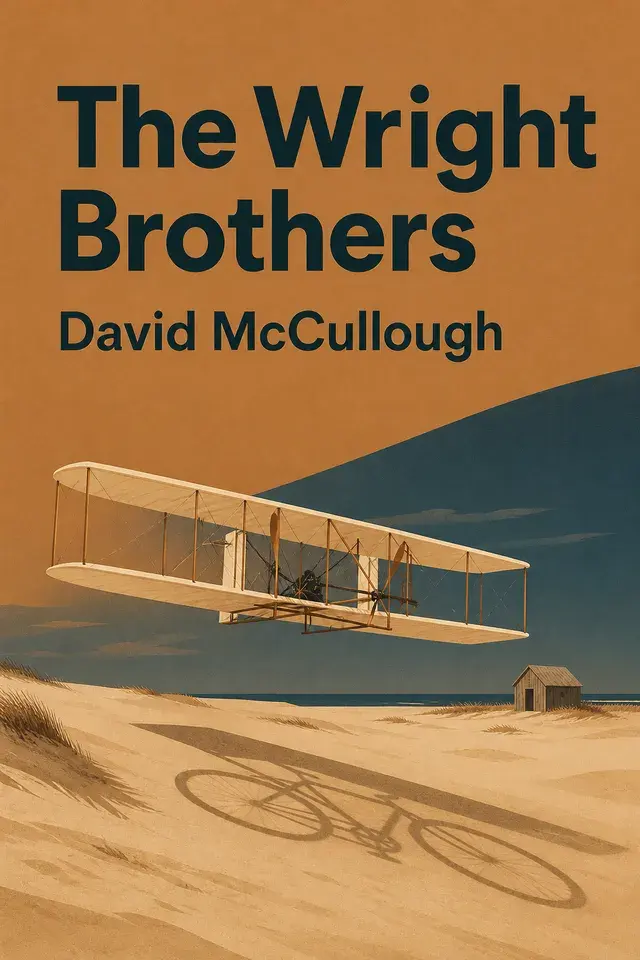
Key ideas from The Wright Brothers
These ideas compress the book's argument without treating the author's view as settled fact. Use them as an orientation before reading the full work or listening in Wiseley.
A household of reading, independent judgment, encouragement, and worthy work turned curiosity into disciplined self-education.
Wing warping turned bird-inspired observation into a control principle first tested in a mixed-result biplane kite.
The 1901 failure turned unreliable inherited calculations into a demand for direct measurement.
Powered flight required a coordinated engine, propeller, airframe, and operator system rather than simply more power.
Huffman Prairie turned flight into an adaptive routine of launching, turning, landing, consultation, and learning through failure.
Le Mans replaced disputed claims with visible evidence of controlled, repeatable flight.
French training and repeated passenger flights made controlled aviation teachable while preserving the discipline behind the spectacle.
Orville accepted aviation’s wartime destruction without regretting invention, holding its uses morally ambivalent like fire.
How The Wright Brothers builds its case
Follow how the book develops its argument. Each note is a brief orientation, not a replacement for the chapter.
A Family Built for Flight
The human wish to fly long predates the Wright brothers. Across centuries, people imagined entering the sky and tried to build their way there.
Learning to Control the Air
Flight became tractable for the Wright brothers when they stopped treating it as a marvel and began treating it as a problem to investigate. During Orville’s long recovery from typhoid in eighteen ninety-six, Wilbur read aloud about Otto Lilienthal.
Failure Becomes Measurement
After the 1901 season, the Wright brothers faced a failure of method, not just a disappointing machine. Their glider had performed less well than inherited calculations predicted, and confidence in aerodynamic tables associated with Otto Lilienthal and Octave Chanute had weakened.
Power, Propellers, and Proof
Once the Wright brothers had learned to control a glider, the central question changed. Their gliding work did not answer the separate problem of building a machine that could carry itself and a pilot under power.
Learning to Fly in Public
After 1903, the Wright brothers had proved controlled powered flight, but not repeatability. The decisive task was to make the Flyer launch, turn, and land often enough to become an aircraft rather than an astonishing event.
From Secrecy to Sale
Once the Wrights had a machine that could fly repeatedly, their problem changed. Flyer Three was no longer only an experiment; it was a claim about ownership, value, and trust.
Le Mans Ends the Doubt
By August 1908, the Wright brothers had a machine they said could fly, but in France saying so was not enough. The French press treated them as frauds, and a published Kitty Hawk photograph had even been retouched as supposed evidence of fabrication.
The Price of Proven Flight
While Wilbur’s flying in France was changing opinion there, Orville was preparing the first full-scale public performance of a Wright airplane in the United States. Fort Myer provided a parade ground, a hangar, and Army assistance, though its usable flying space was relatively tight.
A World Learns to Fly
Once the Flyer was believed, the Wrights faced a different problem. They had to show what flight meant in public, teach others to operate it, and respond to crowds, institutions, money, and fame.
Ownership, Memory, and Consequence
After the Wright brothers had been publicly accepted, the nature of their work changed. They no longer had to persuade the world that controlled flight was possible.