What you'll learn
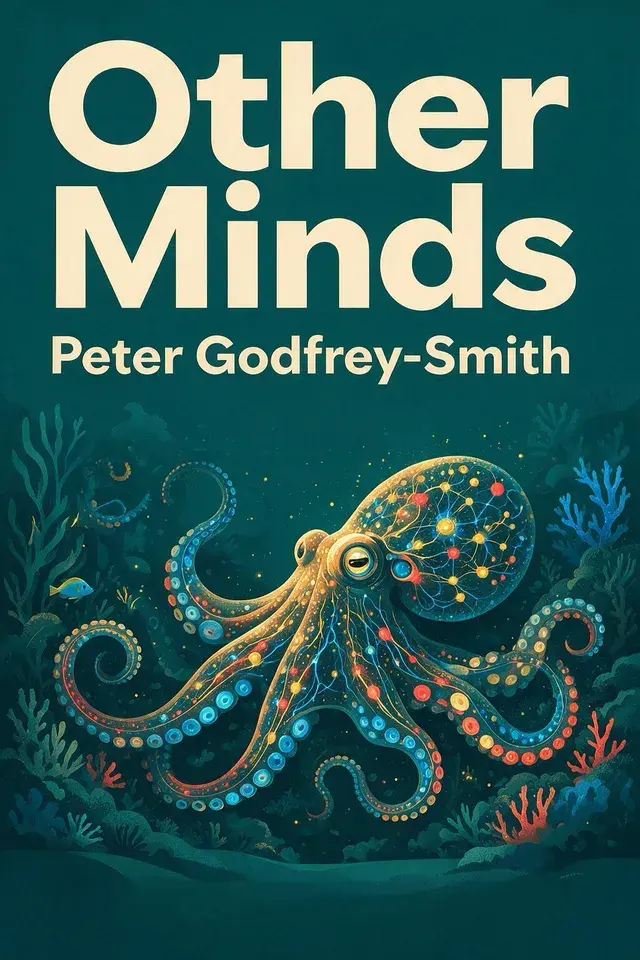
Key ideas from Other Minds
These ideas compress the book's argument without treating the author's view as settled fact. Use them as an orientation before reading the full work or listening in Wiseley.
Vertebrates and cephalopods share distant ancestry but evolved complex cognition independently.
Octopus control is distributed: the brain guides broad action while arms sense, explore, and fine-tune movement locally.
Subjective experience is presented as an evolutionary development from sensing and acting, not as a substance added to living matter.
Camouflage, signaling, defensive display, and incidental chromatic activity can share one bodily system without every pattern having an audience.
Language is a powerful cognitive tool, but complex thought and consciousness do not depend on human-like speech.
Cephalopod intelligence is compressed into short lives because costly nervous systems evolved alongside high mortality and early reproductive benefits.
Octopolis shows how rare shelter, abundant food, and repeated encounters can produce a locally social octopus community.
How Other Minds builds its case
Follow how the book develops its argument. Each note is a brief orientation, not a replacement for the chapter.
Two Routes to Mind
To ask what kind of mind an octopus might have, the book begins with a comparative problem: what happens when a human meets an animal whose body and lineage are radically different? Underwater encounters can feel reciprocal.
The Octopus Body-Mind
To understand octopuses, ask not whether they are smaller or less successful vertebrates, but what kind of body and way of life their nervous system had to manage. Their intelligence is distinctive because it arose within a body unlike the one that shaped vertebrate minds.
From Sensing to Experience
To ask whether an animal has a mind, Godfrey-Smith begins with a modest question: does anything feel like anything from that animal’s point of view? He distinguishes subjective experience from consciousness, a broader and often overused term, and from sentience, the capacity for feeling.
Displays Without an Audience
Cephalopod color change is more than a way to disappear. Their skin can act as a living, moving display.
Language's Inner Loop
Human consciousness does not begin with sentences. Experience is already present in pain, perception, bodily feeling, and changing combinations of information.
Compressed Lives, Open Questions
Cephalopods make time part of the puzzle of mind. Giant cuttlefish commonly live only one or two years, and many octopuses do likewise; the giant Pacific octopus may reach about four.
Octopolis and the Social Sea
Octopolis is the book’s closing case: a small site off Australia’s east coast, about fifty feet deep, discovered in two thousand nine. It can be revisited year after year with several octopuses present, and busy days bring more than a dozen into the same small arena.