What you'll learn
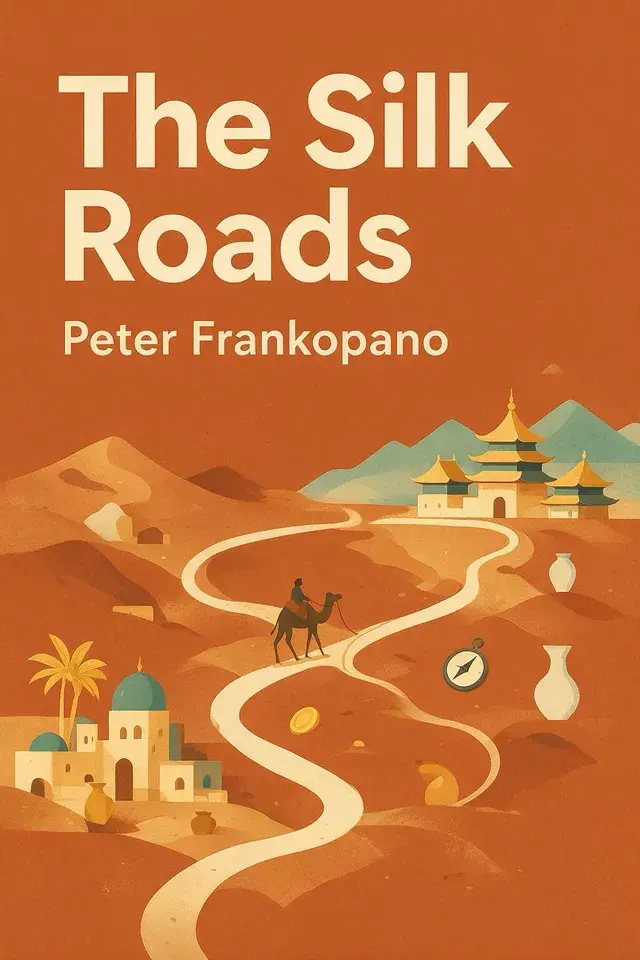
Key ideas from The Silk Roads
These ideas compress the book's argument without treating the author's view as settled fact. Use them as an orientation before reading the full work or listening in Wiseley.
The Silk Roads formed a multidirectional Eurasian network linking the Mediterranean, Central Asia, India, and China through commerce, administration, and conflict.
Islam fused monotheistic conviction with a political identity, organized military loyalty, and shared economic incentives.
Mongol commercial security knit Eurasian markets together, while the same routes carried plague through ports, caravans, ships, and cargo.
Potosí silver reached Asian markets through Europe and Manila, connecting American extraction to distant state-building.
European ascendancy rested on institutional capacity, while Asian commerce continued and imperial wealth remained bound to violence.
Unequal royalties and foreign accounting practices made oil a central issue of Persian sovereignty and anti-British nationalism.
The Iraq war rested on overstated weapons claims and weak aftermath planning, producing insurgency, civil war, and prolonged instability.
Regional institutions and new corridors may deepen interdependence while leaving peace, liberalism, and shared prosperity uncertain.
How The Silk Roads builds its case
Follow how the book develops its argument. Each note is a brief orientation, not a replacement for the chapter.
Re-centering the Silk Roads
To understand world history, Peter Frankopan asks us to move the map’s center. The familiar sequence from Greece and Rome through Christian Europe makes Western triumph look natural.
Faiths Across a Divided East
The Silk Roads carried faiths as well as goods, but religions did not move by momentum alone. Merchants opened routes; rulers chose whether to tolerate, patronize, or suppress; monasteries, translation, and pilgrimage made belief durable.
Islam and the New Imperial Order
Islam emerged as Rome and Persia were exhausted by a late-antique crisis. A plague appearing in 541 moved through Mediterranean, Persian, and Asian networks, devastating populations, removing farmers and consumers, and deepening economic contraction.
The Northern Roads: Fur, Silver, and Slavery
Baghdad’s wealth did not stop at the settled world’s northern edge. Its markets drew goods, silver, and people from forests and grasslands beyond the Muslim frontier, creating a northern Silk Road.
Crusade and Mongol Power
The handoff into the Crusades begins with a shift in the eastern balance. The Seljuks turned military service into territorial power, defeated the Ghaznavids at Dandanakan in 1040, and entered Baghdad in 1055 at the caliph’s invitation.
Connectivity’s Plague and Europe’s Westward Turn
The Mongol age made Eurasia commercially more connected. As fighting made routes through the Holy Land unreliable, Genoa and Venice turned toward Black Sea ports, where grain, low customs, and large ships made trade attractive.
Atlantic Conquest and Silver
Once Iberian voyages opened Atlantic and Cape routes, Europe entered a new intercontinental system. Yet the road of gold was not a peaceful story of discovery.
War, Finance, and the Company State
Europe’s rise, in the author’s account, was not the reward for innate superiority. It grew from repeated interstate warfare: states learned from defeat, raised taxes and loans, improved ships and weapons, and organized private capital for public power.
The Great Game and the First World War
Britain’s nineteenth-century commercial and imperial ascendancy rested on ports, oases, territories, and communications linking possessions to London. Yet reach created vulnerability.
Oil, Borders, and Dependent States
At the beginning of the twentieth century, petroleum turned the Silk Roads into strategic energy corridors. Pipelines, refineries, tankers, and export ports linked Asian fields to European industry.
Wheat, Genocide, and Total War
The Nazi war in the east fused a resource campaign with a racial-colonial project. Germany sought Ukraine’s wheat, eastern land, Caucasian oil, and labor; Nazi ideology determined which populations could be displaced, enslaved, starved, or killed.
The Early Cold War Order
By the end of the Second World War, control of the Silk Roads was shifting from a weakened Britain to an ascending United States. Britain and the Soviet Union had occupied Iran, gaining access to its transport and communications network.
Oil Leverage and Revolutionary Blowback
By the late 1960s, oil producers were becoming political actors. OPEC, founded by Iran, Iraq, Saudi Arabia, Kuwait, and Venezuela, was not itself a political movement, but it coordinated supply and pressed for higher revenues.
Intervention after the Cold War
The 1990 invasion of Kuwait revealed a post-Cold War temptation to treat Asia’s crossroads as controllable. The Gulf War was a constrained success: after six weeks, a coalition liberated Kuwait and defeated Iraq’s army, then stopped short of Baghdad to avoid mission creep and occupation.
The New Silk Roads
Frankopan ends by arguing that the Silk Roads are re-emerging as a central zone of world affairs. Western policymakers often treated Afghanistan, Iran, and Iraq as separate problems, he says, whereas a longer view reveals one connected region, again becoming important to global intellectual, cultural, and economic life.