What you'll learn
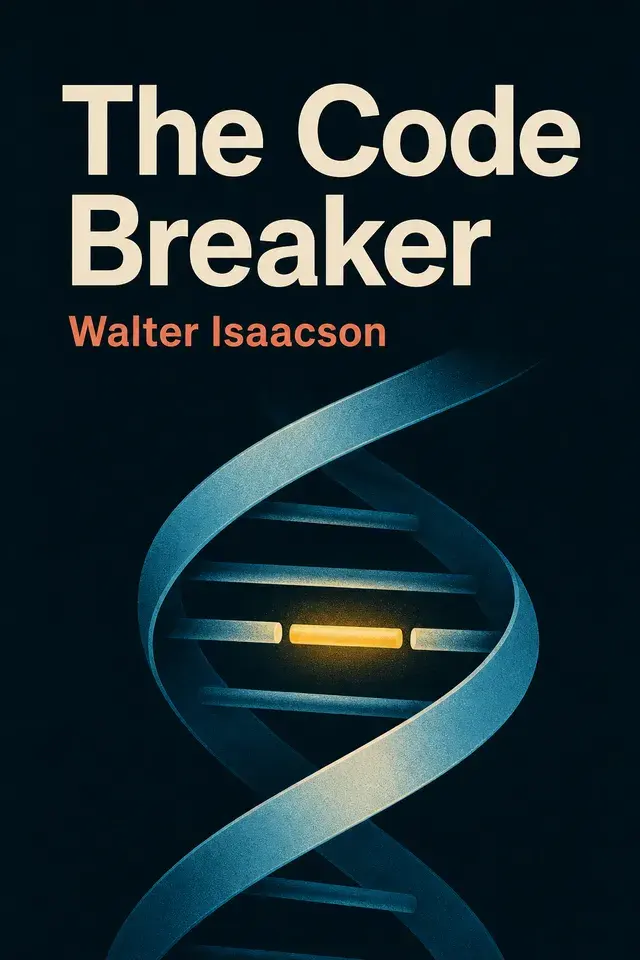
Key ideas from The Code Breaker
These ideas compress the book's argument without treating the author's view as settled fact. Use them as an orientation before reading the full work or listening in Wiseley.
DNA’s double helix explained how genetic sequences could be copied, while genome sequencing showed that reading code was not the same as writing it.
CRISPR began as bacterial immune memory, storing fragments of invading phage DNA between repeated sequences.
Fusing crRNA and tracrRNA created a single guide that made Cas9 retargetable by changing its sequence.
Human-cell adaptation required CRISPR-Cas9 to enter the nucleus and function in a mammalian cellular environment, turning a bacterial tool into a research platform.
Patent law converted a collaborative discovery into contested ownership shaped by uncertain biology, procedural advantage, and competing priority claims.
Early somatic treatments demonstrated concrete medical benefit, while high prices and unequal research investment made access part of therapeutic success.
Mosaic, off-target, and incomplete edits weakened the claim that embryo editing was a safe HIV intervention.
A responsible path favors humility, broad governance, and cautious medical use without treating either a genetic marketplace or total prohibition as sufficient.
How The Code Breaker builds its case
Follow how the book develops its argument. Each note is a brief orientation, not a replacement for the chapter.
Reading Life’s Code
Before CRISPR became a tool for editing genes, biology had to learn to treat life as information. Isaacson presents this as a third information revolution.
Microbes Remember Viruses
Before CRISPR was associated with gene editing, Doudna had been studying RNA interference. Small RNA fragments find matching messenger RNA and help destroy it, silencing a gene.
The Programmable Cut
CRISPR became a programmable machine only when researchers rebuilt its natural bacterial defense in a controlled test tube. The system could remember viruses, but memory alone did not explain how an RNA instruction aimed Cas9 at a particular DNA sequence.
The Race Into Human Cells
Once CRISPR-Cas9 had been shown to cut a chosen DNA sequence in a test tube, the decisive question changed: could it work inside a human cell? Bacterial and archaeal systems operated in cells without nuclei.
Patents, Promise, and Access
Once CRISPR entered human cells, the question shifted from whether it worked to who deserved credit, who could claim it, and who would pay for medicine. It was ensemble science, but prizes, patents, and biographies favored a small circle.
Rules Before the Breach
Before any embryo was edited, biotechnology had already spent decades trying to govern powers it only partly understood. The rules came in layers—laboratory safeguards, professional restraint, public commissions, reproductive screening, and national restrictions.
When Babies Were Edited
By the time He Jiankui edited embryos for pregnancy, CRISPR germline intervention had already been surrounded by meetings, reports, and warnings. Yet safeguards had not produced a clear path from laboratory work to live births.
Who Should Decide?
Once the scandal is set aside, the harder question is who should decide when CRISPR ought to alter an embryo. The power could remove deadly inherited disease, change bodies or minds, and pass those changes to descendants.
A Platform Under Pressure
The book’s final test is not whether CRISPR can do astonishing things. It is whether a discovery born from curiosity and collaboration can become public service without losing judgment along the way.