What you'll learn
Key ideas from Strangers in Their Own Land
These ideas compress the book's argument without treating the author's view as settled fact. Use them as an orientation before reading the full work or listening in Wiseley.
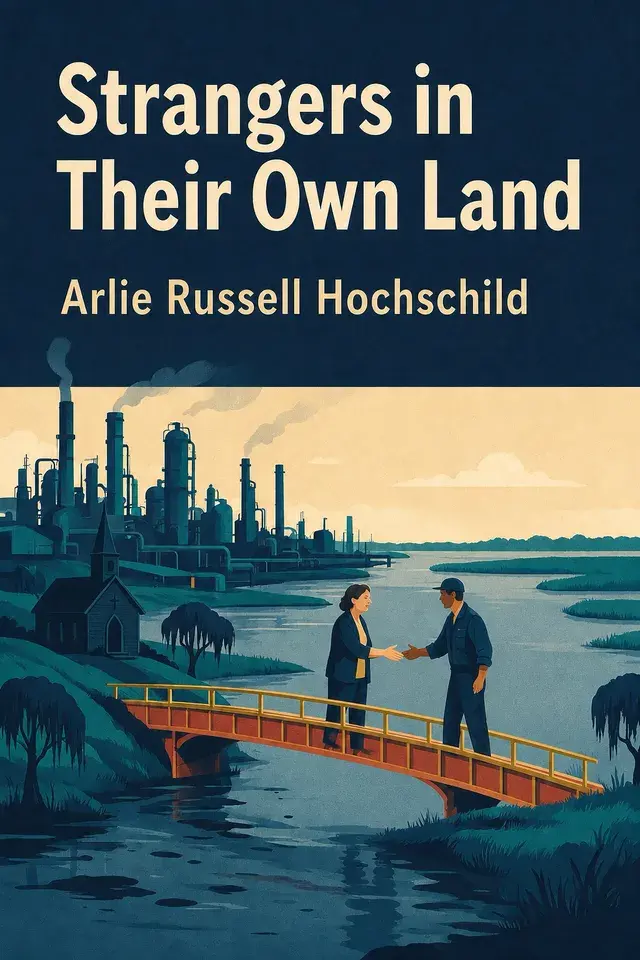
Hochschild frames the right’s limited-government politics amid poverty, pollution, and public dependence as the Great Paradox.
An empathy wall blocks inside understanding, while empathy can support clear analysis without requiring agreement.
Environmental concern and conservative identity can coexist when trust, honor, faith, and local belonging outweigh confidence in distant government.
Least-resistant siting and corporate incentives shift pollution, infrastructure costs, and economic risk onto communities and public institutions.
The deep story turns economic stagnation into a felt waiting line, where older white Christian workers believe work and sacrifice entitle them to progress.
The Green Army and common-good proposals show how environmental protection can cross ideological boundaries while leaving federal distrust intact.
Trump turns a preexisting story of displacement into rally-based belonging, emotional release, and exclusion.
The democratic response compares partial stories, crosses the empathy wall, and finds cooperation around shared public goods.
How Strangers in Their Own Land builds its case
Follow how the book develops its argument. Each note is a brief orientation, not a replacement for the chapter.
Crossing the Empathy Wall
In Strangers in Their Own Land, Arlie Russell Hochschild begins with alarm over an increasingly hostile split between America’s political camps. Left critics see Republicans and Fox News dismantling government while helping the wealthy; right critics see government as an elite machine that amasses power and distributes money for Democratic loyalty.
Pollution, Work, and Memory
Environmental injury might seem like a straightforward argument for stronger regulation. In Hochschild’s Louisiana, it is not.
The Price of the Jobs Story
Louisiana’s jobs story turns an economic arrangement into a moral choice. Residents repeatedly hear that environmental rules threaten employment, while oil and petrochemicals promise prosperity.
Churches, Media, and Moral Shelter
To understand why anti-government politics can endure alongside reliance on public help, Hochschild follows the institutions that give this position a moral home. The contradiction is selective, not absolute.
The Deep Story of the Line
To understand the politics at the heart of Hochschild’s account, we first have to enter a story that feels true before asking whether it is factually complete. She calls it a deep story, a “feels-as-if” narrative expressed through symbols.
Honor, Faith, and Risk
The deep story gives these people a shared feeling of being pushed back, but it does not dictate one response to danger. Hochschild’s portraits show political identity becoming an ethic of conduct: a way of deciding what to endure, renounce, or call courageous.
History, Rebellion, and Trump
Mike Schaff shows that conservative identity is not sealed. Before Bayou Corne, he was a lifelong oil worker, conservative Republican, and Tea Party loyalist.
Evidence and a Shared Future
By the time Hochschild turns to Trump, the deep story is waiting for a spark. It pictures patient people pushed back while strangers move ahead, a president siding with them, and cultural elites treating those in line as backward.