What you'll learn
Key ideas from Influence
These ideas compress the book's argument without treating the author's view as settled fact. Use them as an orientation before reading the full work or listening in Wiseley.
Human stereotypes and words such as “because” provide efficient shortcuts, but their triggers can produce mistaken compliance.
Reciprocity turns received favors into expectations of repayment, making cooperation across time possible while attaching social costs to nonreciprocation.
After people take a stand, they often reshape beliefs and confidence to make the choice seem consistent with who they are.
Social proof uses other people’s behavior as evidence of what is correct, appropriate, funny, or possible.
Friendship, attractiveness, similarity, familiarity, praise, and association can manufacture a sense of personal connection that strengthens compliance.
Credibility requires checking both an authority’s relevance to the question and their likely truthfulness or incentives.
Scarcity-induced arousal is a warning to pause, regain calm, and separate ownership value from functional performance.
The requester’s appeal and the request’s merits are separate objects of judgment.
How Influence builds its case
Follow how the book develops its argument. Each note is a brief orientation, not a replacement for the chapter.
Automatic Influence and Its Shortcuts
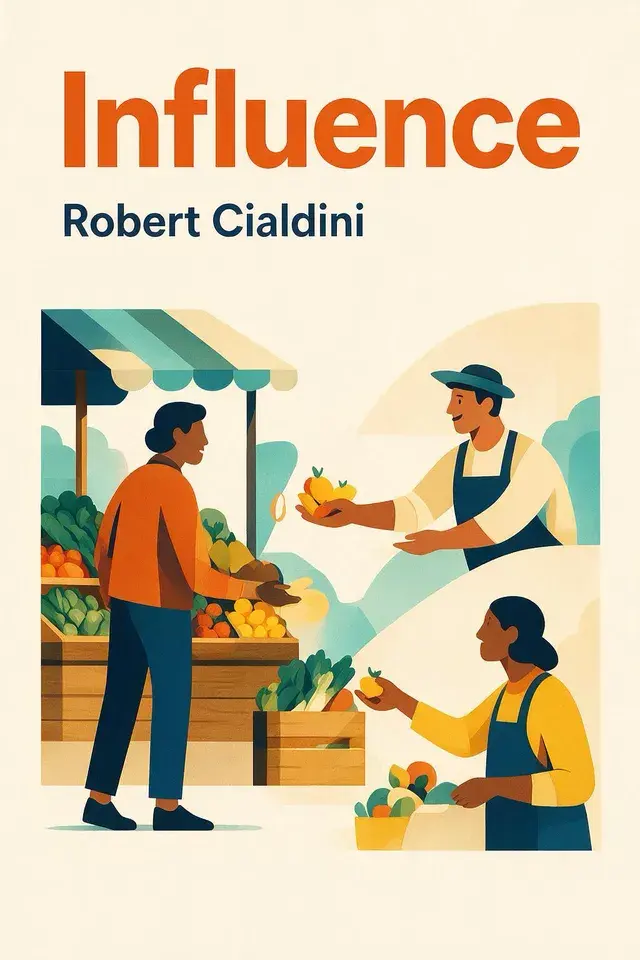
Why do people accept one request but reject another that asks for essentially the same favor? Cialdini opens Influence with that problem: compliance can arrive before a person has examined the request fully.
Reciprocity Creates Social Debt
Reciprocity is the social rule that a favor should be answered with a favor. Ordinary language treats gratitude as debt: in English, “much obliged” can mean “thank you.”
Concessions That Capture Agreement
The previous chapter established that reciprocity can support cooperation but can also create pressure. This chapter focuses on a more specific maneuver: rejection followed by retreat.
Commitment Becomes Identity
Consistency is usually treated as a virtue. It suggests logic, stability, honesty, strength, and trustworthiness, while also saving mental effort.
Owning the Choice
Commitment becomes powerful not simply when it is active, visible, or difficult, but when a person experiences it as a choice he or she owns. Cialdini treats inner responsibility as more important than those other properties together.
When the Crowd Becomes Evidence
One of the quietest ways people decide what to do is to watch what others are doing. Cialdini calls this social proof: determining what is correct by finding out what other people appear to think or do.
Uncertainty, Imitation, and Inaction
Social proof is a useful shortcut because other people’s behavior can reveal what is safe, correct, or possible when we lack information. But uncertainty also creates its most dangerous form.
Liking Before the Ask
Before a request is judged on its merits, the requester may already have won our willingness to listen. Cialdini presents liking as a broad rule: people are generally more willing to say yes to someone they know and like.
Authority Without Real Expertise
Authority is not automatically a problem. The book presents it as a useful social arrangement.
Scarcity, Freedom, and Urgency
Scarcity closes the book’s specific principles by showing how a shrinking opportunity can change desire. When an object, freedom, or piece of information seems limited, people often value it more, partly because they fear losing it.
Keeping Shortcuts Honest
Influence ends with a qualification that changes how its entire argument should be used. The problem is not that people rely on mental shortcuts.