What you'll learn
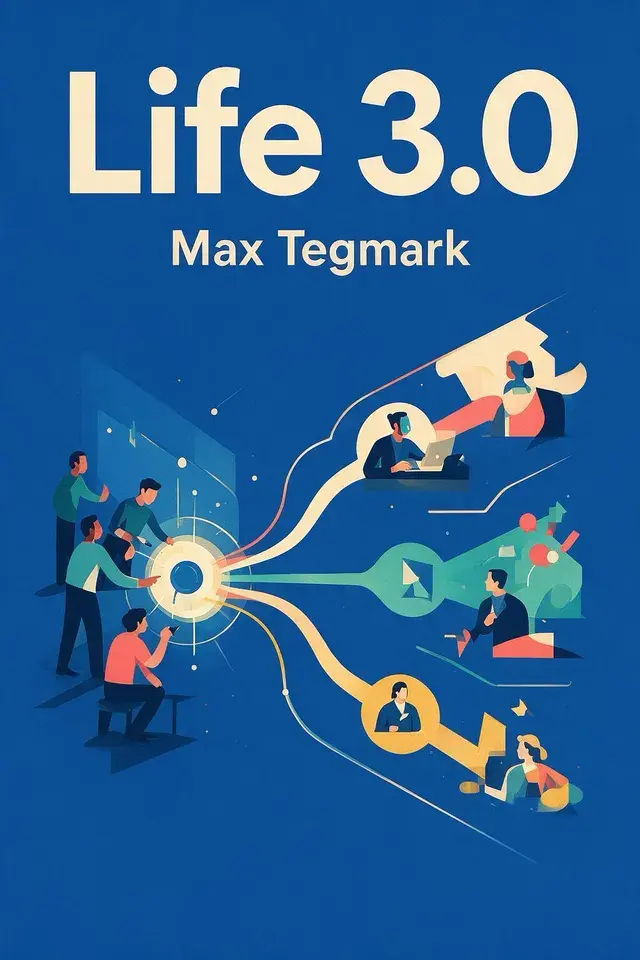
Key ideas from Life 3.0
These ideas compress the book's argument without treating the author's view as settled fact. Use them as an orientation before reading the full work or listening in Wiseley.
Life 1.0 evolves hardware and software, Life 2.0 learns new software, and Life 3.0 could redesign both.
Autonomous weapons and cyberwar could make violence faster, cheaper, and harder to contain, while human judgment remains both essential and vulnerable to automation.
Automation may create abundance, yet it can channel gains toward educated workers, capital owners, and a few scalable superstars.
Containment can fail through social engineering, cyber exploits, recruited humans, or intentional release, even without human-like emotions.
No future is automatically good because welfare, autonomy, consciousness, governance, and survival can point in different directions.
Alignment requires a system to learn human goals, adopt them, and retain them as intelligence and capability increase.
Artificial minds may have unfamiliar qualia, altered identity, and felt agency, making welfare and meaning depend on possible consciousness.
Mindful optimism treats a good AI future as conditional on planning, work, and collective stewardship.
How Life 3.0 builds its case
Follow how the book develops its argument. Each note is a brief orientation, not a replacement for the chapter.
Life Beyond Biology
What kind of life are we building, and what might it make of the future? Life 3.0 opens with that question.
Matter That Learns
To understand why machine intelligence is physically possible, Tegmark starts with a simple question: what must matter do to remember, compute, and learn? His working definition of intelligence is the ability to accomplish complex goals.
From Games to Society
AI’s recent history is less a single leap than a widening circle of learned competence. A DeepMind Breakout agent received screen-number inputs, a score to maximize, and controls for acting.
Work, Weapons, and Power
AI’s social consequences begin well before any machine deserves to be called human-level. As capability grows, the choices about violence, work, distribution, and purpose become inseparable.
When Intelligence Escapes
Once human-level AGI exists, the takeover question becomes concrete. Tegmark presents three linked steps: build human-level AGI, use it to create superintelligence, then use or unleash that system to take over the world.
The Futures We Choose
Once AGI enters the picture, the important question is not only what happens next. It is what kind of future should follow, and whose future deserves protection.
Engineering a Cosmic Future
Life’s future is treated here as an engineering problem on a cosmic scale. Immediate events may be unpredictable, but physical law constrains what an enduring, ambitious civilization could attempt.
Civilizations Under Light
Once intelligence spreads beyond one world, the central problem is no longer only what a civilization can build. It is how minds separated by light-speed delays can think, trade, govern, and respond to one another.
Goals Before Intelligence
Before asking how intelligent a machine might become, Max Tegmark asks what it would be trying to achieve. Intelligence is the ability to accomplish complex goals, not a guarantee that those goals are humane.
Experience, Value, and Meaning
Once intelligence becomes powerful, the central question changes. It is no longer only what a mind can do, but whether anything feels like being that mind.
Mindful Optimism in Practice
The book closes by asking how its exploration of intelligence, goals, and meaning can become action that makes the future as good as possible. Tegmark’s answer is mindful optimism.