What you'll learn
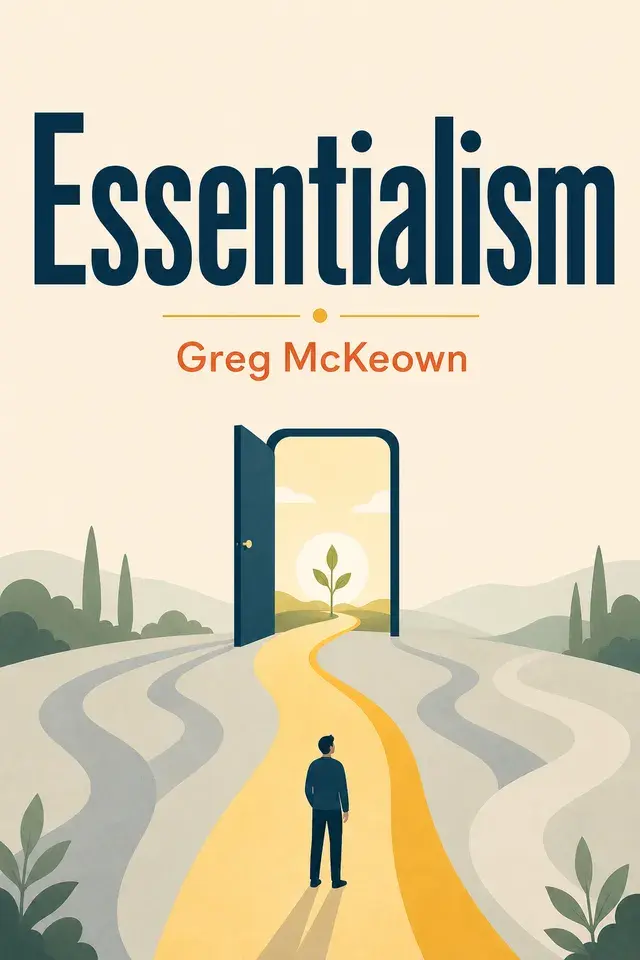
Key ideas from Essentialism
These ideas compress the book's argument without treating the author's view as settled fact. Use them as an orientation before reading the full work or listening in Wiseley.
Explore, eliminate, and execute form a recurring cycle for distinguishing vital work, accepting trade-offs, and removing obstacles to progress.
Explicit priorities clarify action when desirable values conflict; unranked lists offer no decision rule.
Total conviction, the Ninety Percent Rule, and minimum and extreme criteria make opportunity screening explicit and deliberately selective.
Essential intent joins inspiration with measurability, turning one memorable choice into guidance for many later decisions.
Refusal protects the essential by making the opportunity cost of every yes visible.
Zero-based evaluation asks which obligations, projects, and relationships would be chosen today if they were not already underway.
System-wide progress is governed more by the limiting bottleneck than by optimizing secondary tasks or adding pressure.
Deliberately designed routines make essential actions more automatic and reduce repeated decisions.
How Essentialism builds its case
Follow how the book develops its argument. Each note is a brief orientation, not a replacement for the chapter.
Choose Less, Better
Essentialism begins with a practical limit: no one has enough time, energy, or attention to pursue every opportunity and satisfy every demand well. The problem is not simply finding a better way to fit everything in.
Find the Vital Few
Hard work is not a reliable measure of value. Essentialism begins with a more unsettling question: which effort produces the most important result?
Make Space to See
Discernment cannot happen at the speed of reaction. When email, meetings, requests, and new ideas all claim immediate attention, the mind has little chance to compare them or ask what matters.
Protect Capacity, Select Well
Essentialism depends on protecting the capacity that makes discernment possible. McKeown treats the self—mind, body, and spirit—as the asset through which contribution happens.
Clarify the Essential Intent
Once selection has narrowed attention to what matters, another task begins. Essentialism is not complete when you know what matters; you must remove what prevents that priority from becoming real.
Say No with Purpose
Once priorities are clear, the next test is responding when someone asks for your time. McKeown treats refusal as the practical expression of choice.
Uncommit Without Regret
Once a commitment is underway, letting go can feel like admitting that the time, money, or effort already spent was wasted. McKeown argues that this feeling is precisely why Essentialists must learn to uncommit.
Edit Life, Set Limits
Once the vital few have been chosen and unnecessary commitments released, subtraction is not finished. McKeown presents it as ongoing editorial craft.
Build Frictionless Progress
Once a priority has been chosen, execution can still fail if work is arranged around ideal conditions. McKeown treats execution as a design problem.
Make Essentials Automatic
Once an essential priority has been chosen, the next challenge is making it dependable. Greg McKeown presents routine as a deliberate achievement, not a dull substitute for ambition.
Focus on What Matters Now
Focus is not simply a matter of arranging a schedule. It is the discipline of giving full attention to what can be done now.
Live and Lead Essentially
Essentialism is easy to mistake for a set of techniques: choose, remove, focus, and repeat. The closing argument is deeper.