What you'll learn
Key ideas from Tools of Titans
These ideas compress the book's argument without treating the author's view as settled fact. Use them as an orientation before reading the full work or listening in Wiseley.
A personal blueprint emerges from borrowing and recombining useful ideas while preserving context and noticing blind spots.
Biomarkers become useful through context, repeated measurement, trend analysis, and precommitted decisions rather than isolated values.
Rare combinations of useful skills, unusual traits, and constraints can create value outside crowded contests.
Bounded bets require survivable loss, explicit rules, diversification, and evidence because intuition and failure are ambiguous.
Fear-setting makes risk more legible by comparing downside, recovery options, upside, and the cost of inaction.
Persistence combines truthful feedback with repeated action, while praise, hostility, and rejection remain incomplete evidence about the work.
Achievement is placed inside relationships, parenting, presence, peace, and meaning rather than treated as an end in itself.
How Tools of Titans builds its case
Follow how the book develops its argument. Each note is a brief orientation, not a replacement for the chapter.
Borrowed Tools, Personal Tests
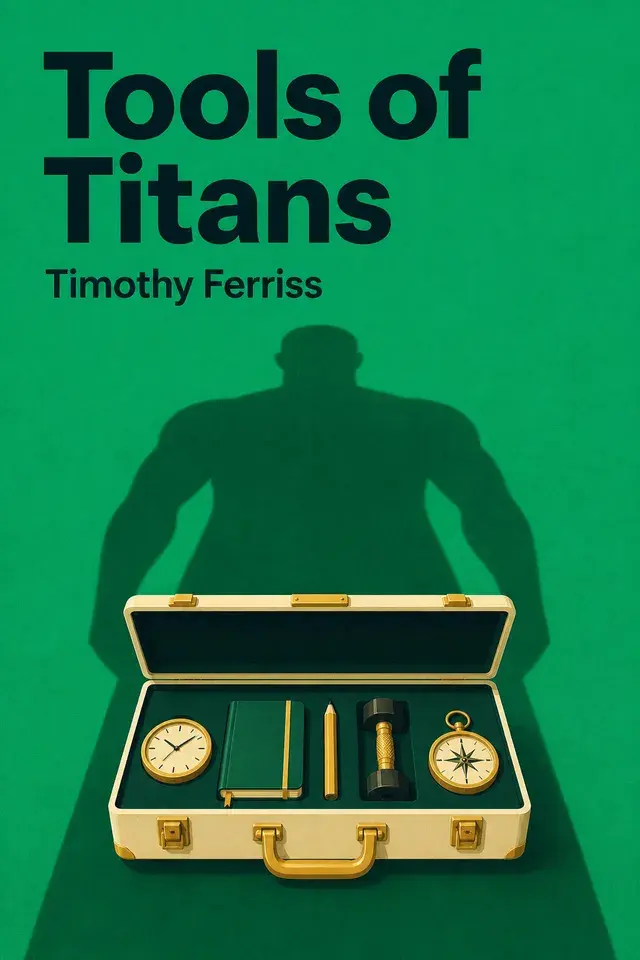
Tools of Titans opens with a reading contract: interviews are hypotheses, not instructions. Timothy Ferriss organizes the material under Healthy, Wealthy, and Wise, a tripod whose supports include health, money, time, and relationships.
Build the Adaptive Body
An adaptive body is not built by finding one perfect diet or heroic workout. Ferriss’s profiles ask what is neglected, what training should improve, how results will be measured, and what should change when the body responds poorly.
Powerful Experiments, Narrow Guardrails
The most memorable health experiments in Tools of Titans are not ordinary habits. They push metabolism, temperature, breathing, sensory input, or consciousness, so their value cannot be separated from danger.
Stabilize the State
Reliable attention does not begin with forcing the mind to behave. In Ferriss’s account, it begins with immediate conditions around it: sleep, the first minutes of the day, and a way to return when attention wanders.
Position the Uncrowded Advantage
Achievement starts with a question: what counts as success for this person? Derek Sivers argues that status cannot answer it without knowing someone’s aims.
Learn Through Bounded Bets
Curiosity becomes useful when it leaves opinion and meets reality. This chapter pairs questioning inherited premises with a practical discipline: design experiments whose losses you can survive and whose results you can inspect.
Serve a Focused Market
Useful work becomes durable when it begins with a specific group and a problem they will actually pay to solve. Building at scale on enthusiasm alone is fragile.
Make Under Constraint, Reinvent in Public
Creative careers advance by making before conditions are ideal. Ferriss’s interviews present constraints as forces that shape a project’s subject, medium, and form.
Freedom Requires Preparedness
Freedom, in this chapter, is the ability to preserve choice when demands, fear, or disruption arrive. Ferriss starts with subtraction.
Turn Fear into the Work
Fear becomes workable when it stops being a fog and becomes something inspectable. Caroline Paul does not seek to eliminate fear.
Make Achievement Serve a Life
Tools of Titans closes by changing the question. After asking how to train, build, sell, create, and persist, Ferriss asks what those capacities are for.