What you'll learn
Key ideas from Big Magic
These ideas compress the book's argument without treating the author's view as settled fact. Use them as an orientation before reading the full work or listening in Wiseley.
Fear protects against real danger but cannot be allowed to choose creative direction.
Creative life combines disciplined labor with rare external assistance, so inspiration may be welcomed without being awaited, commanded, or made responsible for identity.
Creative entitlement is presented as a birthright to speak and practice, not a guarantee of talent, income, admiration, credentials, or audience control.
A creative life holds two truths together: the work matters completely during creation and cannot govern sanity.
Gilbert defines creative vocation as a vow to return to the work without making publication, greatness, income, or success conditions.
Disciplined imperfection treats finishing and releasing a sound work as more valuable than endless repair toward impossible flawlessness.
Gilbert rejects suffering and self-destruction as requirements for serious art, favoring love, health, stability, and creative connection.
Fierce trust is commitment to making and sharing despite likely failure, with love outweighing the ego’s need for validation.
How Big Magic builds its case
Follow how the book develops its argument. Each note is a brief orientation, not a replacement for the chapter.
Courage Before Confidence
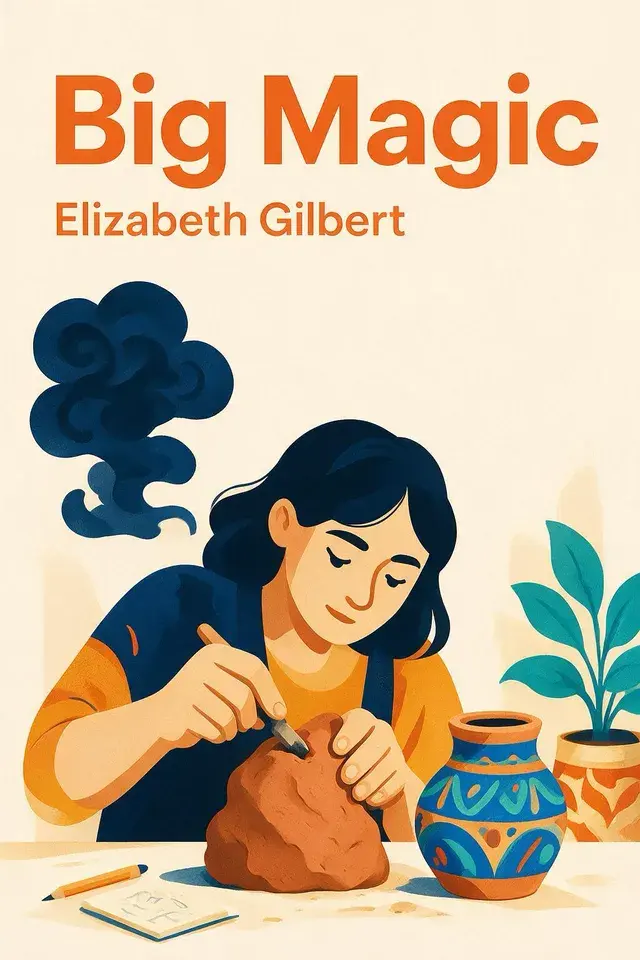
Big Magic begins with a question that is both simple and demanding: what might be hidden inside you, and do you have the courage to bring it into the world? Elizabeth Gilbert treats each person as a repository of buried capacities—untried talents, longings, perspectives, and creative possibilities.
Ideas That Seek a Maker
Gilbert introduces her account of magic through a novel she failed to write after Eat Pray Love. She feared that success had ended her ability to write fiction.
Permission to Belong and Begin
Once creativity is admitted, another obstacle appears: feeling that someone else must authorize it. Gilbert answers with a birthright argument.
Art Matters Without an Emergency
Gilbert’s defense of creativity reaches a deliberately uncomfortable conclusion: art can be deeply meaningful and still be nonessential. She says this without indifference.
The Vow of Daily Practice
Permission matters only when it survives an ordinary Tuesday. After arguing that people may create, Gilbert asks what happens when work is slow, confidence is low, and life still needs paying for.
Ritual, Imperfection, and the Submission Game
Once creativity has been accepted as a vocation, execution becomes the test. The question is no longer whether the work matters, but whether the creator will keep returning until something is finished and can be offered to other people.
Love, Play, and the Trickster
Elizabeth Gilbert begins with Robin Wall Kimmerer’s classroom question: do students love nature, and do they believe nature loves them back? The environmental students answer yes to the first and no to the second.
Failure, Ego, and Fierce Trust
After practice, execution, and a playful relationship with the work come a harder question: what happens when the work fails? Gilbert remembers completing an entire book and discarding it because it simply did not work.
Accidental Grace, Living Paradox
At the end of Big Magic, Elizabeth Gilbert turns to Bali for a story about how creative meaning can change in motion. The story matters because it does not begin with a solemn masterpiece.