What you'll learn
Key ideas from Conscious Capitalism
These ideas compress the book's argument without treating the author's view as settled fact. Use them as an orientation before reading the full work or listening in Wiseley.
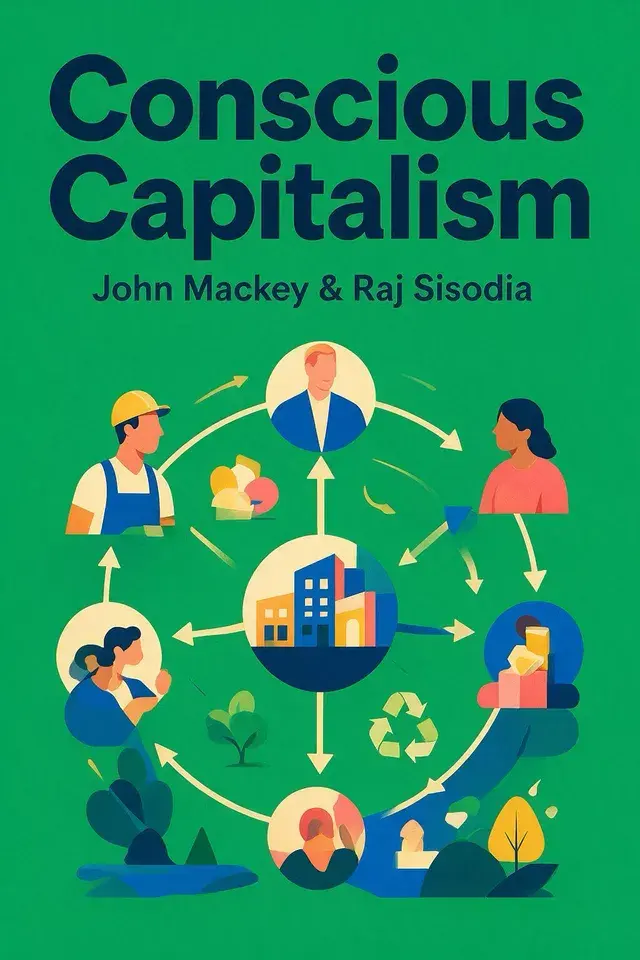
Conscious Capitalism presents higher purpose, stakeholder integration, conscious leadership, and conscious culture and management as one system.
Higher purpose gives an organization meaning and aligns strategy, decisions, and people around the contribution it seeks to make.
Stakeholders co-create value in an interdependent system, so the company’s task is to expand total value rather than assume fixed-pie conflict.
The environment is a silent, non-contracting stakeholder, so unintended ecological harms call for innovation and effective regulation.
Conscious leaders serve purpose and stakeholders as trustees, integrating analytical, emotional, spiritual, systems, and moral judgment.
TACTILE culture makes purpose visible through trust, accountability, caring, transparency, integrity, loyalty, and egalitarianism.
Conscious management converts culture into self-management by combining autonomy, information, resources, and clear expectations.
The authors judge business by total stakeholder wealth, including financial, social, ecological, cultural, intellectual, emotional, spiritual, and physical value.
How Conscious Capitalism builds its case
Follow how the book develops its argument. Each note is a brief orientation, not a replacement for the chapter.
The Case for Conscious Capitalism
Conscious Capitalism opens with an argument that is both defensive and corrective. Mackey and Sisodia defend free-enterprise capitalism’s record.
Purpose Makes Profit Sustainable
After introducing the broader case for conscious capitalism, the authors turn to its first tenet: higher purpose. They define purpose as the difference a company seeks to make beyond profit and shareholder value.
Stakeholders Share One System
Stakeholder integration begins with a different picture of what a company is. It is not an owner standing at the center while other groups compete for slices of a fixed pie.
Partnerships Create Durable Value
Chapter 3 maps stakeholder integration as a system. This chapter asks what it changes in four operating relationships: customers, team members, suppliers, and investors.
Business Beyond Its Boundaries
Business does not end at the edge of the firm. The authors treat local, national, global, and virtual communities as genuine stakeholders because businesses exist within human communities and affect their well-being.
Leaders Serve the Whole
Once an organization has a higher purpose and sees its stakeholders as interdependent, someone must hold that whole picture together. The authors call this conscious leadership.
Culture Turns Values into Practice
Purpose is not complete when it is printed in a mission statement. It becomes credible through repeated social habits: how people treat one another, customers, suppliers, and the wider community.
Empowerment Scales Human Potential
Once a company has a culture people can recognize, it still needs an operating system for daily decisions. This chapter presents conscious management as that system: decentralization, empowerment, innovation, and collaboration.
Testing the Promise
The final test of Conscious Capitalism is not whether it sounds attractive, but whether a company can remain financially strong while creating value for the whole system. The authors answer yes, while defining success more broadly than a stock-price result.