Choose by bottleneck
Most leadership shelves mix books that operate at different altitudes. Drucker works on the individual executive's habits; Collins works on an entire institution's trajectory; Scott and Brown work on the emotional mechanics between people; Wiseman works on how much intelligence a leader releases or suppresses. Diagnose the constraint first, then pick the altitude that matches it.
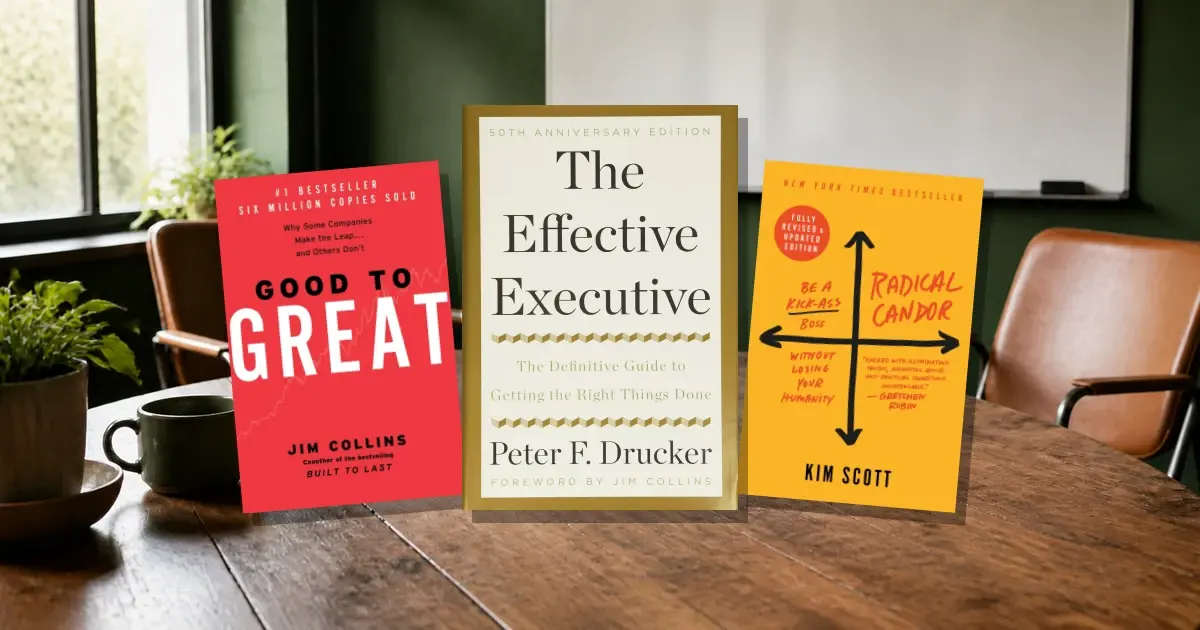
- Busy days produce little lasting result: The Effective Executive.
- The company is good but stuck at good: Good to Great.
- Problems stay invisible until they are expensive: Radical Candor.
- Fear quietly shapes what the team will say or attempt: Dare to Lead.
- People defer upward and stop thinking for themselves: Multipliers.
What each book adds
Drucker makes effectiveness a learnable discipline: record where time actually goes, define contribution by outward effect, staff for demonstrated strength, concentrate on first things first, and decide by diagnosis with structured disagreement before commitment. Collins supplies the institutional layer — Level Five leadership, first who then what, the Stockdale Paradox, the Hedgehog Concept, and the flywheel of consistent pushes. Scott names the failure modes of feedback — obnoxious aggression on one side, ruinous empathy on the other — and shows care personally and challenge directly operating together. Brown turns courage into practices: rumbling with vulnerability, operationalized values, BRAVING trust behaviors, and planned recovery after falls. Wiseman closes with the five multiplier disciplines, from talent magnet to investor, measured by one question: do people leave you sharper?
- Best starting point for a new manager: Radical Candor, because feedback is management's atomic building block.
- Best book for senior leaders of established organizations: Good to Great and its people-before-strategy sequence.
- Best complement to any of them: Multipliers as the test of whether the other lessons are landing.
A reading order from self to system
Work outward from what you control. Begin with Drucker on time, contribution, and concentration, because every later practice consumes those resources. Add the interpersonal layer next — Scott for direct guidance, Brown for the fear underneath silence — and finish with the systemic views: Collins for organizational direction, Wiseman for whether the team is getting smarter even when you are absent.
- Keep a one-week time record before changing anything else.
- Practice one feedback conversation per week while reading Scott.
- Re-run the multiplier self-check after each quarter's biggest decision.
Sources and scope
Book ideas are attributed to their authors. External evidence is linked directly when a claim needs more than the source book.
- The Effective Executive: Source for time recording, contribution thinking, staffing for strength, concentration, and decision diagnosis.
- Good to Great: Source for Level Five leadership, first who then what, the Stockdale Paradox, the Hedgehog Concept, and the flywheel.
- Radical Candor: Source for the care-personally/challenge-directly map, growth decisions, and making feedback reciprocal and systemic.
- Dare to Lead: Source for armored versus daring behaviors, operationalized values, BRAVING trust, and rising after failure.
- Multipliers: Source for the five disciplines: talent magnet, liberator, challenger, debate maker, and investor.
To report a factual, attribution, rights, or accessibility concern, email hello@wiseley.app.
Questions readers ask
What is the best leadership book for new managers?
Radical Candor is the most immediately usable: its four-quadrant map turns vague discomfort about feedback into specific, fixable behavior. Pair it with The Effective Executive once the manager's own calendar starts filling with other people's priorities instead of contribution.
Are Good to Great's findings still trusted?
Treat it as a pattern library rather than proof: the research compared matched companies, so its ideas describe what sustained transitions shared. The durable parts are conceptual — first who then what, confronting brutal facts, the Hedgehog Concept, and flywheel momentum — and they remain useful lenses even where individual case companies later stumbled.
How do Radical Candor and Dare to Lead relate?
They cover similar ground from different directions. Scott builds an operating framework for giving guidance; Brown builds the emotional foundation — shame resilience, vulnerability, trust behaviors — that makes direct challenge survivable. Readers who find one uncomfortable usually need the other.