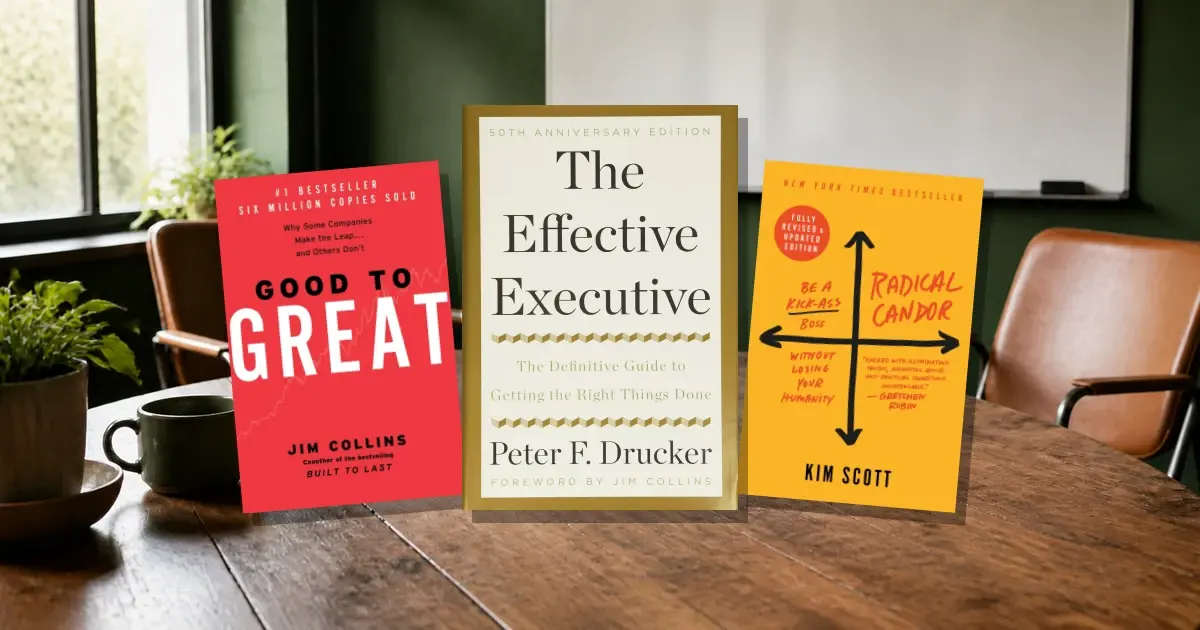
What you'll learn
Key ideas from Radical Candor
These ideas compress the book's argument without treating the author's view as settled fact. Use them as an orientation before reading the full work or listening in Wiseley.
Radical Candor joins whole-person care with clear, humble challenge and openness to correction.
Sincere praise explains what mattered and why, while effective criticism addresses fixable work, context, reasons, and a path forward.
Life stories, dreams, skill matrices, and eighteen-month plans connect personal priorities with concrete development opportunities.
Clarification and ego-free debate improve ideas before fact-based decision ownership assigns authority to the people closest to relevant information.
Trustworthy feedback cultures begin with managers who solicit criticism, listen without defensiveness, and visibly respond to what they hear.
Success appears when candor becomes a self-correcting culture that continues beyond its founding manager.
How Radical Candor builds its case
Follow how the book develops its argument. Each note is a brief orientation, not a replacement for the chapter.
Why Candor Needs Care
Radical Candor starts with a management problem that is easy to miss: management is not simply decision-making or output measurement. A boss must guide people, build the right team, and drive results collaboratively.
The Four Quadrants of Guidance
Radical Candor becomes easier to recognize when it is treated as a map rather than a personality label. The map has two dimensions: care personally and challenge directly.
Grow People, Match the Work
A strong team is not one in which everyone is chasing the next job. It is one in which people do excellent work in roles that fit their present capacities and desired direction.
Collaborate Toward Results
Durable results rarely come from one person giving orders. They emerge when people with different knowledge care enough about one another’s work to combine it.
Center the Manager, Free the Team
After introducing the ideas behind Radical Candor, the book turns to the manager’s inner foundation. Responsibilities and relationships reinforce one another: strong relationships make it possible to guide a team toward results, while the way a manager carries responsibility changes those relationships.
Make Feedback Systemic
Once the four-quadrant model is in place, the practical question is how to make guidance ordinary, reciprocal, and dependable. The author calls it management’s atomic building block, though it is uncomfortable.
Design the Working Team
Radical Candor aims at a result no individual can produce alone: a team achieving results collaboratively. An especially important sign is a self-correcting team, where problems are solved before the manager knows about them.
Practice Until It Spreads
The final lesson is that reading about Radical Candor is only a beginning. Scott says she does not have all the answers, and understanding a management technique is different from making it habitual.