What you'll learn
Key ideas from Good to Great
These ideas compress the book's argument without treating the author's view as settled fact. Use them as an orientation before reading the full work or listening in Wiseley.
Level Five leadership joins personal humility to fierce professional will aimed at institutional greatness.
The right people come before strategy because a committed, self-motivated team can adapt when direction changes and build beyond one leader.
The Stockdale Paradox pairs faith in eventual success with unblinking honesty about the present.
The Hedgehog Concept joins best-in-world potential, economic logic, and genuine passion into one framework for coherent organizational choices.
Self-disciplined people, rigorous thought, and accountable action coexist with freedom inside a consistent framework.
Technology amplifies momentum but cannot create the disciplined people, culture, management, or Hedgehog Concept that greatness requires.
Breakthrough emerges when consistent pushes compound into momentum; it is rarely the product of one miracle moment.
Enduring greatness depends on clock building: people, systems, and principles keep an institution moving beyond any one leader.
How Good to Great builds its case
Follow how the book develops its argument. Each note is a brief orientation, not a replacement for the chapter.
The Good-to-Great Question
Good is the enemy of great. That unsettling premise frames Jim Collins’s central question: can a company that is already good make a sustained leap to greatness, and what explains the change?
Leadership Beyond Ego
One of the book’s most surprising findings is that all eleven companies in the final good-to-great study had a Level Five leader at the pivotal transition. The research team had been instructed to minimize executive explanations and was not looking for a leader profile.
Put People First
Many leaders assume that a turnaround begins with a new vision, strategy, or bold plan. Collins’s research points to a different sequence: first who, then what.
Facts Without Surrender
Greatness, in Collins's account, does not begin with a reassuring story about the future. It begins with a willingness to look directly at the present.
The Three-Circle Discipline
Jim Collins begins with a contrast between the fox and the hedgehog. The fox pursues many ends and sees a tangle of possibilities.
Freedom Inside Discipline
Jim Collins presents a culture of discipline as a balance. Self-disciplined people take disciplined action while retaining freedom and responsibility inside a clear framework.
Technology in Its Place
Technology is powerful, but in Good to Great it is not the starting point of greatness. Collins distinguishes between technology that accelerates momentum and technology expected to create momentum from nothing.
Momentum Beats the Miracle
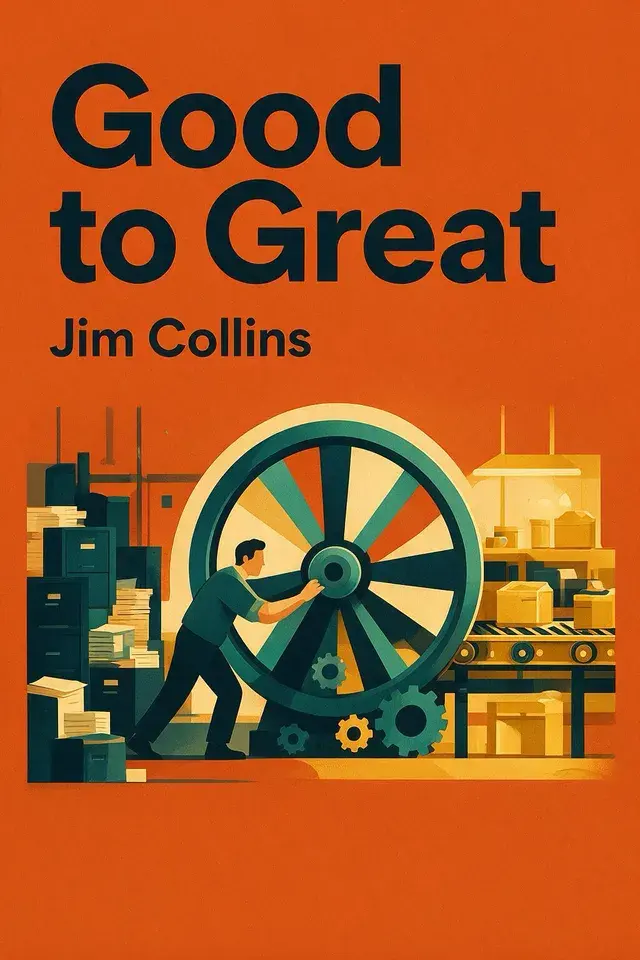
Good to Great’s central image is the flywheel: a heavy wheel that moves only slightly when the first pushes begin. At first, effort produces little visible movement.
Greatness That Outlasts Leaders
Greatness is not complete when an organization reaches a breakthrough. The deeper question is whether it can keep moving when the leader who helped create success is gone.
Applying the Integrated Framework
The epilogue turns the framework from a set of findings into a set of practical questions. Can it help a small organization?
How the Study Was Built
Collins’s team turned the book’s question into a testable comparison. They defined a good-to-great transition in measurable terms, then built selection screens, matched comparisons, financial tests, interviews, and qualitative case analyses.